
New visions of the classics


Fresh interpretations of dramatic masterpieces at the Hong Kong arts festival
THE CAPE TOWN-based company Hand Spring Puppet Theatre shot to
international stardom a few short years ago when its critically acclaimed “War
Horse” played to sold-out houses in London’s West End.
Hand Spring’s new work, a collaboration with the UK’s Bristol Old Vic, “A
Midsummer Night’s Dream”, is having much the same effect on Hong Kong
audiences, playing until tomorrow to capacity crowds as part of the 42nd Hong
Kong Arts Festival.
I was amazed by the company’s “Tall Horse” during their US tour and “War
Horse” in the West End, so was eagerly anticipating this third presentation. And I
wasn’t disappointed! Far from being a mere showcase of puppets and drama
techniques, Hand Spring’s offered a fascinating retelling of Shakespeare’s most
performed romantic comedy.
Sensibly, director Tom Ford and puppet master Adrian Kohler made greater use
of puppets in the fantastical scenes while deftly connecting the three sets of
characters and plots. At the beginning, we see Theseus visit Hippolyta in her
studio where she’s carving masks and puppets. These are subsequently given
life by the actors manipulating them, among them Oberon, who was represented
by an actor holding a mask above his head and a mechanical arm. Other
apparatus and utensils later become characters in the world of fairies, the most
noteworthy being Puck who is made out of a basket, a blow-torch, a saw and a
fork and manipulated by three performers. Even planks of wood are put to
frequent use though the most ingeniously designed puppet is the one that
transforms Nick Bottom into a donkey and, coherently with the line “Thou art
translated”, turns his buttocks into the donkey’s cheeks.
Adding to the enjoyment was the 12 performers’ obvious love for what they do,
a passion that was shared with the audience as much as the art of puppetry.
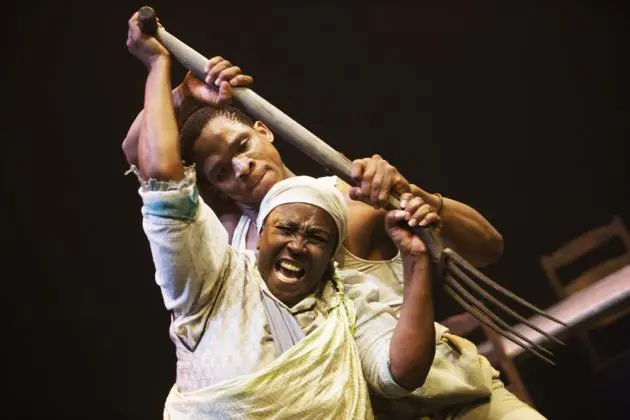
Also from South Africa and continuing until tonight is the Baxter Theatre Centre
at the University of Cape Town’s “Mies Julie”. Playwright and director Yael Farber
based this play on Johan August Strindberg’s seminal naturalistic drama “Miss
Julie”, relocating it to a post-Apartheid farm in a South African dry land. John is
the farm hand and is often seen cleaning his master’s boots. His mother
Christine, who cleans the floor, also raised the master’s daughter Julie. And the
array of incidents in the kitchen one summer evening is filled with racial and
sexual issues and raises political, social and cultural questions – an example of
how contemporary theatre artists respond to a foreign classic with a local
audience primarily in mind.
In addition to the arresting performances by the three lead thespians, the
production includes some highly shocking elements, pushing the audience to
close their eyes at some spots and especially at the moment when Julie makes
sure she’s no longer carrying John’s baby.
In English and Xhosa, the play is almost entirely accompanied by background
music, which mixes pre-recorded tunes with live performance by a virtuosic
saxophonist onstage and a folk singer/musician who is like an ancestral spirit
overlooking the events.
All elements combined, the play eventually does much more than shock. It also
provokes the audience into rethinking several issues that they thought they
already understood.
Artists continue to offer us their fresh interpretations of the stories playgoers
already know well, making use of the theatre’s nature in which we share both
time and space with them. What better reason for probably going to the theatre
in this age of social media?
The writer wishes to thank Hong Kong Arts Festival Society’s Alexia Chow for all
assistance.
WORLD CLASS
- The 42nd Hong Kong Arts Festival runs until March 22. Book online at
www.UrbTix.hk.
- For more information, visit www.HK.ArtsFestival.org.
