
Go roll in your money


Play
The Royal Thai Mint's new learning centre actually showers you in history rather than coins
A CROWD is gathering at the Royal Thai Mint in Pathum Thani, but thankfully times aren’t so hard that they’re all beggars or thieves. Instead, it’s families – with lots of kids – packing into the mint’s Learning Centre, which has lots of fascinating displays of items dating back as far as 154 years, when our first round, silver coins bore a likeness of King Mongkut (Rama IV).
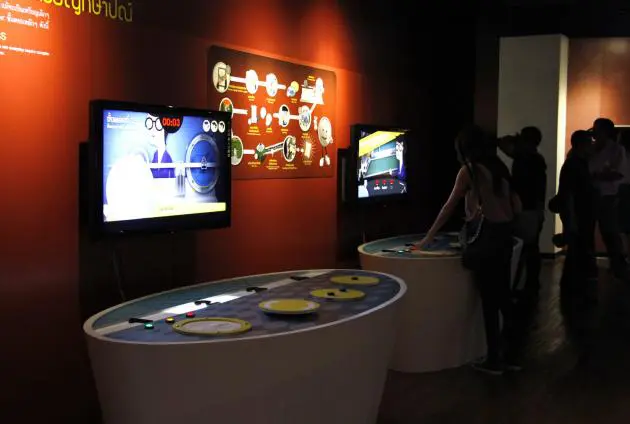
The assortment of artefacts is enormous and backed up with interactive videos and games that explain how Thai currency evolved and how the Royal Thai Mint came to be. All the innovations in coins are shown, along with commemorative medals and royal decorations.
The mint was established during Rama IV’s reign at the Grand Palace. The government’s Treasury Department is now in charge, overseeing the production of up to a billion coins a year.
“This is the nation’s fifth mint,” director Somruk Tangnaikunthum explains. “We moved here, to Klong Luang district, in 2002. For 154 years we’ve been responsible for producing the coins that go into circulation as well as all the commemorative coins, medals for various occasions and royal orders.”
The most recent facility occupies 128 rai and has the look of a modern factory, yet has the added charms of Sukhothai-style architecture. The Learning Centre opened last May on the third floor.
Visits begin with a viewing of a seven-minute film at the mini-theatre, which opens the tour with “Prelude”. The movie features “Uncle Rak”, who wears a curly moustache and classical Siamese costume as he describes how we got from heavy, round “bullet coins” – pod duang – to the flat discs in use today and encapsulates the mint’s history.
There’s more in the next room, marked History of Coins, where antiques predominate – and we’re going back thousands of years here, to the era when metal weapons, plant seeds, seashells and various ornaments were exchanged to shore up the shortcomings of the usual barter system.
The gradual shift from maritime trading, when the seaports controlled the currency, to inland commerce, saw the cowry shell eventually replaced with bullet coins. These first appeared in Sukhothai but continued to be used in the Ayutthaya and Thonburi periods.
There’s a remarkable hologram of a bullet coin from the Thonburi era, made sometime in the mid- to late 1700s, when a Bt1 bullet coin was equal in value to 15.24 grams of silver. It bears a five-pointed chakra wheel and the royal seal of the Tawiwut variety – a two-pronged spear.
King Mongkut’s mint utilised different metals, such as tin and brass for the coins known as Solot, At, Sio and Sik, which signified their origin in the Kingdom of Siam with a relief design called the King Maha Mongkut.
The original mint at the Grand Palace, the Sitthikarn, is rebuilt in miniature for the exhibition. It operated from 1860 to 1875. Next to it is a model of the Pradipat Road Mint, which opened in 1972. You can also watch a hi-tech video of the first coin press being installed at the Sitthikarn, and vintage black-and-white footage about a fake-coin crisis during the reign of King Rama V.
In “Current Thai Coins”, you can find out by playing a game how silver coins are minted, or use a coin-exchange machine to get your hands on rare Bt20 coins bearing Rama V’s seal. Most of the kids visiting are more interesting in having their photos taken while “virtually wearing” the white uniform of a government official festooned with royal decorations.
The “Coins and Medals” hall zeroes in on modern times and the commemorative coins issued on the grand occasions during the reign of His Majesty King Bhumibhol and his family.
“Foreign Coins and Commemorative Medals” has pieces from more than 20 countries – from Denmark to Japan – and a chance to have your own face impressed on a coin.
The mint itself isn’t usually open to the public. It’s not like they don’t trust us – but the temptation to pilfer might prove irresistible. Somehow, though, a group of reporters are deemed trustworthy enough on a press tour to be allowed a look.
Director Somruk shows us the coin-making process, which involves 16 top-of-the-line Grabener presses imported from Germany.
“The mint today produces nine kinds of coins for circulation, and these machines can make more than 3,000
a day,” he says. “The Bt1 coin is made of nickel and steel and the Bt5 coin nickel and copper.”
In case you’re wondering, the nine coins issued are the one-, five-, 10-, 25- and 50-satang pieces and the one-, two-, five- and 10-baht pieces.
Our tour ends up with a workshop on how to spot fake coins and how much damage a coin can sustain before it has to be removed from circulation.
JINGLE JINGLE
>>The Royal Thai Mint Learning Centre is located at 13/1 Phahonyothin Road, Klong Luang district, Pathum Thani.
>>It’s open Monday through Saturday from 9.30am to 3pm and admission is free.
>>Find out more at (02) 834 8300-50 or www.RoyalThaiMint.net.
