
Remembering a man of peace
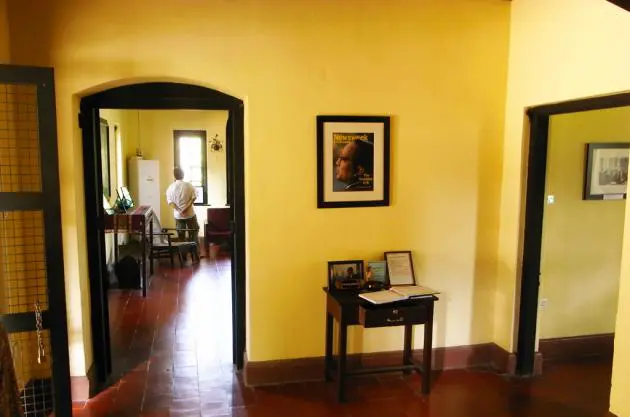


The daughter of former UN Secretary General U Thant turns the old family home into a museum
At the heart of U Thant’s stellar career as the third Secretary-General of the United Nations was his belief in “one world” – that no matter their religion, colour and culture, human beings are really no different from each other..
That belief lives on at the newly opened U Thant House where his daughter Daw Aye Aye Thant is hoping to cherish his legacy.
Back in Yangon recently from the US where she lives in Westport, Connecticut, Aye Aye is devoting much of her time to planning future events for the U Thant House, reminiscing about the past in Myanmar and reflecting on her father’s political values.
Surrounded by a beautiful garden, the two-storey museum was U Thant’s family home from 1950 to 1957, at a time when he was a senior civil servant but later became government property. It wasn’t until November 2012 that the property came under the care of the U Thant House Trust, which is managed by Aye Aye and his son Dr Thant Myint U. With the approval of President U Thein Sein, renovations were carried out to turn the house into a museum.
Today, while the museum is open, it is still somewhat of a work in progress with the planned construction of a conference room, a library and a cafe. The ground floor hosts an exhibition of U Thant’s family photos and familiar shots of his time at the UN. The second floor is still under renovation.
“My mission is to promote my father’s vision of one world through various activities here,” says Aye Aye.
“But the museum is too small and we need another building. The museum will not show only the past, but the present and future of my father’s work in peace building. For instance, when we look at a photo of him shaking hands with President Kennedy, we can look back and see what he did during the Cuban Missile Crisis, and what we can learn for the future.”
The family came back to Myanmar for the first time in 1964 and then in 1974 for U Thant’s funeral.
Aye Aye then moved to Bangkok with her husband Prof Tyn Myint U, who joined the United Nations Economic and Social Commission for Asia and the Pacific. They were back again in 1987, but the events of 1988 forced them to stay away until 2003.
The museum has plenty of photos of family life in Yangon. While a senior civil servant, U Thant liked to invite his colleagues and friends round for a meal at his home. One of them was U Nu, the first prime minister of Myanmar, who was in power from 1948 to 1956, and to whom U Thant served as secretary.
The family then left for the US where U Thant assumed his role as the Myanmar ambassador to the UN in 1957.
He served as the Secretary-General of the UN from 1961 to 1971, a period that saw him take on a number of major issues including decolonisation and global poverty, the Cuban Missile Crisis, the Vietnam War, the 196 India-Pakistan War, and the Six Day War. In Myanmar, he was known as an educator, a writer, a secretary and de factor adviser to Prime Minister U Nu, and a permanent representative to the UN.
Aye Aye wasn’t keen on her father’s peace-building ideas but today regards his vision of “one world” as his biggest achievement. U Thant was famously quoted as saying: “We look for a future in which tolerance, understanding, and mutual assistance will make, at least, a reality of life concept of human brotherhood.
“If we can achieve that reality, and free ourselves from the shackles of hatred, fear, and prejudice, as well as from want and disease, we may hope for a new and great resurgence of creative activity – a vast spiritual and intellectual reawakening of mankind.”
“These democratic values made him who he was,” she says..
To Aye Aye, U Thant as the UN boss was no different from U Thant the father. His office life was from Monday to Saturday. Unless there was a state dinner to attend, he would come home for a meal together with his family.
“He was never too busy for his family. This is also another quality that I really now admire and appreciate with gratitude. He might be late sometimes. He never said, ‘don’t talk to me. I have so many things to do.’”
One of the reasons why U Thant always tried to have din
ner at home was because he enjoyed his wife’s cooking.
“He loved seafood and I remember we often ate prawn dishes,” his daughter recalls. “And there was always bar la chaung [fried dried chilli with dried prawn] and ngapi, or fish paste,” she laughs.
How does Aye Aye want her father to be remembered by the Myanmar people?
“As a peacemaker, a person who has a great sense of respect for other people and a good individual too. I can still recall him saying, ‘we have to respect others as we want others to respect us’. That belief made him achieve his goal as a man of peace,” she says.
PAY A VISIT
The U Thant House is at 31 Pan Wah Lane, Kamayut, Yangon. For details, e-mail [email protected].
