
Got that manga nailed


Play
Thais continue to dominate Japan's top cartooning competition
JAPAN’S DORAEMON, One Piece, Naruto, Gandum and Pokemon now rule a cartoon-loving world populated by more Asian kids than Disney could ever hope to reach, but it’s Thai artists who seem to be colonising that world fastest.
While the beloved Japanese characters serve as their country’s cultural bridge to the world, young Thai illustrator claimed the gold medal at the International Manga Awards in 2012, and last year Prema Jatukanyaprateep has done it again.
The competition hosted by Japan’s Foreign Ministry, launched in 2007 to recognise the planet’s best manga art and promote it further overseas – as if that were even necessary – last year drew 256 entries from 53 countries.
Not only did Prema, 31, win the gold, Thailand’s Piyapharch Jeeno, Ruangsak Duangpla and Pittaya Werasakwong shared the bronze. The silver medals went to artists in the US, China and Belgium.
Shigekazu Sato, Japan’s ambassador to Thailand – who happily admits he was always reading comics as a child – says he expects manga to become even more popular in Thailand as a result, to become part of the Thai culture that’s associated with Japan.
“Manga is representative of Japanese culture. It’s part of the pride of the Land of Rising Sun. We publish more than 10,000 comic books a year, which make up about 40 per cent of the global market. And now manga takes several forms, like animation, that have proved popular in America and Europe. Many Western institutes give awards for work in cartooning.
“We will create a ‘Nobel Prize’ from this popularity,” Sato declares. “We want to promote the winners so that their work can be published and sold around the world.”
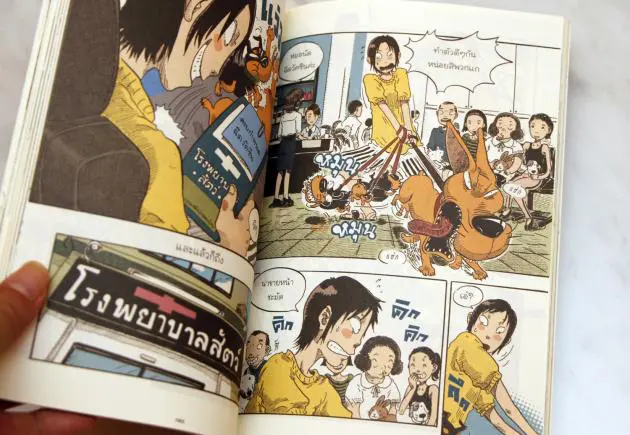
The Cartoonthai Institute published Prema’s “Bokbig” in 2012, a funny series of strips about her pet dog Bokbig, a miniature pinscher. “A spoiled dog and an honest boss” is the catchy theme.
“It actually developed out of the thesis I did while studying decorative art at Silpakorn University,” she says. “Someone from the Cartoonthai Institute saw the drawings in an exhibition and asked about them. I was planning to study animation techniques in France, though, so I had no time to turn it into a full comic book.”
The story, rendered in simple lines and vivid hues, begins the day her father brings Bokbig home. The dog’s cheerfulness ensures he immediately becomes a member of the family. Everything goes well until the family gets another dog, Bamboo. The two pooches are expected to be friends, but are instead fierce rivals.
Prema says the judging panel appreciated both her drawing style and the content – the fact that it’s about a pet, a focal point to ensure that anyone can empathise with the Thai lifestyle.
She got her start in 2004, illustrating the children’s book “Vera and Victor Discover Thailand”, published by Sweden’s Wirdheim Culture AB. She did indeed continue her studies in France, graduating from Ecole Pivaut University.
Since returning to Bangkok in 2010, Prema has been an instructor at King Mongkut’s University of Technology in Thonburi and done many illustrations for magazines, graphic novels and other kids’ books.
Piyaphach Jeeno, 27, who studied painting at Chiang Mai University, goes by the “brush name” Art Jeeno. He won a bronze award in Japan with a cartoon pocketbook called “D Day” that Salmon Books released in 2012. “D Day” contains three short stories about different youngsters’ lives. The first is funny: a teen boy “trolling” for love in high school. The second is serious, a musician in search of himself. And the third is inspiring, about a girl waiting for that “good opportunity” that will change her life.
“I started telling stories like this while I was still in high school,” Piyaphach says, “and kept it up in university – cartoons I shared on a blog – and I got a lot of good feedback. I use a lot of different techniques in drawing and watercolour, but my signature is in the way I let the readers decide for themselves how the stories should end.”
Keep an eye out for Piyaphach’s other cartoon books – “Be Right Back” and its sequel, “Juice” and “Now” – all of which track the younger generation.
Fellow bronze medallist Ruangsak Duangpla, 48, came out with “Boon Home Khonpong” in 2012 with the help of the Cartoonthai Institute. Boon Home is a young man who disrupts life in a village in the Northeast by going against tradition.
“I have 25 years’ experience illustrating books and novels, but I’m always trying to improve my skills, both in cartoons and realistic portraits,” says Ruangsak. “My work mostly reflects the charm of Isaan culture – that’s where I come from.”
Pittaya Werasakwong, 28, who studied animation at Rangsit University, won his bronze award with his first cartoon series, “Pandism”, which was self-published. The black comedy follows six pandas that are infected by the human “sensuality virus”, which makes them comment sarcastically on society and suggest philosophical alternatives.
“I’d designed panda patterns for the T-shirts I sold at my shop at Chatuchak Weekend Market and Terminal 21,” Pittaya says. “My younger brother won the gold award in this competition in 2012, so that inspired me to enter. We’ve both loved drawing cartoons since we’re were kids.”
