
The hijab for the catwalk
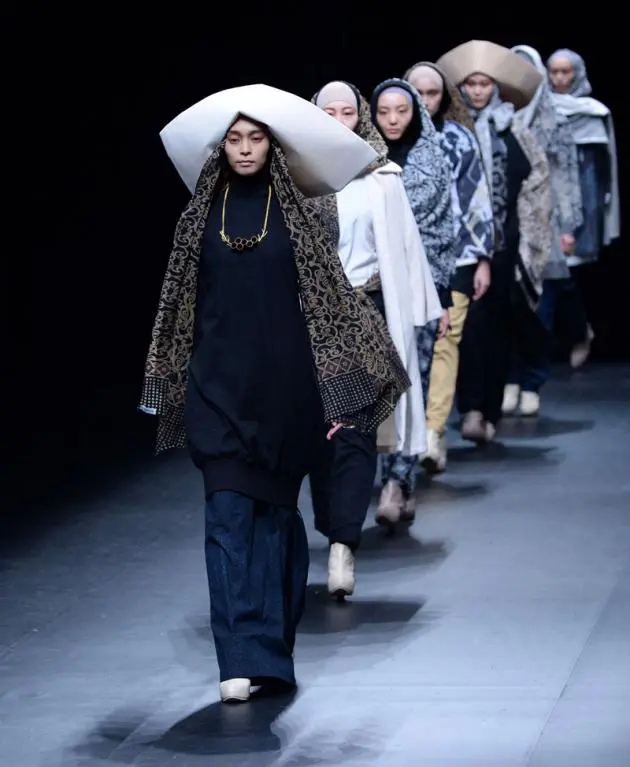


Innovation in the Muslim headwear takes centre stage at Tokyo Fashion Week
Among the aspiring Asian designers competing for the limelight at Tokyo Fashion Week earlier this month, one of the most striking was an Indonesian label’s bid to blend a traditional Muslim headscarf with haute couture.
The twice-yearly show saw NurZahra roll out its autumn-winter collection “Layers of Fidelity”, turning the modest hijab into sophisticated fashion.
The label – whose name means “the luminous light” in Arabic and refers to Fatimah Zahra, the daughter of Prophet Mohammed – wanted to prove that the female hair-and-neck wrap, common in the Islamic world, could still take on playful elements.
“The modest hijab is not actually a restriction” in fashion, designer Windri Widiesta Dhari said after her stylish designs hit the catwalk. “It’s how you cover yourself and look more elegant in a way that has a loose fit.”
The wearing of the Islamic veil, limited historically to conservative Gulf monarchies, gained ground, including in sports, since the 1979 Iranian revolution and the creation of an Islamic republic. Use of the veil spread quickly as Islamist movements grew in the wake of the Arab Spring uprisings.
France has outraged many Muslims with a law against full face-covering veils, while the use of the hijab in sport, including football, has sometimes stirred cultural clashes. But Dhari sees the traditional scarf as not just a matter of modesty, but also a stylish, comfortable accessory.
“We want to inspire people to think that wearing hijab is not something difficult, and could be worn by anyone,” she said.
Her collection also bucks a contemporary design trend for simplicity and minimalism. Blending in cotton or silk, she includes natural-dye prints that rely on a traditional Japanese tie-dye technique called shibori and the Indonesian batik method.
With patterns ranging from mini-mandalas to Turkish geometrical figures, Dhari plays with multiple layers of fabric to freely shape her silhouettes.
Another eye-catching element of the collection was a hat that spreads wide in the back, a throwback to the 1960s with elements resembling a long-ago royal headpiece.
“The concept of the hat was actually inspired by the style in one from 1963,” Dhari said. “I was looking for vintage hats that could be used to cover your hair and also your neck. I used that inspiration and then mixed it with a traditional ethnic concept, so it becomes something very unique.”
Tokyo has long been the centre of cool, renowned the world over for its far-out fashions that see young women donning gothic-inspired “Lolita” outfits and chise’led young men with highly coiffed hair. But at the latest Tokyo Fashion Week, it was newcomer brands from several Asian fashion houses outside Japan, such as NurZahra, which breathed fresh air into the show in the Japanese capital.
Another Indonesian brand, Major Minor, hit the runway for the first time, showcasing styles incorporating mainly monochrome tones and simple silhouettes.
The opener of the event was Thai brand Sretsis – “sisters” in reverse – led by designer Pim Sukhahuta, who works alongside two female siblings. Among their offerings was a cartoon-like print – girls’ faces dotting the fabric – that meshed touches of American high-school and Japan’s Lolita themes.
