
Fostering a fresh world


Play
Bangkok, which has no iconic Norman Foster Architecture of its own, gets to see what it's missing
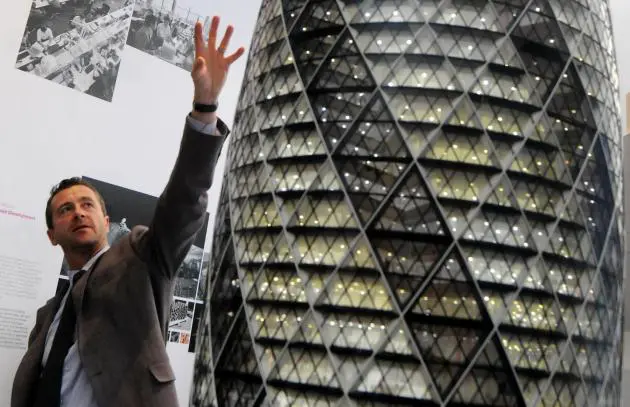
More than 80 of the buildings designed by the house of celebrated architect Norman Foster are on view in miniature form at the Bangkok Art and Culture Centre through June.
The exhibition “Foster and Partners: The Art of Architecture” covers the British firm’s projects from the Sainsbury Centre for Visual Arts in 1978 to last year’s Lunar Habitation and features not just models but documentation on the design process.
Foster and Partners’ unwavering attention to ecological issues and sustainable design is evident in each of the show’s themes – infrastructure, high-rise, urban design, history and culture – even amid a wide diversity of architecture.
The firm has rendered urban master plans and built public infrastructure, airports, cultural buildings, private homes and various types of workplaces and even designed commercial products. It has won more than 100 architectural competitions since its inception in 1967 and around 630 awards for excellence.
The exhibition is the first chance for Thais to see exactly how the firm that Norman Foster founded went about conceptualising the world’s largest passenger terminal at Beijing International Airport and the environment-minded London headquarters of Swiss Re.
There are scale models as well of the New York headquarters of the Hearst media group, of Jakarta’s Ilham Baru Tower, of the home of Commerzbank in Frankfurt, Germany, of the Millau Viaduct in France (“the world’s tallest bridge”) and of London’s Millennium Bridge.
Of keener local interest will be Wembley Stadium in London, home to many of history’s greatest sporting (and musical) events, and Stansted Airport down the road in Essex, the stepping stone to the British capital, with its famously lightweight roof that dispenses with all the accepted rules of airport design.
For future consideration, there is also Spaceport America in the New Mexico desert, the planet’s first dedicated “landing pad for aliens” – or for any Earth-made spacecraft that might need it.
Foster’s city planning projects include a redesign for the dense urban blocks hemming in London’s iconic Trafalgar Square, a scheme for a “cultural district” in Hong Kong’s West Kowloon, and a master plan for Masdar, a new city rising in Abu Dhabi.
The firm has led the way when it comes to ensuring that public buildings have plenty of public space. The Great Court at the British Museum in London, Berlin’s new Reichstag (parliament) and the Carree d’Art in Nimes, France, are all generous with their room to move.
You can see models of the Chateau Margaux winery in France and the Einstein Museum and Safra Centre in Israel too.
“The exhibition shows how we address the various needs of a building in different ways, right from the beginning in the studio with the original sketches,” says Toby Blunt, who joined the firm in 1995 and became a full partner in 2006.
“You can get unique insight about the integrated-design process, in which architects an engineers collaborate on everything, and the use of different tools and technology.”
Blunt stresses that sustainability – a principle that revolutionised the way designers work – is forever at the heart of Foster architecture.
“Sustainability has always been a concern. It’s thinking about how a building responds to its surroundings. It’s thinking about large scales and the whole way the people and the city live and operate. It’s not just one building, but the big picture.”
Blunt is particularly proud of Masdar in Abu Dhabi, which is now being erected as the world’s first “carbon-neutral” desert community.
“Sustainability means that a number of considerations are equally important in future projects – infrastructure, renewable energy, public space and technology – as is learning from the past, as well. It’s very important to make sure that we understand the place for which we’re designing architecture. We tend to do a lot of thinking and research before getting anywhere near the design stage.
“Every country has a different climate, so a particular design has to respond to that environment. There’s always a balance. Simple things can have a big impact. So the design doesn’t come easily. We test a lot of our models using digital and 3D technology.
“We never fall in love with the first idea, even though losing your first love can be very hard!” he laughs.
Thai Sunphol Sorakul, who’s worked at Foster since 2001, seems fully assured about his love for the firm’s Habitable Lunar Settlements Study, conducted in collaboration with the European Space Agency. The actual residences in which the moon’s first colonists will live could be built with 3D printers, using regolith (the lunar soil) in place of plaster and concrete.
“In the future, architectural form will be free from conventional structure, which is limited to steel columns and the like,” Sunphol says. “Instead there will be weight-bearing walls with a cellular structure.”
BIGGER AND BETTER
- The exhibition “Foster and Partners: The Art of Architecture” continues through June 29 at the Bangkok Art and Culture Centre. It’s open daily except Monday.
- In a series of lectures during the exhibition period, Foster design chief David Nelson will share his insights on “Integrated Design”; Toby Blunt, a partner in the firm, will address “Sustainable Design”; and Sunphol Sorakul, an associate at Foster, will describe how to “Design a Better City”.
- Get the details at www.ArtOfArchitecture.org.
