
Picasso and his raging bull


Play
The Minotaur stalks China's National Gallery as the Vollard etchings go on view
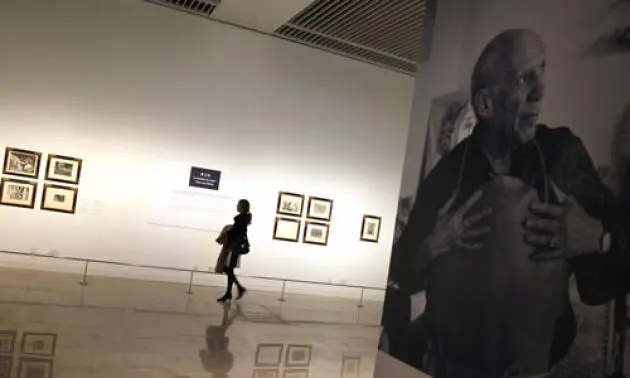
Richly emotional and sometimes erotic, the Vollard Suite – the 100 Pablo Picasso etchings on exhibit at the National Museum of China – reflects both the artist’s versatility and a milestone in 20th-century art.
Curators at the British Museum have described the suite as “a walk through Picasso’s mind” and “the centre of the labyrinth”, where the master’s inner self resides. Acquiring the complete set is an ambitious goal for public institutions and private collectors.
The set was assembled by the Official Credit Institute Foundation of Spain, reputed to be one of the most important collections of Spanish art of the 20th century. Its current display at the National Museum of China also celebrates the 40th anniversary of Sino-Spanish diplomatic relations.
For Chinese viewers who mostly know about Picasso’s cubist works, especially the celebrated painting “Guernica”, this set, using a neo-classical style, will shed new light on their understanding of the gamut of Picasso’s rich emotions, and his obsessions with art and eroticism in particular.
He worked on the Vollard Suite from 1930 to 1937. For some, it marks a pinnacle not only of his career but also the etchings of the 20th century.
The 100 plates fall into six categories, while they need to be appreciated in their entirety to fully represent Picasso’s changes in perspective over time, as well as his anxieties over the worsening political situation at the dawn of World War II.
For example, the Minotaur – the half-man, half-bull of Greek mythology) often featured in Picasso’s art – recurs in this set. He first appears as a tender, gloomy lover, then becomes a blind, weak loser. Critics suggest the transformation indicates Picasso’s marital vicissitudes, juggling between his wife, Olga Khokhlova, and Marie-Therese Walter, his mistress and muse, 28 years his junior.
Picasso used a variety of techniques, including aquatinting, dry point and hot embossing, and Alicia Gomet, Spanish curator from the OCI museum, says the suite gives viewers the feeling of looking down a small hallway in Picasso’s artistic and personal life.
“Picasso carried out a profound self-examination of his contradictory feelings and impulses, in a way much like writing visual diaries,” she says. “The set is a representative testament to his creative eruption when in the 1930s he experimented with different art styles.”
After developing cubism, Picasso achieved gradual maturity in handling all kinds of techniques and art languages. However, he turned to the classical presentation when producing the suite. Critics complained that he moved backward from the modernist trend and compromised with the order.
“I’ve been reading Francoise Gilot’s book ‘Vida con Picasso’ (‘Life with Picasso’), in which she mentioned that 64-year-old Picasso once talked about the Vollard Suite,” says Manuel Valencia Alonso, Spanish ambassador to China. Gilot, a French painter, had a decade-long affair with Picasso and bore him two children.
Gilot quoted him as saying, “It all happens on the mountainous Creta Island in the Mediterranean Sea where the Minotaur resides. The Minotaur places works of the best painters and sculptors everywhere in his home. He likes to be surrounded by beauties, so he forced the island’s fishermen to seduce beautiful women elsewhere to Creta. When the daytime heat fades away, the Minotaur plays host to artists and their models at his place. Accompanied by the music, they feast with delicious seafood and drink champagne, till their sorrows are gradually replaced by infinite joys.”
“Turning to a puzzled-looking Gilot, who was in her early 20s, Picasso said, ‘I know everything I said sounds like a mess. But don’t you understand from what I said what does genius mean?’”
Valencia Alonso believes the suite fully expresses the complexity of Picasso’s unique persona. The Minotaur is taken as an incarnation of the artist himself, speaking for his loneliness and twisted inner world.
The set was commissioned by and named after the pioneering patron of modern art Ambroise Vollard (1866-1939), and contains three portraits of him. Picasso exchanged the set for paintings by Cezanne and Renoir. Vollard had long before established his reputation by representing many notable artists, including those two and Gauguin and Van Gogh.
Vollard mounted Picasso’s first exhibition in Paris, in 1901. Their association was a long-lived one, though Vollard never became Picasso’s contracted dealer. “They maintained quite a good friendship. For Picasso, Vollard was more than a gallerist – he was a friend – and that’s why the portraits of Vollard made by Picasso were so important,” Gomet says.
“But in an artistic way, Picasso was more comfortable with Daniel-Henry Kahnweiler, who was his real gallerist.”
Art historians say Vollard failed to recognise Picasso’s full potential, since he ignored Picasso’s ventures into cubism and abstraction.
ETCHINGS, EH?
n The Vollard Suite is on view through April 27 at the National Museum of China in Beijing.
