
The world's fastest focus


Play
Sony's Alpha a6000 sees the shot before you do - and might see it clearer too
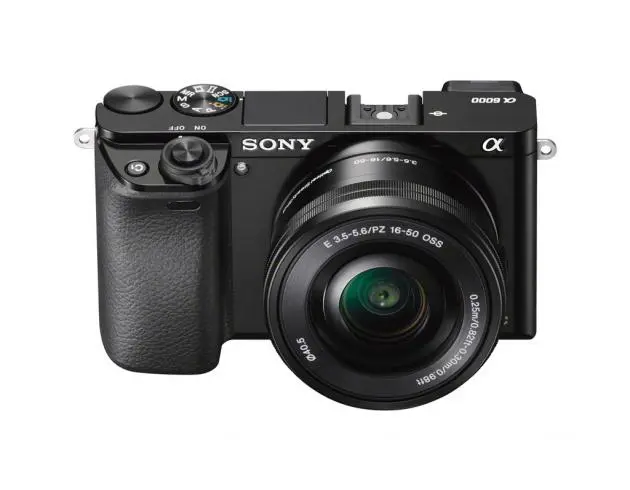
The Sony Alpha a6000 is a new mirror-less, interchangeable-lens camera with the fastest auto-focusing you’re likely to find anywhere. The image quality is truly impressive.
How fast is the focus? It takes 0.06 seconds, less than the blink of an eye. Sony says it had a good look around and, as of February 12, could find no other interchangeable-lens digital camera with an APS-C image sensor on the market that can match the a6000 for auto-focus speed.
That speed – 0.06 seconds – was measured internally by CIPA with an E PZ 16-50mm F/3.5-5.6 OSS lens mounted, through the viewfinder rather than the LCD monitor. Credit for the rapidity goes to Enhanced Fast Hybrid auto-focus technology, which combines lightning phase-detection AF with highly accurate contrast-detection AF. A new Spatial Object Detection algorithm is at work as phase-detection tracks 179 densely placed points and adjusts the lens to match while contrast-detection AF fine-tunes everything.
Add to this the equally intense Bionz X image processor and the a6000 can shoot continuously at an amazing 11 frames per second. That’s terrific for shooting fast action like sports. AF tracking keeps moving objects in sharp focus. Details are crisp even in low light, from a sensitivity range from ISO 100 to 25000.
The large (23.5 x 15.6mm) Exmor APS HD CMOS sensor and the image processor are both new, with the former 20 per cent more sensitive than Sony’s popular previous model, the NEX-7. The latter is the same size as those used in most digital SLR cameras, giving the a6000 abilities similar to a DSLR camera at only half the size and weight. The resolution is a very high 24.3 megapixels, beyond that of many DSLR cameras.
A “multi-interface” shoe on top will take a wide range of accessories, from video lights and shotgun microphones for making movies to high-capacity flash units for still imagery.
I also love the OLED Tru-Finder electronic viewfinder. You have four double, aspherical lenses displaying rich, real-time data so you can plan and preview your shots, even the effects and settings. You see the entire frame, with a viewing angle corner-to-corner of about 33 per cent.
A tilting three-inch (921k-dot) Xtra Fine LCD Display can rotate up by 90 degrees and down by 45 degrees, so you can use it to compose shots high over crowds or get a pet’s-eye view.
Built-in Wi-Fi and NFC (Near Field Communication) allow you to easily connect to a phone with NFC technology for copying images and video clips. From the phone it’s a hop to sharing them on the social networks.
The a6000 is quite intuitive to use and has seven easily customised buttons, two of them dedicated custom buttons and the others ready to take 43 different functions.
The mode dial changes exposure and the control dial next to it switches shooting parameters according to the current exposure mode. I love the function button because it provides quick access to the available exposure parameters that can be changed without having to use the menu.
Turn the mode dial to the Scene Mode, for example, and you can use the function button to access other available program-scene modes – Portrait, Sports Action, Macro, Landscape, Sunset, Night Scene, and Hand-held Twilight.
Experienced users will appreciate the advanced exposure modes, which are much like those of a DSLR, including Manual Exposure, Aperture Priority, Shutter Priority and Programme Auto. Newcomers can get just as beautiful photos effortlessly by using the Intelligent Auto and Superior Auto modes.
Intelligent Auto analyses lighting and selects the best program-scene mode. In a complicated lighting environment, like when the light comes from behind the subject, Superior Auto goes beyond that, taking multiple shots at different exposures and combining them into one crisp, clean photo with a lot of details.
I found that both of these modes effectively selected the correct scene modes for me. If you want to choose your own scene mode, turn the mode dial to Scene Selection.
I was particularly impressed with Portrait Shooting, especially the Soft Skin effect. People look truly beautiful in the pictures, with bright faces and smoothened features. And shooting the end of a day in Sunset mode is great. The rays from the dying sun come up deep orange in a nice contrast with the dark silhouettes of buildings.
I tested the a6000 with its kit lens, a 16-50mm F/3.5-5.6 OSS. Although the f/3.5 aperture isn’t too impressive in terms of brightness, I managed to capture sharp images with well-saturated colours. You can enhance the performance with any of the 54 E-mount lenses Sony markets, and that selection is growing, the firm says.
In terms of overall performance, it took about 2.2 seconds for the camera to prepare for the first short after being turned on. I noticed no shutter delay, and the time between shots was about half a second.
The Sony Alpha a6000 with the SELP 16-50 kit lens retails for Bt27,990.
KEY SPECS
Type: Interchangeable-lens digital camera with built-in flash
Lens: Sony E-mount lenses
Provided lens: E PZ 16-50mm F/3.5-5.6 OSS Power Zoom Lens, equivalent to 24 to 75mm focal length
Image sensor: 24.3-megapixel APS-C type (23.5x15.6mm) Exmor APS HD CMOS sensor
Focus area: Wide (179 points, phase-detection AF; 25 points, contrast-detection AF)
Metering system: 1,200-zone evaluative
Exposure compensation: +/- 5.0EV(1/3 EV, 1/2 EV steps selectable)
ISO sensitivity: ISO 100-25600 equivalent (1/3 EV step)
Shutter speeds: 1/4000 to 30 seconds, bulb
Video recording: Full HD in 60p/50p, 60i/50i or 24p/25p resolutions in MP4 and AVCHD Version 2.0
LCD monitor: Three-inch TFT with 921,600 dots
Viewfinder: 1cm (0.39 inch) OLED Electronic viewfinder (colour)
Recording format: Jpeg (DCF Ver. 2.0, Exif Ver.2.3, MPF Baseline compliant), RAW (Sony ARW 2.3 format)
Recording media: Memory Stick PRO Duo, Memory Stick PRO-HG Duo, Memory Stick XC-HG Duo, SD memory card, SDHC memory card (UHS-I compliant), SDXC memory card (UHS-I compliant)
Battery: NP-FW50 310 shots (viewfinder), 360 shots (LCD monitor)
Dimensions: 120x66.9x45.1mm
Weight: 285g (body only)
