
The spirit unleashed


Play
Thailand discovers the contemporary art long hidden behind Myanmar's wall of intolerance
The opening-up of Myanmar has brought a slew of artists into the global spotlight and many of them are using Thailand as their gateway to the world. Bangkok and Chiang Mai galleries now routinely stock art from our neighbour to the west, and it’s interesting to see what’s emerging from fertile ground newly unshackled from censorship.
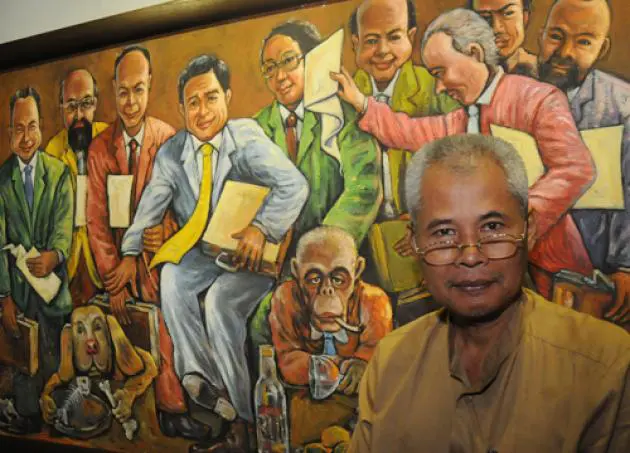
Bangkok’s Thavibu Gallery last month offered the politically charged work of Myint Swe, who hasn’t actually painted for three years, instead opening a meditation centre, but was suddenly enjoying his first solo show outside his homeland.
Thavibu’s Jorn Middelborg, a Norwegian expatriate, started collected Myint Swe paintings more than a decade ago, when he worked in Myanmar with Unesco. The works were so politically contentious they had to be smuggled to Bangkok, where they were simply kept in storage for years. Now that Myanmar’s rulers permit some freedom of expression, the Thavibu felt confident putting them on public display.
“Burma: The Quiet Violence” featured 30 remarkable paintings done in Yangon between 1995 and 2005. The subject matter included Aung San Suu Kyi’s tribulations and other discouraging socio-political developments.
“Living under a military junta was frustrating and depressing – I painted with blood and tears,” Mint Swe told The Nation.
He regards Suu Kyi as his heroine, the bulwark of democracy. Due to the encompassing censorship, he did not paint a realistic portrait of her but instead offered symbols – a rose, water hyacinth, a locked houses – with only a woman seen from behind.
“Myint Swe is an artist for whom the suffering that has arisen in Burma created the determination to address issues of humanity and dignity,” curator Shireen Naziree said.
The artist has now found peace at his meditation centre, which he initially set up for retired academics but now accommodates people of all ages, even children. “I felt isolated from the community at large and my former friends because of my political leanings,” he said. “I found my salvation in meditation.” Painting had long been therapeutic, he added, “but meditation has become the prime focus of my life – I have little desire for the material things of life. I want to share my Buddhist convictions and values with others.”
The Thavibu also has on its roster relative newcomers like Nyein Chan Su, Phyu Mon and Phyoe Kyi, who work in photography, video art and installation.
Moe Satt of Yangon is well known for his through-provoking installations and performance art, presented in Bangkok in recent years at the Jim Thompson Art Centre, H Gallery and White Space. He’s the curator of the group show “General/Tiger/Gun” continuing all next week at the new Rebel Art Space on Sukhumvit Soi 67. Its paintings, sculpture and installation art address Myanmar’s reforms in diverse ways. The participants are San Min, Myat Kyawt, Wai Mar Nyunt, Maung Day, Thoe Htein, Than Htay Maung, Thu Rein and Moe Satt himself.
“As recently as 10 years ago, contemporary artists in Myanmar were few and far between, and only a handful ever got the chance to exhibit abroad,” Satt says, but he rejects the notion that their experience beyond the border made them better artists than those who were “left behind”.
“Myanmar artists have received little attention or recognition from the international art community. Previously, whenever institutions in the region organised a Southeast Asia contemporary-art event, we didn’t even receive an invitation to take part. It either meant Myanmar was being marginalised or they were simply unaware of the existence of contemporary artists in Myanmar. Do regional institutions think Myanmar art is limited to just the traditional forms?”
“General/Tiger/Gun” is a game like “Paper/Scissors/|Stone”, but the message is that no once can keep on winning forever – just as nobody keeps losing forever.
“You find these three things in our society, so powerful and omnipresent,” says Satt. “We lived under the sickening military rule for a long time and the images of generals and guns are what remain firmly in people’s memories as symbols of the junta – both serving as killing machines.
“In our language ‘tiger’ has two meanings. One is the beast and the second is any male. Our society is still a male-dominated society.”
Satt points out the irregular-shaped bottles that Than Htay Maung salvaged from factory waste and suggests they allude to the “massive political and social pressure that maimed the country and disfigured society”.
“Now the country is being reformed, but it’s not a pleasant walk in the garden. Since the political changes began, civil wars have come thick and fast, Buddhist fundamentalists have arisen and sectarian violence has surged. We all know that this is a game the government and elitists are playing. Do we need to be involved in that game or should we ignore it?”
Satt says the work of Myat Kyawt directly addresses the effort by “fundamentalist monks” to revamp marriage laws to force Muslim men to convert if they wish to marry Buddhist women. “Are Buddhist monks entitled to make a new law? Many of us aren’t sure if they should be involved in the political sphere this much.”
Thoe Htein’s piece “A soldier with a gun and flower bullet in my mind” recalls the common fear of armed troops in 1988, when dissension was violently repressed. “What might they be thinking? What should I do?” Htien asks. “This generation shared the same experience all their lives. As I grew older I wished them only smiles, and to keep with us the spirit of whatever we had experienced.”
Maung Day, who works for a non-governmental organisation in Bangkok, says he was creating the piece on view in the show while thinking about the ethnic conflict back home and around the world. “I felt gutted, and more than disgusted by how everyone might be perpetuating such conflicts without knowing it. Being politicised isn’t the same as having a conscience.”
Wair Mar Nyunt, the show’s sole female participant, examines loss and irretrievable memory in the nine-minute film “Happy Soul”, shot in Prague in 2010. It recalls the times she and her family would spend making woollen birds to hang as decorations. The installation in which the movie is projected has eight birds in the film, one for each family member. A fittingly nostalgic radio soundtrack plays.
Myanmar progress thus far is universally welcomed, but these artists are agreed that more is needed. “We still need real democracy and real freedom of expression,” is a typical comment among them.
“My hope is that it becomes a truly democratic country,” says Myint Swe, “and that we eliminate poverty and provide education for everyone.”
BEST PLACES TO SEE IT
In Bangkok, work by Myanmar artists is on view at the Thavibu Gallery (www.Thavibu.com), H Gallery (HGalleryBkk.com), White Space (www.WhiteSpace.com) and Rebel Art Space (www.RebelArtSpace.com).
In Chiang Mai, check out Golden Triangle Art (for Tin Maung Oo, Tin Win and Zaw Win Pe) and the Suvannabhumi Art Gallery (mostly modern landscapes, portraits and abstracts), which has the exhibition “Say” with San Minn, Aung Myint and Yei Myint from June 15 to 29 (www.SuvannabhumiArtGallery.com).
