
Graffiti for the Great Wall
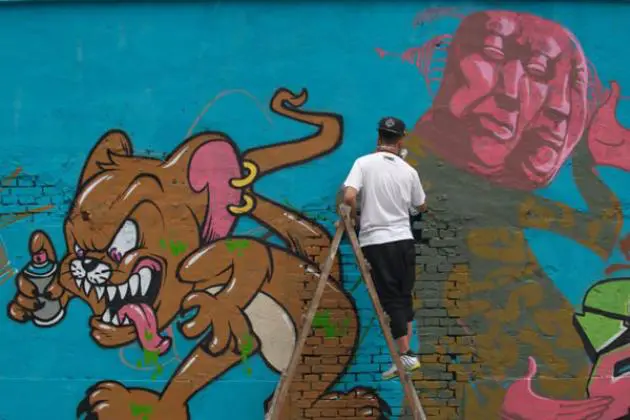


And it won't be illegal for China's no-longer-underground artists
In loose jeans, armed with a gas mask and a black backpack, Ye Shu walks into the woods next to Jingmi Lu, a road beside Beijing’s airport expressway. He glances around, making sure no one is watching, before taking out the spray cans from his bag. For graffiti artists like Ye, the woods are the perfect playground.
He will spend hours or even a whole day in these woods, spraying colours on the wall, admiring his work for a few seconds and taking photos of it. Ye, 30, has been doing this for nearly 10 years.
A new generation of urban youth seeking new ways to express themselves has seen graffiti emerge from the underground. Graffiti artists, like Ye, are eager to attract a wider audience to their art.
A tag featuring the Chinese characters “Za Tou”, which is rumoured to have been created by a foreigner named Zato, can be seen throughout the city, from store’s roller doors to hutong walls. In May a large graffiti appeared overnight under the Anzhenqiao Bridge in northern Beijing and received wide attention.
“I love painting there because the walls are hidden behind the woods and unnoticed by police. It’s really frustrating to see an unfinished work whitewashed by police,” Ye says.
But Ye no longer has to paint on hidden walls. In fact, he is making a living as a graffiti artist. In 2010 along with the other members of ABS Crew, a graffiti group which Ye founded in 2007, he opened a studio in Beijing’s 798 Art Zone, a popular hub showcasing contemporary Chinese art.
Two years later he opened a store next to the studio, selling products such as spray paint and T-shirts featuring his art. This summer Ye will launch a hip-hop summer camp in cooperation with the French embassy in Beijing, presenting various street culture events, like break dancing and graffiti.
“Graffiti has been recognised today, but has a niche market. Even today some people still cannot understand what we are doing,” he says.
In 2004, when Ye was a student of art design at a university in Tianjin, he watched Jackie Chan’s “Rumble in the Bronx”. He was fascinated by the graffiti scene and bought a can of spray paint from a hardware store and painted his name on a wall at the university.
“I felt so excited to see my name on the wall because the visual impact was so strong,” he recalls. However, his teachers and classmates were less impressed, accusing him of vandalism.
The first public graffiti that Ye’s ABS Crew undertook was to spray paint a six-storey building in Tianjin. The local government commissioned the piece for a music-theme street outside the Conservatory of Music.
Since then Ye has worked with private firms such as Nike and Audi. He now plans to work with Beijing’s CBD area to create graffiti art amid office buildings. He’s excited by the news that a section of the Great Wall in the popular tourist destination of Mutianyu has been flagged to become a dedicated graffiti zone.
Zhang Tongcai, an official from the management office of Mutianyu Great Wall, says the intention is to protect the ancient bricks rather than encouraging graffiti, but Ye says he and his team intend to create some art specifically for the area.
Zhang says 2.8 million tourists visit the Mutianyu Great Wall every year, and 40 per cent are foreigners.
“Graffiti has been controversial because the line between art and vandalism is blurred. There is no law on graffiti in China, so people feel free to paint wherever they want,” says Liu Zheng, a graffiti artist with the Kwan Yin Clan, a group founded by Liu in 2006 along with several other young people in Beijing.
Liu, 29, who studied visual design, was a rapper at the university. He created his first graffiti on the walls outside Sihui subway station in Beijing in 2006, which he described as “dropping a bomb”.
“I used to paint at night and quickly or I would be stopped by police,” Liu recalls.
At first he painted to express himself and to relieve pressure. Now, he says, he combines the techniques of traditional Chinese ink painting with graffiti.
Along with members of the Kwan Yin Clan, Liu has painted the walls outside Beijing Institute of Technology and Beijing Institute of Fashion Technology, as part of a project commissioned by the government during the 2008 Beijing Olympic Games.
“To me the attraction of graffiti is the beautiful colour and lines. The more I paint, the more I realise it’s about culture and society,” Liu says.
“People’s attitude toward graffiti has started to change because they can appreciate it in advertising and on TV. It’s not something secretive any more.”
