
Almost lost, the art of puppet theatre


Play
Language barriers and a decline in viewers lead wayang potehi toward oblivion
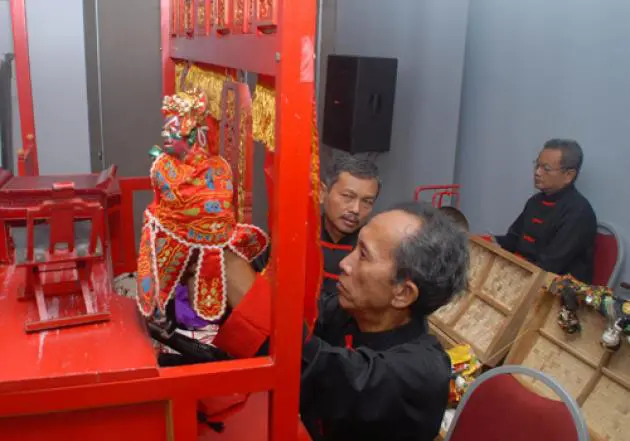
One of China’s centuries-old arts is the form of theatre known in Indonesia as wayang potehi, the wooden-puppet drama originally called pouw tee hie in the Hokkian (Fujian) dialect, meaning “cloth-bag puppets” or “glove puppets”.
Each around 30 centimetres in height, the puppets have wooden heads, hands and feet and are clad in the various costumes of relevant characters.
Believed to have originated before the 16th century in Fujian province, potehi spread along with the migration of Fujian people to regions across the South China Sea, including to Java. With no exact historical records, this art is estimated to have been familiar to overseas Chinese descendants in the 1600s.
Like wayang kulit – the shadow puppet shows in Java – wayang potehi is also performed with musical accompaniment, but its dalang (puppet master) has an assistant and there are only three musicians.
Over time, however, potehi lost its popularity, in contrast to barongsai (the lion dance) and liong (the dragon dance), which are still performed today on various occasions. Nowadays potehi in Indonesia has virtually faded into oblivion.
Toni Harsono is one of the few “potehi activists” in the country. “Only about 12 puppet masters, called sehu, are left in Indonesia to my knowledge,” he says at the Klenteng Hong San Kiong (temple) in Gudo, Jombang, East Java.
Harsono is the grandson of a potehi sehu named Tok Su Kwie, who came from China. The temple chairman indicates that many factors hampered the growth of the art. “Besides the New Order government’s ban on Chinese art performances in 1967, the number of potehi players and musicians is decreasing,” he says.
Although the ban on Chinese art was lifted by former president Abdurrahman Wahid, revival has been rocky. By potehi standards, the players have to be fairly proficient in Hokkian in order to understand the episodes. This regional language is also spoken at the opening of the show, which can be followed by Indonesian or Javanese narration and dialogue.
Potehi musicians need to master Chinese traditional instruments such as erl hu (big violin), yana (small violin), piat ko (drum), twalo and dongko (small gongs) and yang cing (hammered dulcimer).
But Harsono admits that money is the main drawback, since it’s difficult to rely on this art for a living. “The honorarium received by potehi artists is sometimes as low as only 500,000 rupiah [Bt1,340] per show, which is shared by five people,” he notes. At malls or hotels they get more pay, but only during the Lunar New Year holiday or other ceremonies.
With the scarcity of potehi shows, the art will struggle to grow. The performances at Chinese temples can last for more than a month, with long dramatic sequences, but at present only a few of the large temples organise potehi programmes on a routine basis.
“If only they made it twice or three times a year, there would be more job opportunities for potehi players,” Harsono says. Recent potehi developments, innovations by sehu to attract audiences, are acceptable, he says, provided they don’t deviate too much from standard. He refers to shows given at the invitation of Islamic educational institutes in Jombang, which were modified and suited to the local language.
The difficult life as a puppet master prompted his late father, Tok Hong Kie, also a sehu, to forbid Toni from following in his footsteps.
Harsono doesn’t actually work as a sehu, although he made and played potehi in secret as a child – against his father’s command. Now he’s a successful jewellery businessman, but the charm of wayang potehi fascinating him since childhood lingers on. A backer of all activities to preserve this art form, he also provides facilities and opportunities for potehi shows as chairman of Hong San Kiong.
He now has 12 sets of puppets, complete with their stage or platform, accessories and musical instruments, besides another stage and a number of century-old puppets inherited from his grandfather.
Made from six-year-old waru gunung wood, a set of potehi comprises 100 to 160 characters. One set and the stage cost up to 50 million rupiah.
His hard work to revive potehi has been rewarding. Hong San Kiong has now become a famous centre of wayang potehi in Indonesia. The puppets in the two-hectare temple are known to be original.
“Even in China it’s now very hard to find such original characters,” says Harsono, claiming to have a collection of about 3,000 puppets for potehi shows in different regions.
These puppets are kept at Hong San Kiong, in his residence and in several cities like Jakarta and Yogyakarta. They are lent to sehu free of charge.
Widodo, 42, an indigenous-Javanese sehu living not far from Hong San Kiong, says puppets became his career choice after he learned the art in 1993 and made his debut in 2001. When he has no gigs he helps Harsono’s puppet-crafting work. Widodo expects his only child to join this profession. “At least I’m nurturing his love of this theatre,” he says.
Another Javanese puppet master, Sesomo, 67, has 40 years of potehi stage experience. Sukarli helps him, with Slamet Kianto, Sugiono and Slamet as musicians.
“We’ve performed in nearly all East Java cities and other places in Java and Bali,” says Sesomo after a Lunar New Year show at the Hotel Ibis Styles in Malang. “It’s difficult to find successors, particularly from the ethnic Chinese group, even though this art comes from China.”
Sesomo says players today are actually also related by kinship ties and mostly used to live near the temple. “One of my nephews is interested in potehi and I’m just providing guidance,” adds the grandfather of 14.
By joining Harsono, Sesomo and his colleagues receive more work and use wayang property for free, which would eat up at least 10 per cent of the fee paid for a show. “The sehu profession will thus hopefully attract the younger generation,” he says.
