
A village goes vertical


Play
German architect Scheeren wins Award for his interlaced apartment building in Singapore
German architect Ole Scheeren has won the first Urban Habitat Award from the Chicago-based Council of Tall Buildings and Urban Habitat (CTBUH).
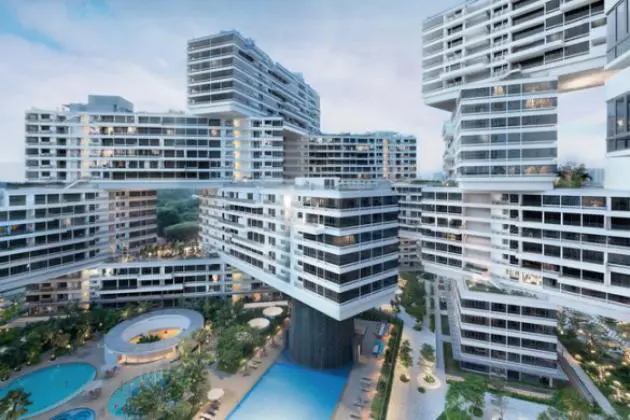
The prize was presented for the Interlace, a housing development in Singapore.
The project combines environmentally friendly urban living with social sustainability, qualifying it for the new category of the CTBUH, which awards a range of architectural prizes.
Scheeren rose to fame with the landmark cuboid CCTV Tower in Beijing, the headquarters of China’s state broadcaster, which won the council’s Best Tall Building prize last year.
The 43-year-old from Karlsruhe designed the project in Singapore while he was still part of Netherlands-based firm the Office for Metropolitan Architecture, but since 2010 he has run his own architecture company in Beijing with 40 employees.
“The idea was to create a vertical village,” Scheeren says. The 170,000-square-metre complex in Singapore was completed in 2013 and is now fully occupied.
“It evolved around the question of how to redefine the living realm of human beings not only in an individual but also a social sense, and how to develop a building structure out of that.”
Instead of following the usual typology of urban housing with clusters of isolated towers, the design turns the vertical into the horizontal.
Its 31 apartment blocks, each six storey tall, are stacked in a hexagonal arrangement around eight courtyards.
“You could also say, I took vertical high rises, knocked them over into the horizontal and piled them up,” Scheeren says.
The interlocking blocks with their outdoor spaces are intended to form a topography. Roof gardens and landscaped terraces together provide a green area 112 per cent the size of the unbuilt site.
The blocks hover on top of each other to form an “interlaced” space that connects 1,040 individual apartments with community areas, “to turn vertical isolation into horizontal connectivity,” Sheeren explains.
“Interlace opens a space of collective experience within the city and reunites the desire for individuality and privacy with a sense of togetherness and living in a community,” the architect continues..
“Social interaction is integrated with the natural environment in a synthesis of tropical nature and habitable urban space.”
This way the design “generates a multiplicity of qualities and choices for its inhabitants,” he says.
The environmental analysis and low-impact passive energy strategies earned the housing development the Green Mark Gold Plus Award for sustainability from Singapore’s Building Construction Authority.
Sheeren’s current projects include an art centre near the capital’s Forbidden City and Angkasa Raya, a 268-metre skyscraper in Kuala Lumpur.
Other projects are DUO, a large-scale mixed-use development under construction in Singapore, as well as Mahanakhon, which will become Bangkok’s tallest skyscraper.
