
Tabla maestro plays farewell beat


Play
Departing Ustad Vasi Ahmed Khan charmed thousands of Thais with the rhythms of the world
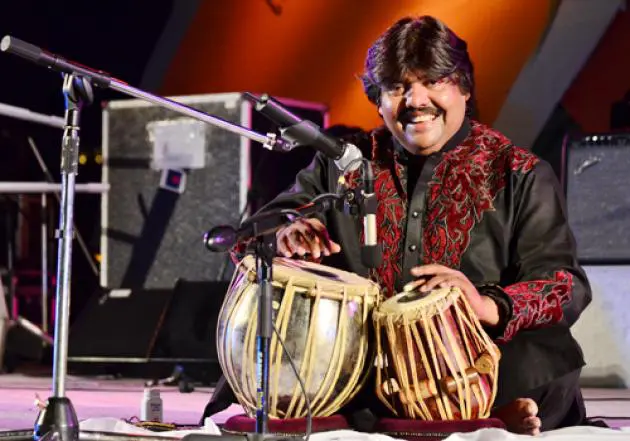
For nearly an hour, it was entertainment as usual for the Bangkok audience as the Indian Cultural Centre’s tabla maestro, Ustad Vasi Ahmed Khan, unleashed his wide repertoire of skills in the auditorium of the Modern International School.
He could have hogged the limelight at what was, after all, his farewell, presided over by Indian Ambassador Harsh Vardhan Shringla. But he chose instead to share the stage with a few of the many students of many nationalities he’s groomed in Thailand.
Together they performed compositions in the 16-beat teen taal”cycle, followed by the more demanding 12-beat “Ek taal”. Livening up the session were his young and talented sons, Farraz on the tabla and Wajid on the djembe, with their fast-paced rolls and beats.
As claps rang out loud and long at the end of another entertaining and educating exposition by Khan, there was just a hint of melancholy as he stepped offstage. After two years as resident teacher, Khan took his final bow along with Kathak dance teacher Anjana Jha, who also performed with her students and regaled the audience.
As an ambassador of Indian music, Khan has demonstrated his skills in different parts of Thailand, delighting audiences with all that can be accomplished on just those two drums – the wide-bodied metal bass drum and its wooden-bodied companion.
Despite Thais’ limited exposure to Indian music, Khan managed to strike a great rapport with audiences in Phuket, Chiang Mai, Khon Kaen, Sukhothai and other places. Students at Thai universities in particular were drawn to his lively rhythms. “I always mix my traditional art with local rhythms so that people can associate with it,” Khan says. “Quite a few students at Khon Kaen and Maharasarakham universities were interested in learning the tabla, but distance and inaccessibility were the problem.”
What probably endeared him most, to the connoisseur as to the layman, is his ability to mix the classical with a wide range of global rhythms, producing sounds from the tabla that left every listener’s feet tapping.
“It was a pleasure to perform in front of the audiences here, drawn from many nationalities. But my most memorable experience was to perform in front of Her Royal Highness Princess Maha Chakri Sirindhorn at Chulalongkorn University last year,” he says.
Khan built his versatility and wide repertoire through years of playing for orchestras and Hindi films. Among the composers he’s worked with is Oscar winner AR Rahman. “The purists tend to look down on film or pop music, but I, as one who has straddled the world of classical and pop, can vouch that often pop music requires greater creativity,” he says.
“Undoubtedly you need classical training to master the art, but as you understand your own interests, get more exposure to different musical forms, you evolve. I love world music and that’s why I incorporate different rhythms in my concerts.”
Khan has been involved in fusion music and he also once played with American jazz musicians at a concert in Mumbai. During a visit to Yemen he performed eight different global rhythms on each of the eight days he spent there.
Even in Bangkok, one of his more acclaimed performances was the one entitled “Global Rhythms”, when he had the audience in raptures with Indian, Thai, Arab, African and Latin American beats. “A good performer is one who can convince the audience in any part of the world of his musical form and entertain them,” he says.
And, because his commitment to the listeners is so strong, he often tries to get them involved, without compromising on the integrity of his skills. On one occasion in Bangkok, as he played the teen taal cycle of 16 beats, which ends with the first beat of the next cycle, he encouraged the audience to join in with intermittent rhythmic clapping. When the exercise was over, Khan knew he had misfired during the cycle and so, to satisfy the purist in him, he repeated the whole cycle, this time perfectly – and without the clapping – to ensure he hadn’t let down his musical masters.
He is the fourth generation in a family of musicians and learned his skills from his father, Ustad Nawab Ali Khan, starting at the age of five. They belong to the Farukhabad gharana, one of the five traditional schools of the tabla. He gave his first solo concert on All India Radio when he was just 10.
As a teacher he had the ability to instil hope in even the weakest of his students, which is why many Thais, Westerners and Indian expatriates found it so easy to learn from him.
Ambassador Shringla paid tribute to Khan’s ability after the farewell concert. “The Indian Cultural Centre was fortunate to have a musician of his calibre teach and perform here,” he said. “It’s certainly a loss for all of us. Anybody who has listened to him knows what a versatile and wonderful performer he is.”
As Khan sails towards a new future, the Indian Cultural Centre is itself in transition. Opened in 2009, it has moved to new premises at Lake Rajada on Ratchadaphisek Road. Shringla said its next home, in the near future, would be a purpose-built structure in the heart of the city. “We have already signed the deal for the purchase of the land. The architecture design is ready and we expect construction to begin shortly.” He said the new centre should be up and running in three years.
