
Seeking safety with trees


Play
Residents of northeast Japan set out to protect themselves against future tsunamis
If there is one resolution the residents of Iwanuma on Japan’s northeastern coast are determined to keep, it’s that any future tidal wave will be unable to do such devastating damage as the Great East Japan Earthquake and tsunami in March 2011.
To that end, they have joined up with city administration in building a long section of an anti-tsunami corridor to help protect against future waves, in addition to repairing and rebuilding existing embankments damaged by the event.
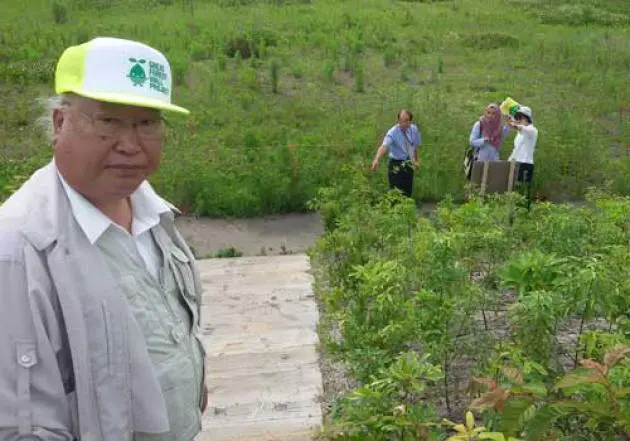
Construction of the 10-kilometre corridor, which has been dubbed the Great Forest Wall, began last year and will consist of a large number of clay mounds, each 10-metres high, in an inverted parabola shape with the flat top. The structures, 70-100 metres in length and 60-70 metres in width, will be made largely of non-toxic debris and sediment collected and transported from several tsunami-hit areas. Saplings will then be planted to form an eventual tree wall.
Explaining why the debris-mixed earthen mounds and trees have been selected to stand behind the embankments, Makoto Nikkawa, director of the Public Interest Incorporated Foundation for the Re-use of Debris, says that the trees could last for more than 1,000 years, compared to the embankments, which will probably be worn out or damaged in less than a century.
"That is why the project has the alternative name of ‘Millennium Hope Hills’," Nikkawa says.
The corridor will cover a 10-km stretch of Iwanuma City’s beachfront, the site of Sendai airport that was severely damaged in the tsunami, and behind embankments that are to be rebuilt or repaired. Nikkawa says city administrations in neighbouring prefectures from Fukushima south of Miyagi to Aomori in the north, will be encouraged to implement the project along their coastlines over a total distance of 300 km.
The size and height of the mounds could vary depending on the land or space on which they are built, he adds, with the shortest length measuring 30 metres and the smallest width five metres.
Each of them, to be built 30-50 metres inland, will serve as a foundation for various types of broadleaf trees – selected by renowned botanical pathologist Akira Miyawaki – that will provide better protection than the pines planted in the days of the Samurais to absorb past tsunamis.
The broadleaf trees are also expected to catch drifting houses and cars, and save people from being dragged out to sea by the undertow, which is known to have contributed to a high number of drownings among those who managed to survive the incoming rush of water.
Nikkawa, who knows Thailand well, points out that damage from the 2004 Indian Ocean tsunami would have been far less had the a large coastal area covered with mangrove along the Phuket and Phang Nga shores not been dredged to make way for hotels and resorts.
Within 15 years the new trees – acastanopsis, oaks and machilus are among the 17 species selected – would grow by 20 metres, establishing a 30-metre corridor on top of the 10-metre mounds to absorb the strength and height of future tsunamis. The waves that hit Iwanuma in 2011 averaged 25 metres.
The Great Forest Wall has several advantages over concrete embankments, as the mounds full of trees would require zero maintenance while fertilising the oceans and the tributary rivers, through minerals produced in the forest.
The mounds and the trees are also resistant to severe environmental conditions like rain and wind. The main trees, machilus, contain a lot of water and therefore help preventing the spread of fire.
The corridors will be open to visitors, both during construction and after completion of the project, with no admission charge initially levied although a fee might be requested later on.
Of course such a project requires money – a lot of it – and to save on manpower expenses, a series of activities were held last year that saw 8,500 residents plant a total of 60,000 trees. Central government has bought the land and now the administration is launching fund-raising and donation campaigns to buy a total of 90 million seedlings of the broadleaf trees, at 500 yen (Bt160) apiece.
