
The Thai Pavilion comes home


Play
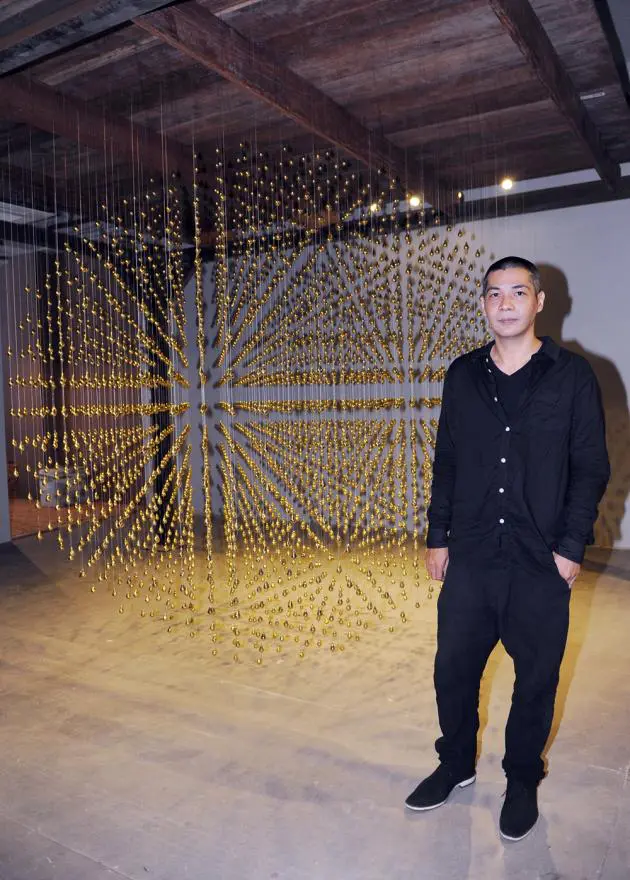
A hit at last year's Venice Biennale, it features the remarkable golden teardrops chandelier
HAVING THRILLED visitors at the Venice Biennale in Italy last year, the Thai Pavilion is finally on view at home. Arin Rungjang and Wasingburee Supanichvoraparch have mounted their installation “Poperomia/Golden Teardrop” at Siam Center.
The chatter in Venice last summer led thousands of art enthusiasts to an abandoned warehouse in the Santa Croce neighbourhood, the building brought back to life for the Biennale. There they gaped at a chandelier made of thousands of tiny bronze “teardrops” and sampled the Portuguese-Thai dessert called thong yod – “golden teardrops”.
The Culture Ministry’s Office of Contemporary Art and Culture commissioned Arin, Wasingburee and curators Worathep Akkabootara and Penwadee Nophakate Manont to represent Thailand at the prestigious European event that offered art from 88 nations. Together they showed what Thailand is capable of when it comes to contemporary art.
Now dozens of sculptures, photographs and installations by the Thais and foreigners festoon the Bangkok shopping mall and the Thai Pavilion itself is laid out like a quiet art gallery.
Arin’s magnificent “Golden Teardrop” chandelier is inside, showering the room with a glittering spectrum of light reflected from the 6,000 bronze globules. Each “teardrop” is beautifully constructed, hung from the ceiling on a thread. Collectively they form a huge ball, and the surrounding void acts to solidify the shape and stress the immense volume.
The chandelier echoes the venerable “golden teardrop” dessert that the Siamese of Ayutthaya concocted, based on a treat imported by the Portuguese who came here to trade 500 years ago.
Arin’s 30-minute video is screened as part of the exhibition, depicting a Japanese woman in modern-day Rattanakosin making thong yod, and Thai goldsmiths sculpting the bronze teardrops for Arin’s chandelier. The film juxtaposes the histories of Siam, Japan and Portugal amid his conversation with Australian art scholar and critic David Teh.
The Office of Contemporary Art and Culture last year insisted for the first time on a theme for the Thai pavilion in Venice. It had to be about Thai cuisine and thus bolster the government’s ambition to make Thailand “the World’s Kitchen”.
Arin and curator Worathep decided on the golden-teardrop dessert and also – in keeping with the Biennale’s overall theme “Encyclopaedic Palace” – wanted to share the histories of the sugarcane industry and Siamese craftsmanship. Arin’s video explains how thong yod was derived from “ovos moles”, the sugary Portuguese snack invented in the 17th century.
Arin is interested in cross-border relationships and, while showing art in New York, he researched the history of the marine trade and its contribution to “globalisation” in its original form. He tracked down a correlation between South American sugar-cane plantations and the origins of Siam’s golden-teardrop dessert. When the Culture Ministry invoked its theme for the Thai Pavilion, Arin already had a solid basis thanks to his personal interest in history.
Arin had discovered that a Portuguese nun had first deep-fried “ovos moles de aveiro” circa 1500 and presents this fact alongside the “edible history of sugar” as “a commodity that changed the world”. Sugar was responsible for the first migration of labourers and a massive movement of natural resources from the New World to meet demand among the wealthy people of the Old World.
“The documentary presents the imperfection of history, no matter what the viewpoint,” advises Arin, 39, who’ll be taking the show to Singapore later this year. “This is not an effort to connect the dots, because that would be awkward and pointless. If we projected something beyond our ability to interpret, it would be like stacking history on the table and putting it together like a jigsaw puzzle.
“For me this is not about concocting history. Based on Joseph Beuys’ concept, we should use existing items to set the direction and connect with the future. Parties with different sets of truth normally fight. We tend to connect history without any direction because the most powerful data was overwhelmingly interfered with. This leaves people disturbed and prevents us from drawing a map of history.”
While Arin’s work is more conceptual, Wasinburee’s Thai house made of colourful yarn is playful. The centrepiece is a fibreglass sculpture of a water buffalo in honour of Thailand’s agricultural heritage.
Wasingburee and Penwadee came up with “Poperomia” to match the Thai cuisine theme and make historical and geographical connections. The classical Thai house is fashioned from more than 5,000 red ceramic bricks made in the traditional manner at Wasingburee’s own factory in Ratchaburi. Visitors are invited to wrap bricks in colourful yarn while watching the 1976 docu-drama “Tongpan”, about a farmer whose livelihood was threatened by construction of the Pa Mong Dam in the Northeast. The installation symbolises modern pop trends that encircle the old traditions of weaving and brick-making.
“In the title, ‘pop’ refers to popular culture. Poperomia is a plant that can quickly absorb liquid,” says Wasingburee, 43, who received the Culture Ministry’s Silapathorn Award in 2010. “I wanted to reflect that, although our culture is complex, nowadays it absorbs a lot more pop culture.”
The exhibition is a joy despite the mall’s frequent promotional announcements, especially annoying when you’re trying to watch the videos. But it has to be said that displaying contemporary art in a place like this certainly draws a crowd, and that’s important in getting the masses used to this often-challenging genre.
“I like the show very much,” a tourist from Amsterdam smiled while exploring the exhibition. “It’s a good idea to bring art to the mall. My girlfriend loves playing with the bricks!”
ABSORB ART
“Poperomia/Golden Teardrop” runs until August 28 in Siam Center’s ground-floor exhibition hall.
