
Great new museums to mull


Play
You'll be in the money at the Coin Museum and awash in history at the Pipitbanglamphu
MUSEUMS HAVE muscled in among the artists who gather along Phra-Arthit and Chakrabongse roads. The Pipitbanglamphu Museum and Coin Museum Thailand both opened there earlier this month with interactive exhibitions about Phranakorn district, the Treasury Department and the Royal Thai Mint.
Innovative 3D techniques help make the new institutions well worth day trips, but the main attraction is the wonderful education in history on offer, dating back to the reign of King Rama I, founder of the Chakri Dynasty and the new Siamese capital on Rattanakosin Island.
The Treasury Department’s Pipitbanglamphu Museum stands next to the centuries-old Phra Sumeru Fort on Phra-Arthit Road, a Bt70-million revamp of the buildings that once housed the Wat Sangwet Printing School and Kurusapa Printing House. The Museum also houses a community library and public recreation areas.
The buildings, occupying one rai, combine Western and Thai architecture and were registered as an historic monument by the Fine Arts Department in 2000.
“The department is responsible for maintaining and developing all of this royal property as public space – or as private dwellings,” says director-general Naris Chaiyasoot.
“But when the Kurusapa compound was registered as an historic monument, we were inspired to conserve the site and turn it into an educational centre for the Bang Lamphu community, which had always been the city’s economic heart.”
Naris points out that both the Pipitbanglamphu and coin museums bear “universal” designs that accommodate visitors of all ages and handicapped people as well. “Everyone has the same opportunity to enjoy the experience, and English translations are found everywhere.”
A visit starts in the two-storey, L-shaped Bauhaus-style concrete building with the temporary exhibition “Our Greatest Queen”, presented this month as part of Her Majesty’s birthday celebrations.
Another room is dedicated to “The Fortresses of Rattanakosin City”, with miniature models of the old city walls and 3D presentations including a map of the Chao Phraya River and adjoining canals. You can see vividly how people lived around the city gates in bygone days.
On the second floor are displays telling the story of the Royal Treasury Department, with the facilities set up to resemble its original headquarters in the Grand Palace. Five window-like information panels explain the day-to-day activity at present.
The “Asset of Pride” section shows how the department has developed the royal properties with a huge interactive model of business venues in the Wattana and Klong Toei neighbourhoods. You can even check out the land’s current estimated value.
In the section “The Opening of the Royal Thai Mint”, visitors can track the history of our currency. Hi-tech multimedia demonstrates how silver coins are made, and with the help of miniature ticket- and drink-vending machines and games, you can better understand how coins circulate.
A traditional Thai house made of solid teak in 1932 fills seven spacious rooms with depictions of various cultures, nationalities and lifestyles found in the business quarter of Bang Lamphu.
“Lively Bang Lamphu” offers an introduction to the modern district with clever use of “projection wall mapping”. And a theatre in the “Clues of Shore” section affords an eye-catching backdrop of Klong Bang Lamphu, a short film harking back to the early Rattanakosin Era, crowded with Chinese, Khmer, Lao, Mon and Muslim people living among the Siamese on the river’s edge.
You cross a miniature Norraratsatan Bridge to get to the Phranakorn Centre, a gathering of assorted famous entertainment genres, old boutique, cafes and restaurants from the 1960s and ’70s, all under one roof.
You really get the sense that you’re wandering around the downtown of yesteryear. Grab a ringside seat for Mae Boonak’s Musical Comedy and check the showtimes for the Thai blockbuster films at the Bussayapan cinema. But it’s a decidedly modern touch-screen that explains likay, the musical folk drama, and you can even try on some of the colourful costumes.
Inside there’s a whole shopping street, where you find Thailand’s first “coffeehouse forum” at the Nuntiya Coffee Shop, and the Kaew Fah Department Store offers a selection of premium handmade leather shoes. The Chinese restaurant Un Hiang Lao is famous for roast duck, dim sum and duck-stuffed buns.
“The Story of the Alley” is a jigsaw puzzle where you have to hunt for Otop products from seven communities around Bang Lamphu. Learn how to carve banana stalks in Wat Mai Amataros village. Sample the triangular rice-banana dessert khaotom namwoon in the Wat Samphraya community and admire fine Nielloware made by master artisans from Baan Panthom.
It’s a ten-minute walk to the Coin Museum on Chakrabongse Road. This one represents a Bt170-million ongoing renovation of the Office of Currency Management, which by the end of 2016 will boast exhibition halls, a new library, activity rooms, a souvenir shop and a cafe.
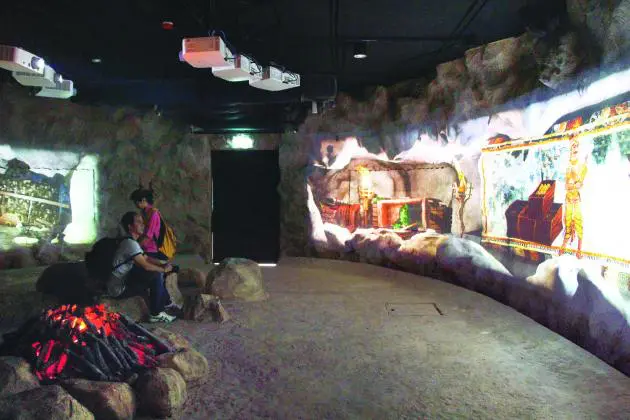
Open for inspection are four rooms dedicated to the history of and innovations in the country’s currency. Among the highlights is a 360-degree virtual “cave” where the first coin was struck. So-called “4D” animation creates a fully immersed environment.
The “Primitive Money” sector reaches back thousands of years, when cowry shells from the Maldives also served as currency for the Siamese. Meanwhile the people of New Guinea were using wolf fangs, Native North Americans swapped beaver skins and the Aztec of Mexico bartered with cocoa.
“Traveller Coins of Suwannaphum” looks at pod duang, the heavy “bullet coins”, and how they evolved into the flat discs we use today.
Hi-tech innovations in coinage around the world are on view in the next zone. You’ll marvel at the silver coins bearing zodiac signs found in Belarus and Australia’s more scientific coin portrait of the Southern Cross. A coin called Element of Life actually contains a DNA extract from a tame Cheetah in the Democratic Republic of Congo.
All of the commemorative coins minted in Thailand for special occasions in the life of His Majesty the King are on display.
Audio guides are available in Chinese, Japanese, Korean, English, German and French, as well as Thai.
GET THE DETAILS
>>Admission is free at both museums through September.
>>The Pipitbanglamphu Museum is on |Phra-Arthit Road and open daily from 10 to 6.
>>Find out more at (02) 629 1850 and the Pipitbanglamphu page on Facebook.
>>The Coin Museum Thailand is on Chakrabongse Road and open daily from 10 to 5.
>>Learn more at (02) 282 0818 and the CoinMuseumThailand page on Facebook.
