
Playing around with nature


Play
A hybrid cat finds a new home but can he settle?
ONE DAY, a cat-loving lady sees her neighbour attempting to throw a cat out of the house.
“We don’t want this cat anymore,” the neighbour explains. “He pees everywhere.”
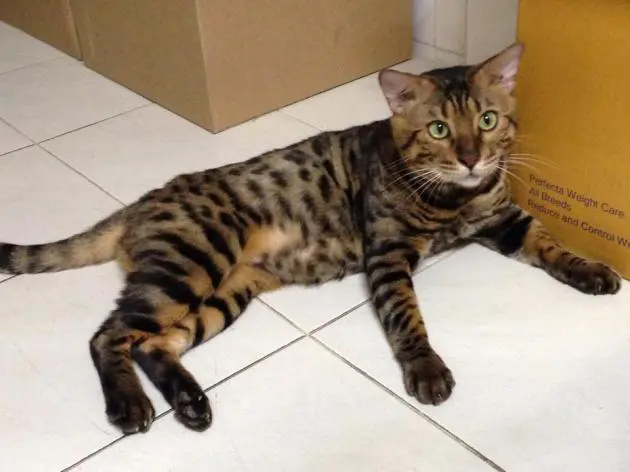
The lady looks more closely at the soon-to-be abandoned cat, and somehow, he doesn’t look Thai. He’s big, his head is rounder than a Thai cat’s, and his fur has markings she’s never seen before.
“What breed is he?” she asks the neighbour.
“Oh, a Bengal cat,” the neighbour replies. She doesn’t mind when the lady asks to adopt him.
I’ve never met the cat, but his photos do indicate that he is indeed a Bengal.
Bengals are hybrids, and hybrids are an extremely controversial subject.
When two genetically distinct individuals are bred together, their offspring is called a “hybrid”. Hybrid species are quite common in plants, not as much in animals, although a great many of the pigs and cows we eat are hybrids, developed to improve health, quality and strength.
In Nature, different breeds or species may mate, creating new hybrid species that may or may not survive.
The problem, as I see it, is that some people enjoy playing Nature, just to see what will happen. A well-known example is the offspring of a tiger and a lion. Tigers and lions don’t normally mate, but if they’re kept together in a limited area, such as a zoo, without access to their own kind, they do.
The result is a huge animal much larger than either of its parents, but not built to survive in the wild.
Another well-known hybrid is the wolf-dog, when people decide to breed their dog with a wolf. The result is neither wolf nor dog, a very confused animal, part wild, part domestic.
Bengal cats are a cross between a domestic cat and an Asian leopard cat. The resulting offspring are beautiful, but in the wrong hands can be dangerous.
The offspring themselves are classified as a “Filial 1 hybrid” or F1, meaning that the kid is the first generation, a half-and-half. The second generation, when the F1 generation is bred with other domestic cats, is called “F2”, and in the genetic makeup of those offspring, the percentage of “wild” genes is reduced.
From generation to generation, the wild genes drop further, but with careful breeding, the physical appearance is maintained.
Why reduce those wild genes? Because, despite the presence of the domestic genes, the F1 and F2 generations, sometimes even the F3 generation, are wild.
They are not your usual pet cats but can be extremely aggressive to people or other animals. It is recommended that a family with children should never have an F1, F2 or F3 Bengal.
At this point, I know that many people will disagree, citing their own F2 and F3 Bengals as “perfect pets”, completely tame with friends and family members. It may depend, to a certain extent, on how the cat is treated by its owners, or on its individual temperament.
At any rate, I’m not sure how many people could handle an F1, F2 or F3 Bengal.
The lady who has rescued this particular Bengal boy doesn’t know much about him, nor about Bengal cats. She does see a cat who looks ill. At the vet’s, it turns out he has feline Aids (Fiv).
His former owners, who haven’t even neutered him, have simply let him wander the sois, where he’s picked up the disease from other cats.
Bengals are expensive, yet how easy it was for these people to throw out their money as well as a cat they didn’t understand.
There’s not enough space in this column to write about other hybrid cat and dog breeds. Perhaps next week, I can write more about the extraordinary hybrids that now have joined our households.
