
Vietnam shoos away 'foreign' lions


Play
Culture Ministry orders non-native statuary replaced at public sites
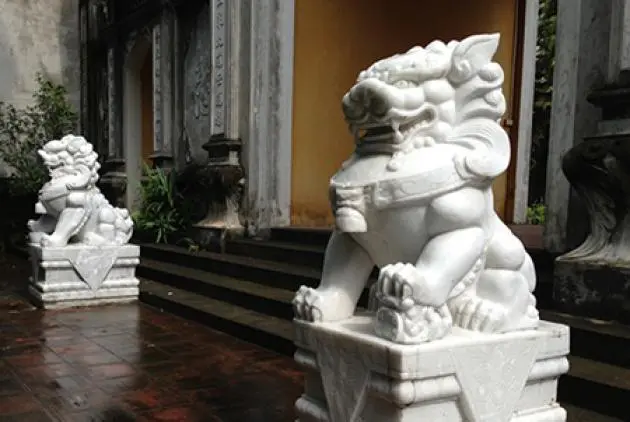
Foreign-style stone lions with their fierce stares, large paws and sharp teeth are soon to be removed from among relics, pagodas and temples throughout Vietnam.
Authorities have decided that authentic Vietnamese guardian-lion statues will replace the objects deemed “unsuited to Vietnamese customs and culture”. People will soon see Vietnamese stone lions roar again at the gates of ruins and heritage sites.
Duong Thi Thanh, vice director of the Ninh Binh Provincial Department of Culture, Sports and Tourism, plans to join other “cultural managers” in raising public awareness about exhibiting Vietnamese sacred objects. They carry the nation’s history, fine-arts traditions and spiritual symbols, she says.
Thanh says she and her colleagues are responding to an official letter from the Culture Ministry’s Department of Fine Arts, Photography and Exhibitions advising them to discourage the display of non-Vietnamese symbols or objects.
The letter was sent last week to cultural agencies across the nation, with photos of traditional Vietnamese sacred creatures, including lions and kylins made from wood, stone and ceramics.
These samples are from exhibits at the Vietnam Museum of Fine Arts, Thanh Hoa Provincial Museum and Hue Royal Palace.
“The pure Vietnamese objects are very suitable to be exhibited at Vietnamese relics,” Thanh says, “since they help create solemnity at these locations.
“It’s consistent to display Vietnamese sacred objects at Vietnamese pagodas and temples. We cultural managers have been concerned about the trend of displaying foreign-style objects at Vietnamese sites for a long time actually.
“We are determined to remove these foreign-style objects from our spiritual sites, such as the Bai Dinh Pagoda, the Unesco-recognised World Heritage Site of Trang An and the temples of emperors Dinh Tien Hoang and Le Dai Hanh,” Thanh says.
“We have tried to explain the meaning of using pure Vietnamese objects at relics to the managers and received their understanding. They have made a commitment to gradually remove foreign-style objects.
“However, for guardian lions located in front of private buildings, we haven’t developed a plan to convince the owners. Currently we’re focusing on objects displayed in public areas and places of national prestige to protect the image of Vietnam’s heritage.”
Based on the photos of sample objects provided by the Department of Fine Arts, craftsmen can manipulate Vietnamese lion and kylin statues, such as the centuries-old statues displayed at ruins.
Vi Kien Thanh, head of the department, says it will continue to collect illustrations of sacred objects that are purely Vietnamese and post them online at APE.gov.vn for public access.
“When the ministry distributed a document warning agencies and individuals not to exhibit or use symbols or objects unsuited to Vietnamese customs and culture, we immediately received images and information of sacred Vietnamese symbols and objects sent from heritage researchers nationwide,” he says.
“Thanks to their assistance we now possess a stock of images. The public and those creating objects for worship can consult these images to understand Vietnamese symbols.”
Fine-arts researcher Tran Hau Yen The says the growing use of non-Vietnamese designs shows people’s lack of knowledge and is a result of non-selective cultural adaptation. “Chinese lions look fierce, angry and threatening, while Vietnamese lions look tolerant and solemn,” he says.
He suggests also displaying elephants and the nghe, a mythical creature with a lion-like head and dog-like body, at gates and in front of buildings.
Wondering where the lions go
A pair of Chinese-style stone lions has already beenm removed from Gia Quat Pagoda in Long Bien District, Ho Anh Tuan announced last Tuesday.
The Deputy Minister of Culture, Sports and Tourism said his fellow deputy, Dang Bich Lien, led a team around Hanoi informing people about the new policy and prompted the managers of the Gia Quat Pagoda to return the Chinese lions guarding the gates to their donor.
Nong Quoc Thanh, vice director of the ministry’s Heritage Department, said people donated such objects to pagodas and temples to express their faith and pray for safety, unaware that their foreign style rendered them unsuitable for Vietnam. But exhibiting these objects at recognised sites violated the heritage law, he said.
“We encourage the relic keepers and object donors to voluntarily remove the objects by the end of this year,” Nong said. “Early next year the ministry will send inspectors to look for foreign-style objects.”
The owners of the two lions that have guarded the Mo Lao Pagoda in the capital’s Ha Dong district for more than a decade ago will be difficult to track down, however.
“And, with our cramped quarters, I don’t know where to place them,” said management chief Bach Ngoc Thuy. “Even if we could find the donors, no one wants to exhibit these objects in their private homes, especially if they’ve been located at a spiritual place.”
History professor Tran Lam Bien suggests the unsuitable objects be re-sculpted in the Vietnamese style. Researcher Tran Hau Yen proposed they be placed in parks to mark the period when Vietnamese borrowed from foreign cultures.
Deputy Minister Tuan acknowledged that the large number of foreign lion statues throughout the country would be difficult to handle. But he said the ministry would consult relevant agencies to find an appropriate solution.
Viet Nam News, Asia News Network
