
Her greatest gift was hope
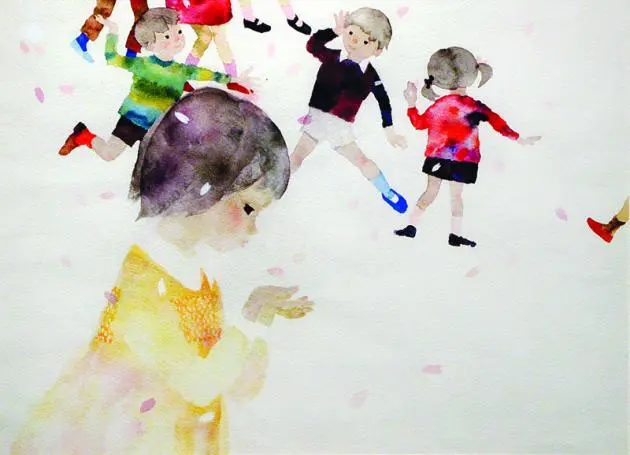


Play
Though scarred by war, Chihiro Iwasaki always believed in a better world
WHEN THE late Chihiro Iwasaki’s illustrations began appearing in storybooks here decades ago, the way she captured the innocent charms of children couldn’t help but capture the hearts of Thais of all ages.
Most famously, the Japanese artist’s soft and subtle watercolours adorned “Totto-chan: The Little Girl at the Window”, the best-selling memoir of TV star Tetsuko Kuroyanagi, which was first published in Thai in 1984.
And now, 30 years later, 55 full-scale reproductions of those watercolours are on view in Thailand for the first time, in the exhibition “Chihiro Iwasaki and Picture Books of Japan”. It’s at the Bangkok Art and Culture Centre until November 16.
On loan from Chihiro’s own museums in Tokyo and Azumino, the endearing pictures of youngsters so familiar to Thai bookworms are mounted side by side with her early drawings in bold pencil, from the 1940s, and the final, gentle strokes she rendered in the 1970s.
“To Thais, Chihiro’s work represents Japanese picture books,” says Yuko Takesako, vice director of the Chihiro Art Museum.
“Throughout her life she continued to draw with the wish for happiness for children and world peace. As a daughter of a Japanese military architect, and having grown up during the war, she wished for a world that would never again see war. She felt children would shine most when the world was peaceful.”
Chihiro authored more than 30 picture books between her first in 1956 and her death at age 55 in 1974. She created well over 9,000 artworks, mostly watercolour on paper, mainly youngsters and flowers. While writing “Totto-Chan” over the course of two years, Tetsuko is said to have visited the Chihiro museum monthly to select the paintings that best matched her childhood memories.
“As a mother,” recalls Yuko, “Chihiro was able to accurately capture the subtle differences between a ten-month-old baby and a year-old infant, without even referring to a model. She needed no initial sketches to paint children’s movements and emotions, working freely across the paper, and without contour lines. The paint would dip softly into the paper, lending a vivacious effect and evoking all sorts of inner emotions.”
The works on display in Bangkok are reproductions made with piezograph technology, a fairly recent invention that more closely maintains the look of the originals – and avoids damaging them. Chihiro worked on what was then called “acid paper”, which readily changes colour and deteriorates. Ultraviolet rays might also alter the colour of the paint.
In 2004 the Chihiro Museum and the firm Epson started digitally archiving her work, making piezographs, which involves precise ink-dot printing that captures every blur, smudge and shading as surely as Chihiro herself caught the nuances in her subject’s expressions. The piezographs resist fading and ultraviolet light. The museum has made 400 reproductions to date.
Chihiro’s work during the 1950s and ’60s is characterised by clearer outlines and bolder colours than what emerged later, and features more blank space. The young subjects are often seen amid the changing seasons. They’re rendered in pastels, with traditional Japanese aesthetics mixing with Western watercolour and Chinese ink-painting techniques.
In sharp contrast, the show also includes sombre black-and-white depictions of children victimised by war. Drawing on personal experience – her own family’s home was destroyed in an air raid during World War II – Chihiro published three books illustrating the pain of war. “When I Was a Child” is about the youth of Hiroshima, struck by an atomic bomb. “Mother is Not at Home” and “Children in the Flame of War” turn the focus to the Vietnam War.
The pieces provide the Bangkok show with a dark yet vital balance, given the sweetness and light of the remaining work.
“I experienced war early in my life, as a force that dashes all youthful hopes,” Chihiro once said. “It had a major impact on how I lived my life. I truly love peace, abundance, beauty and adorable things. I feel limitless anger at the forces that would crush such things.
“Even without seeing a battlefield, one can well understand how children feel in wartime and the effects it has on them. This is because children, from their innocent eyes to their lips and their hearts, are much the same all over the world.”
Marking the release of the “Totto-Chan” memoir 30 years ago, publisher Kodansha recently issued an illustrated edition in two volumes. Its 20 chapter were pared from the original 60, but the 100 illustrations are four times the number in the 1981 book.
Pussadee Navavijit, who translated the original into Thai, has taken charge of the new edition as well. It’s expected to be on shelves early next year, courtesy of Butterfly Publishing House.
Further augmenting Chihira’s exhibition are reproductions of illustrated Japanese scroll books dating back to the eighth century, hand-tinted manuscripts from the 17th century and modern works by noted illustrators including Suekichi Akaba, Takeshi Motai, Yasuo Segawa and Shinta Cho. These also come from the Chihiro museums’ private collection of 20,000 artworks from all over the world.
“Picture books are part of our precious cultural heritage and part of the literature of hope,” Yuko says. “They drive children’s imaginations and put smiles on their faces. Japan has 35 museums dedicated just to these picture books, and we hold more than 300 events a year focusing on them.”
It’s impossible to avoid succumbing to Chihiro’s optimism while gazing at her art. More than fun, more than gaiety, it offers hope in the face of continuing warfare.
“A person like myself, who is neither brave nor courageous,” she said in 1973, the last year of her life, “was probably born to draw pictures – not powerful oil paintings that stir people’s emotions, but modest picture book illustrations.
“I hope that, when the children who have seen these gentle picture books have grown up, they will still keep them somewhere in their hearts, so that, when they face sad or desperate times, they can be soothed by remembering even small bits of the gentle world depicted. I think this is my way of repaying a number of people and is my own reason for living.”
AT PLAY, AT PEACE
“Chihiro Iwasaki and Picture Books of Japan” continues until November 16 on the third, fourth and fifth floors of the Bangkok Art and Culture Centre.
The centre at the Pathumwan intersection (National Stadium BTS station) is open daily except Monday from 10 to 9.
Find out more at (02) 214 6630-8, www.BACC.or.th and www.JFBkk.or.th.
