
Genghis Khan as Chinese citizen


Play
John Man sees the irony in Beijing anointing its foreign conqueror a national hero, but warns of legacies usurped
“On the subject of Genghis’ grave,” John Man wrote in his 2004 biography of the Mongol warlord, “about the only certainty is that little is certain.” Now here we are in 2014: “The only certainty is that very little is certain.” He’s still writing about the location of Genghis Khan’s horse-and-concubine-stocked tomb, but a decade later he’s even less sure where it might be.
In 2009 Mann went back up the mountain on whose slopes the Great Khan was supposedly buried in secret, this time serving as hired guide to four “adventure tourists”. Obviously he found nothing further on this hunt, though he did manage to convince himself that the seemingly artificial rock formations that might be marking gravesites are entirely natural.
Was “The Mongol Empire” – the latest of several books by Man about the dynasty that once ruled most of the known world – inspired by his new career sideline as a tour guide? It’s unlikely, and we can surely also rule out as a rationale the fact that he’s been mulling a foray into screenwriting.
“The idea for this book,” he says in the introduction, “came from working on a proposal for a series of films” about Genghis. An aspiring movie mogul had broached the idea with him, but it came to naught because putting the whole Genghis story in cinemas would be just too ambitious, too unwieldy. Imagine “The Legend of King Naresuan” stretched out to 10 full-length features, or more.
But, Man writes, “It made me take the long view and look back on the Mongol empire from today with Asia dominated by the empire’s top successor, China.”
Unfortunately Man does a tepid job on the linkage and, as evident from the line just quoted, his prose is no longer nearly as elegant as it was in “Genghis Khan: Life, Death and Resurrection” (2004) and “Kublai Khan” (2006), both of which I gave enthusiastic reviews in The Nation.
The flow of the words in “The Mongol Empire” splashes about unevenly because the book is really just an updating of its majestic predecessors. Whole passages are recopied, but the frequent amendments disturb the assured grace of the originals.
There are worthwhile additions, of course – some interesting ideas and discoveries have emerged in recent years. Overall, however, it might have been better to leave the memory of the older books to rest in peace, much as the dying Genghis commanded his attendants to bury his remains in a secret place and tell no one the location. Nevertheless, lots of people over the centuries have set out in search, shovels in hand.
And so it is with the Mongol legacy, which Man the tour guide points out for us in the great wall of modern Chinese nationalism. The conqueror in whose name China was utterly subjugated to Mongol rule is now one of its most venerated heroes.
“Genghis’ conquests, which were given their universalist ideology by [his son] Ogedei and extended by [his grandson] Kublai, still govern China’s policies on its borderlands: Tibet sucked back into the fold, Mongol lands gradually absorbed – re-absorbed in Chinese eyes – making Inner Mongolia irrevocably part of China. Herders protest the loss of their lands to farmers and miners and get abused, imprisoned and occasionally killed for their trouble.”
Mongolia proper claimed independence after long Soviet control, but the Chinese communists scoffed at the notion, Man notes. “Officially, no one talks of repudiating the status quo. Unofficially, though, there is a wrong to be righted. If this ever comes to pass, it will be done in the name, naturally, of Genghis Khan, because it was his heirs who gave China its present borders … There’s no need for anything heavy-handed, because Chinese pressure is economic and social.
“It may all come to nothing,” Man continues, “but the signs are that big changes are afoot, and Genghis and Kublai are the keys. If the Chinese take over Mongolia, they will do so in the names of Genghis and Kublai, who made Mongolia part of China. And if Mongols resist, they will do so in the names of Genghis and Kublai, who made China part of Mongolia.”
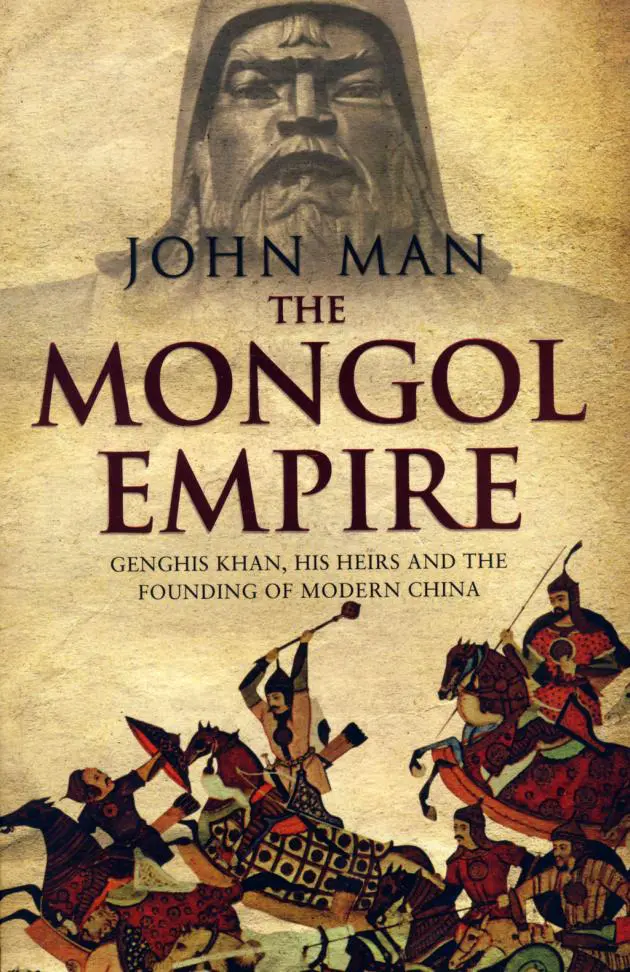
The Mongol Empire: Genghis Khan, His Heirs and the Founding of Modern China
By John Man
Published by Bantam, 2014
Available at Asia Books, Bt625
Reviewed by Paul Dorsey
