
Being an artist isn't easy


Play
Students in this year's Bualuang 101 Art Competition learn that talent alone is not enough
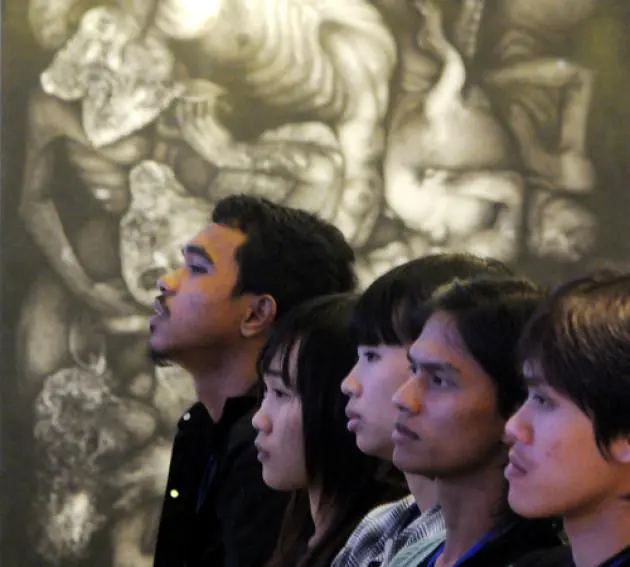
It's not easy becoming a professional artist in Thailand, says a man who ought to know – National Artist Chalermchai Kositpipat. That was his stern but pragmatic assessment for aspiring students at the recent launch of the Bualuang 101 Art Competition.
One of the main problems, Chalermchai warned, is that there are few art dealers here who can help in the necessary marketing and public relations. The artist has to handle all of that by developing social-relations skills. “The key point is you have to sell your paintings!” he said.
Bangkok Bank’s Bualuang Foundation has been hosting the art competition from its start in 2007. This year 52 students from 24 universities will be competing in an “art reality show” from November 1 to 9 at the Queen’s Gallery. The winners will be announced on November 10.
Chalermchai was at the launch to spur the kids on, though the “reality” was glaring in his pep talk – he pulled no punches. Noting that his fellow National Artists Thawan Duchanee and Prayat Pongdam recently died, he half-joked that, “Many of the rest of us are getting close to death too!”
But Thawan, he said, was a fine example of the talents required beyond brush and canvas. “He was not only a good artist but also a good marketer and psychologist. He knew how to talk to customers, the public and the press, which in turn earned him riches and respect.
“So a successful artist isn’t just someone who can do the painting but someone who can also sell the painting. Even if you hate talking to people, you have to develop those skills.”
Among the other tips Chalermchai offered was to always participate in the exhibitions arranged by art teachers. “It’s almost a duty. And it’s important that you’re there personally. I used to be the only student at the teachers’ shows, keeping an eye on the sales, and all my paintings sold, even when those of my teachers didn’t.
“Having your paintings on show alongside those of your teachers creates opportunities for exposure. You get to meet prospective customers.”
Secondly, he said, keep your asking price affordable. “If you set the price too high, no one will buy. And collectors know that, after the exhibition ends and you haven’t sold any work, they can get a bargain because they know you need the money.
“Then, if you sell at a cut rate, thinking no one will know, you’re in trouble. You can do that only once. It’s much better to give your work a varying price range, from expensive to cheap.
“There’s no disadvantage whether you come from the North, South or Northeast,” Chalermchai declared, but he pointed out that artists in Chiang Rai, his home turf, have been generally more successful than anywhere else – because they’re cleverer at marketing. “We do smaller paintings that people can afford. Sometimes we even let the customers set the price, but we often get more than we expected.
“We once held a blind draw for an unspecified painting at an exhibition where every piece was worth Bt50,000, including works by Thawan and me. The customers drew lots and every artist shared in the money raised.”
Chalermchai said the Bualuang 101 competition is great at showing students how to present their work. “There is no better shortcut in training,” he said.
The contest accepts two bachelor’s-degree students from each university. They have to be in their last two years of studies. During the nine days they’ll attend lectures that this year include Thongchai Rakpathum discussing “Bangkok in Dream or in Reality”, Ittipol Tangchalok on “The Process of Creating Art”, and Preecha Thaothong on “Preparation for Art Creation”.
“Bangkok in Dream or in Reality” is the theme for this year’s challenge, the first time it’s had one. It’s good to have a guiding topic, Chalermchai said.
“Artists can tackle any subject, from Heaven to Hell. It’s up to their imagination. But the more you practise specific subjects, the quicker you find your signature style. Having a set topic helps you think differently. You might feel uncomfortable with it at first, but you might actually get something more from it.”
“You need to learn how to ‘decode’ the topic through your feelings,” added Preecha, who’s one of this year’s judges, “and present the finished work in your signature style. Look at Thawan’s work – you don’t need to understand it to see it has a special feeling. Art should come from the heart, not just the ability to draw.
“Just keep in mind that the real competition is within you!”
Khunying Chodchoy Sophonpanich, director of the Bualuang Foundation and chairwoman of the competition, said she buys art based on the emotions it stirs in her. “I don’t own many works by National Artists and I don’t have to have a lot of knowledge about a given painting. I only want to hang it on the wall and appreciate it.”
WATCH IT HAPPEN
You can track the competition at www.Kapook.com from November 1 to 9 and vote for your favourites. The Bualuang101 page on Facebook will have the latest updates as well.
The “Artist of the Year” winner receives a Bt100,000 scholarship and plaque. The “Bualuang Creative Artist” gets a Bt70,000 scholarship. The “Outstanding Artist” earns Bt30,000 and a plaque.
Sketches of Bangkok by youngsters at the Bangkok School for the Blind will meanwhile be auctioned off at www.Bualuang101.Kapook.com, with proceeds going to the Foundation for the Blind in Thailand under Her Majesty the Queen’s patronage.
