
Three clicks to better CABBING
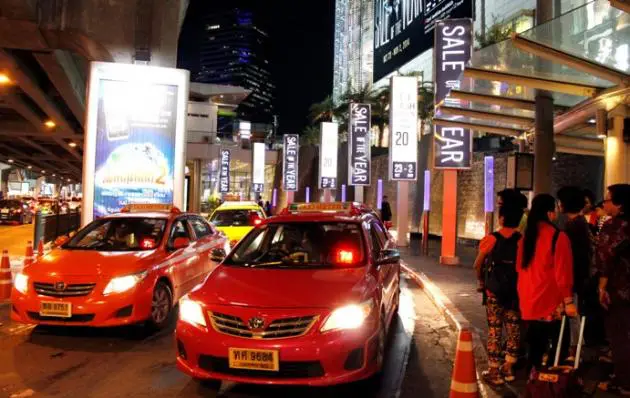


Let your mobile get you mobile - Thailand now has three phone apps for summoning taxis
THE EASE OF summoning a taxi through an online application has proved addictive, with more apps now available to ensure quick response and lessen the risk and inconveniences. Bangkok has more than 100,000 taxis and a lot of them are on call with a few clicks on a cellphone keypad.
There are currently three smartphone apps on offer in the metropolis and likely more on the way. The additional charge is minimal – from Bt25 to Bt45 – and you have the luxury of remaining at home until the cab shows up at your door. No more lame excuses, no more refusals and no more heartache.
If you haven’t yet tried the system, here are a few tips on choosing and using a service.
GRAB TAXI
Launched in Malaysia in 2011, Grab Taxi arrived in Bangkok exactly one year ago and recently began a trial run in Pattaya. The app is free to download for any operating system and then you pay Bt25 extra per ride. The fares match the Bangkok standard rate as shown on the meter.
Grab Taxi has enlisted about 1,000 regular registered taxis in the capital and there’s now a Grab Car service as well, where you use the same app to book a limousine for a more luxurious ride.
The good part about this app is that everything is in “real time” and you get to monitor the cab’s location on a GPS map. The app also shows estimated time of arrival (quite useless in Bangkok traffic, but a comfort when you’re waiting and you can see the taxi edging closer) as well as the estimated fare.
Once you put out a call for a lift, the app shows the taxis available in your vicinity, ensuring the least waiting time. You get a confirmation email once a taxi is on its way that provides the driver’s name and photo and the taxi registration number, best kept for reference in case there’s a problem.
While waiting you can phone the driver to help with directions or they can call you directly if they’re not sure where to find you.
The not-so-good part is that the app doesn’t clue in the GPS as to your exact location, instead using Google Map and Four Square listings. If your location isn’t already on those maps, you have to synch in with the nearest spot shown.
Most taxis we’ve had so far have been clean and nice and the drivers have been polite, but of course the app can’t vouch for every driver. You might get a grumpy uncle or someone with a dysfunctional sense of direction who needs help finding you like a lost pilot being brought down by air traffic control.
Keep in mind too that you can only pay cash with Grab Taxi, and not all drivers are able give you a receipt.
EASY TAXI
This Brazilian app debuted in 2011 and migrated to Thailand about the same time as Grab Taxi. It too is free for all platforms and the features and functions are very much alike. The app automatically detects your location and contacts the taxis closest to you.
While waiting, you get the licence number and can follow the approach on your phone screen. Either the driver finds you with GPS or Easy’s call centre will connect you to him (or her). Again, the cars are all registered taxis and the fare follows standard prices, but this time the surcharge is only Bt20 per ride.
So you have a lower cost and it’s a lot more convenient when the app automatically pinpoints your location. Also, with more than a thousand taxis attached to the service, you won’t have a long wait.
What’s a little inconvenient with Easy is that you can’t communicate directly with the driver. You have to go through the call centre. And, with any of these apps, GPS still isn’t familiar with all the sois and sub-sois, so you still need to verbally help the drivers navigate. Also, same as with Grab Taxi, you can only pay cash.
UBER
Founded in 2009, Uber is a US-based technology firm that launched its on-demand transportation service via mobile application in San Francisco the following year. It’s now used in 45 countries and in 37 Asia-Pacific cities. Thailand has had Uber in Bangkok and Phuket for almost six months. Once again, the app is free to download and compatible with all platforms.
Because this one isn’t technically a taxi service, the fare prices are different. For UberX, the low-cost version, it’s Bt4.5 per kilometre with a Bt45 surcharge. That goes up to Bt9.2 for the “hi-so” UberBlack and carries a Bt75 surcharge. The driver doesn’t follow a fare shown on a meter – there might not even be a meter. Instead you get a bill at the end of the ride.
Regular metered taxis aren’t used at all. UberBlack offers cars with green licence plates that are registered for rental service. They include Toyota Camrys, Honda Accords and even the Mercedez-Benz E-Class. UberX uses registered private cars. The drivers actually wear uniforms.
With either version of the app, once your booking is confirmed you get the car and driver details, including a photo of the man at the wheel.
Navigation-wise, Uber uses GPS to locate you and the driver calls to confirm the booking. Then you track his approach on the app screen.
If this all sounds more elegant (you also get cold towels, bottled water and spacious, comfortable seats), that’s because it is. The minimum fare is Bt75 and you get what you pay for, but do the math and you discover that this is still slightly cheaper than using a regular cab.
And you can pay with a credit card. A receipt will be sent to you via registered e-mail.
The main downside is that Uber doesn’t have a lot of cars on offer, so at those time when everyone’s booking – during rush hour, in heavy rain or on the night of a big concert, say – you might struggle to book a ride. The use of private cars might also raise safety concerns. Be aware that, with the taxi-app trade new and growing fast, the government’s Department of Land Transport hasn’t yet even imposed any regulations on this type of service.
On the Web:
GrabTaxi.com/bangkok-thailand/
www.EasyTaxi.com/th/
www.Uber.com/cities/bangkok
