
Sold out in old Penang


Play
A "Siamese community" is in court after shunning meagre compensation to give up its land for a hotel
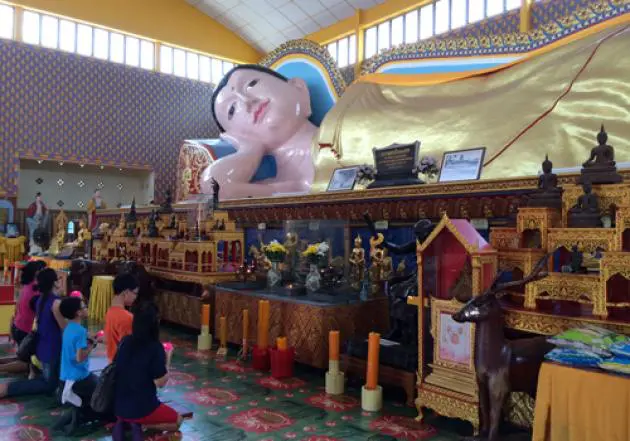
Most Thais visiting Penang in Malaysia visit Wat Chayamangkalaram to see its 35-metre-long Reclining Buddha. Their Majesties the King and Queen were there to honour it in 1962, just four years after it was erected.
Nearby is another place of interest for Thais, Kampung Siam, the island’s only “Siamese village”, a community of 30 families occupying 15 houses and 10 shophouses.
If the name rings a recent bell, it’s probably because the residents have learned that the land on which they live has been sold and they have to clear out to make room for a hotel.
Five Star Heritage, the property developer, issued eviction notices in April and offered compensation of 30,000 ringgits (Bt297,000) per family.
But the residents – several of whom speak Thai – are refusing to move. Some of the families have been there for generations. Britain’s Queen Victoria bequeathed them the land nearly 170 years ago, when Malaya was solidly a British colony.
The developer has sought a court eviction order. Meanwhile the residents have erected signs on the community’s perimeter calling for public support.
It’s all been quite a shock for 91-year-old Wandee Arunratana, who was born in Kampung Siam. His father, a practitioner of traditional medicine, moved there from Songkhla prior to Malaya gaining its independence in 1957.
Wandee was recognised in 2007 as a grandmaster of the menora, the northern Malay-southern Thai folk dance, by Penang Heritage Trust, as an embodiment of Penang’s “living heritage” kept alive in part by the local Siamese.
Wandee lives with his five children under one roof. “I was astonished,” he says of the eviction order. “Suddenly they asked us to move within a month, for no reason. Where will I go? This is my only home!”
Another resident, 31-year-old factory engineer Boonma Sararaks, who has a family of six, says his great-grandfather moved from Bangkok to Penang prior to 1900. “We feel it’s not fair,” he says of the eviction. “We have the right to stay. We feel this land should not be used for commercial purposes, but it’s been transferred to a private firm.”
Boonma emphasises the community’s unique nature as the island’s sole Siamese settlement and says it should be conserved as a “living heritage”. Failing that, he says, the state government must provide them with low-cost housing, since property prices are high.
They have no title deeds or rental contracts, but instead, Wandee and Boonma’s evocation of their “right” to stay is based on the Grant No 2655 issued by the East India Co on behalf of Queen Victoria on May 30, 1845. It gave the land to two Burmese and two Siamese trustees elected by their communities.
The 1845 grant prohibits trustees from dispensing with any of the land bestowed “for the benefit of the Burmese and Siamese Community of Prince of Wales Island”, as Penang was then known.
But, as Yap Soo Huey, who represents the George Town suburb of Pulau Tikus in the state assembly and has sided with the residents, explains, the matter has grown complicated.
The land has been subdivided twice in a series of court proceedings, she says. The status quo as of 1994 was that the Siamese trustees were managing Lot 2102, covering 12,397 square metres and including Wat Chayamangkalaram, and the Burmese trustees were in control of Lot 2013, comprising 5,459 square metres. Lot 2013 was later split in two – Lot 10030 of 2,778sqm and Lot 10029 of 2,681sqm. The latter was Kampung Siam.
In April 2011, Yap says, the Burmese trustees entered a joint venture with Airmas Development to incorporate Five Star Heritage, and hotel plan was unveiled for Lot 10029, with the land transferred to Five Star. “Airmas Development has 200,000 shares in Five Star Heritage while each Burmese trustee holds only 25,000 shares,” Yap points out.
Because it will take a long time for the federal government to declare the village a heritage zone, as the residents have requested, they are seeking “appropriate” compensation in case they lose a court battle resuming mid November, in which they are challenging the legitimacy of the land transfer.
Thai dignitaries and even members of the royal family have lived in Pulau Tikus, Yap says, so its connection is deep. Prince Damrong Rajanubhap stayed near Kampung Siam from 1933 to 1942, and the first Thai prime minister, Phraya Manopakorn, lived there until his death in 1948.
Yap calls the community a vital link in Malaysia’s shared social and cultural history with Thailand and a part of the rich heritage and identity of Pulau Tikus. “It will be a great loss if the Siamese community that has existed for two centuries is forced to disperse and their culture wiped out from this land,” she says.
She has launched a petition at Change.org (http://tinyurl.com/p7c4sa4) that has thus far garnered almost 200 signatures, added to 500 more gathered in person, with the goal at least 1,000. “People in Thailand should voice their concern and support us in convincing the trustees that eviction is not the way to go,” Yap says.
