
Shattered Adam stands tall


Play
The 15th-century marble statue by Italian master Tullio Lombardo has been painstakingly put together after shattering to pieces in 2002
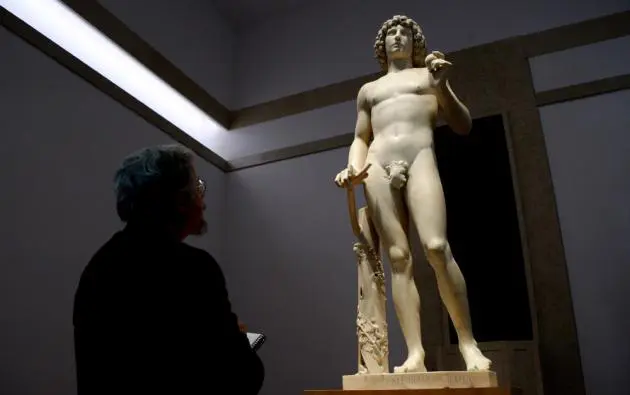
Tullio Lombardo’s 15th-century marble sculpture of Adam considering the temptation of an apple in his hand is on display again in New York after it fell and shattered in 2002. The Metropolitan Museum of Art used ground-breaking technology to reconstruct the figure.
Adam fell on the evening of October 6, 2002 – not in the Garden of Eden but in the Metropolitan Museum of Art.
The 15th-century marble sculpture by Italian master Tullio Lombardo shattered after its supporting pedestal buckled.
Last Tuesday, the statue of a somewhat uncertain Adam contemplating the apple, shows the culmination of 12 long years of painstaking reconstruction.
The sculpture has been a part of the Met’s permanent collection since 1936 – one of the “most important works of art from Renaissance Venice to be found outside that city today”, the museum says.
It broke into 28 large and hundreds of small pieces in what museum officials said in a “tragic accident” on a Sunday evening in 2002, not long after the museum had closed for the day.
Security staff came upon the shards and alerted the museum’s staff. After assessing the damage, they decided to undertake the almost unprecedented project of restoring the artwork to its original beauty.
“It was institutional priority to do everything possible to bring it back,” says Peter Jonathan Bell, assistant curator for the Met's Department of European Sculpture and Decorative Arts.
The project used the latest technology and broke new ground in arts preservation, the museum says.
Conservators worked with scientists and engineers to reconstruct the piece, starting with a three-dimensional laser scan of the larger fragments.
Once the main strains and breaks were mapped out, conservators developed new methods to use as few pins as possible. They tracked down the thinnest adhesive that could hold the pieces together.
In the end, only three fibreglass rods were used to pin the statue together in a process that entailed building an armature to hold the pieces together until the adhesive solidified.
“We can now consider the sculpture as the artist intended it to be seen as a fully unified form,” Bell says. “I’m very happy to bring it back to the public after such a long absence.”
The unveiling of the restored statue kicks off a new permanent gallery for Venetian and northern Italian sculpture, the museum says.
A video detailing the reconstruction process accompanies the piece, which has its own display room at the Met.
A scholarly analysis of the restoration project will also be published in the Metropolitan Museum Journal to advance research in conservation methods.
