
A history of heritage


Play
China's Hunan province sets out to draw more Thai visitors by holding a promotional event in Bangkok
One of the world's earliest civilisations with a history that dates back more than 5,000 years, China is today drawing more than 130 million visitors every year,
Thai tourists tend to be drawn more to the major urban sprawls of Beijing or Shanghai than, say, the tombs of the terra cotta warriors in Xian or provinces teaming with ancient history like Hunan,
Located in south-central China, Hunan’s heritage continues to thrive and its people are fiercely proud of such places as Yuelu Academy, which was founded more than a millennium ago and is still part of Hunan University’s campus.
Sadly though, Thai visitors mostly give it a miss, heading instead to Zhangjiaje and Wulingyuan Scenic Area, home to the quartz sandstone stick-peaks that have acquired film star quality since appearing in James Cameron’s hit movie “Avatar.”
The province’s most famous son is Mao Zedong, who was born to a farming family in Shaoshan. His home, his favourite places and even his favourite food are all promoted here and draw millions of visitors, though few Thais, every year.
Now the Hunan provincial People’s government is setting out to tempt more Thais to enjoy its culture by bringing in some 1,500 cultural products to showcase at the “Hunan Culture Going into Thailand” event taking place this weekend.
As a prelude to the exhibition, the Hunan government recently invited the Thai media to explore the province’s cultural heritage. Stops included several of the better known tourist attractions but also the Yuelu Academy and the Hunan Embroidery Research Institute. Interviews were also arranged with the artists who will be in Bangkok for the event.
The upcoming cultural showcase includes demonstrations of Hunan embroidery, five-colour porcelain painting and lessons on how to select black tea, one of the province’s most famous products
On Sunday at 2pm, respected author Tang Haoming, will give a talk about Zeng Guofan, an eminent Han official, military general, and devout Confucian scholar.
Tang, who serves as the president of the Hunan Writers Association, is the author of a trilogy about Zeng Guofan, which recounts in novel form the warrior’s life during and after the Taiping Rebellion.
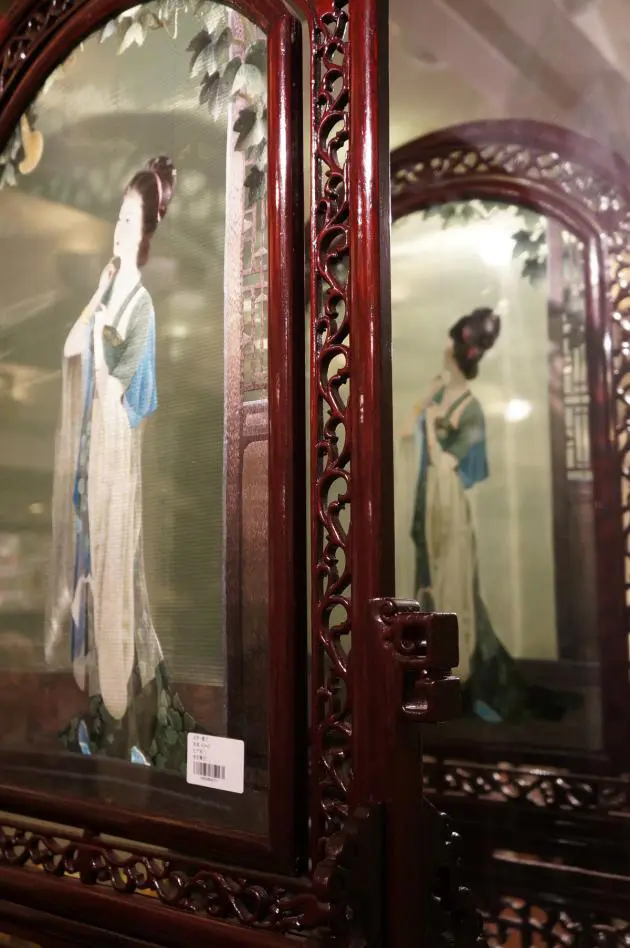
Hunan embroidery – or Xiang Xiu as it is more commonly known – is one of the four great embroidery styles of China, the others being Suzhou embroidery (Su Xiu), Guangdong embroidery (Yue Xiu) and Sichuan embroidery (Shu Xiu).
Xiang embroidery originated in the Chu Kingdom around the third century BC. The embroidery research institute in the provincial capital of Changsha is home to a stunning showcase of works both old and new that clearly depicts the evolution of the art, with many modern works so perfect in their detail that they could be mistaken for photographs.
Using transparent chiffon silk, the needle techniques give the images, many of them of birds and animals against a glorious landscape, a three-dimensional effect. Embroidery artist Li Yan, who is the director of the institute, has selected some valuable works for the Bangkok show and his artists will be demonstrating the delicate technique to Thai people as well.
Also coming to Bangkok are 35 pieces of Liling five-hue underglaze porcelains from Liling city and the famed Fuzhuan tea or Fu tea. Zhuan means brick in Chinese and the tea gets it name from the technique that sees it processed and compressed into brick form. The black tea has a delicate and mild woody scent and the longer it is kept, the better the taste. After harvesting, the tea is pressed into bricks and left to ferment and the fungi develop spores called golden flower (jin hua). It is this that gives Fu tea its distinctive taste.
With a population of 72 million, Hunan has long been home to several ethnic groups including the Tujia, Miao and Yao. Miao and Yao are known to Thais as the Hmong and Yao, hilltribe people who migrated from China and settled in the north of Thailand. Perhaps understandably, their culture is much more developed in their home and they will be bringing selected ethnic performances to Bangkok.
The Hunan Culture Going into Thailand event is an attempt to raise the number of Thai tourists and convince them to spend time not just at Zhangjiajie but in other parts of the province. Recently released figures show that some 150,000 Thai tourists headed to Zhangjiajie last year but only 16,000 Thai tourists spent time elsewhere in Hunan. Thailand, however, drew more than 160,000 tourists from Hunan.-
