
Revival of another kabuki
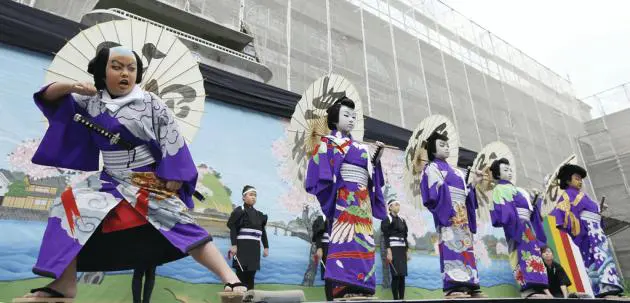


Play
Ko-shibai, rarely seen since World War II, is making a tentative comeback
Avant-garde dancing by Izumo no Okuni was cheered by many people in Kyoto a little more than 400 years ago, a performance that later developed into kabuki. Historically, kabuki has two lines – one of them is better known and still thriving, and the other, though having once declined, just now reviving.
The first line, called o-kabuki (large kabuki), is today’s mainstream style. It was performed under the Tokugawa shogunate’s approval during the Edo period (1603-1867).
The other line, ko-shibai (small theatre performance), was performed for the common people. While o-kabuki was always monitored by the authorities and sometimes banned, ko-shibai was developed at places other than officially licensed theatres.
Although ko-shibai declined after World War II, a group of performers is aiming to revive it by giving a performance designed for the general public to casually enjoy.
“Ground Kabuki” was on view at the Kureha-za theatre at the Museum Meiji-Mura, an open-air architectural museum and theme park in Inuyama, Aichi Prefecture.
The performances, which ended on November 26, featured Makoto Matsui, 54, a popular actor who had played in taishu engeki, a genre of stage performance for the general public, and performers trained at the kabuki actors’ course at the National Theatre.
The event was planned by Genichi Takeshiba, 61, a kabuki scriptwriter. Takeshiba regularly held a kabuki study programme in the 1980s for people interested. Takeshiba invited actors who used to perform on the ko-shibai stage as guests, researched the genre with participants, and performed pieces that were rarely staged in o-kabuki at that time, such as “Yasaku no Kamabara” (“Sickle Suicide by Yasaku”).
Takeshiba started staging kabuki some time ago with actors who trained at the National Theatre. Starting from the ongoing performance, he began using the name Ground Kabuki. The most important factor for actors to perform in the show is the enthusiasm toward kabuki, rather than coming from families with a kabuki background or even being men, unlike o-kabuki. An audition was also held to find promising performers.
The show had two segments. Programme A highlighted “Okyo no Yurei” (“Ghost Image Painted by Okyo”), which was written by Takeshiba based on a rakugo story. For Programme B, “Amma to Dorobo” (“Masseur and Thief”), a TV drama written by Genzo Murakami, was staged. Each programme consisted of four plays.
In the past, “Okyo no Yurei” was performed by Sawamura Sojuro IX while “Amma to Dorobo” was performed by Nakamura Kanzaburo XVII, both master actors of o-kabuki. Takeshiba directed the actors in the latest show using such past performances as references.
Coinciding with his appearance in Ground Kabuki, Matsui began using Hakata-ya as his stage family name, based on Hakata in Fukuoka Prefecture, where he comes from.
Actors of o-kabuki traditionally have a stage family name. Veteran spectators call their names when they strike a swaggering pose or at other highlights of their performance.
“Our kabuki has no rules for appreciation,” Matsui said prior to the performance. “I welcome anyone calling my stage name at any time during my performance, by shouting ‘Hakata-ya!’”
He was born at a theatre for taishu engeki in Omuta, Fukuoka Prefecture. His parents were taishu engeki actors. He also began performing and became a star actor of his mother’s company. When he was 25, he moved to Tokyo to form his own troupe. When he was about 40, he began performing leading roles at such major theatres as the Chunichi in Nagoya, Meijiza in Tokyo and Shinkabukiza in Osaka.
He accepted the offer to perform in Ground Kabuki because he “wanted to make the event exciting with actors trained at the National Theatre and ordinary young people who enthusiastically love kabuki”.
After rehearsals began in late August, he learned how to speak his lines in the characteristic kabuki style. He also learned typical kabuki movements one by one from Kikuzuki Kichiju, a co-performer who used to perform in o-kabuki under the stage name Bando Mitsuemon.
“I’m aware the world [of kabuki] has been built up meticulously. I keenly feel the gravity of kabuki’s 400 years of history.”
After he decided to perform in the show, he recalled his grandfather in Fukuoka Prefecture, who used to perform kabuki under the name Arashi Somegoro.
“When I was seven or eight he performed the role of Ishikawa Goemon [a Japanese outlaw hero in the 16th century] for 10 consecutive days,” Matsui said. It was the time when kabuki for ordinary people was still alive. “When I’m rehearsing, something in my blood starts to stir.”
He is gradually remembering the applause for his grandfather he heard when he was small.
