
A long and winding road


Play
The best way to see Hiroshima prefecture is on two wheels, following the built cycling route from Honshu to the island of Shikoku
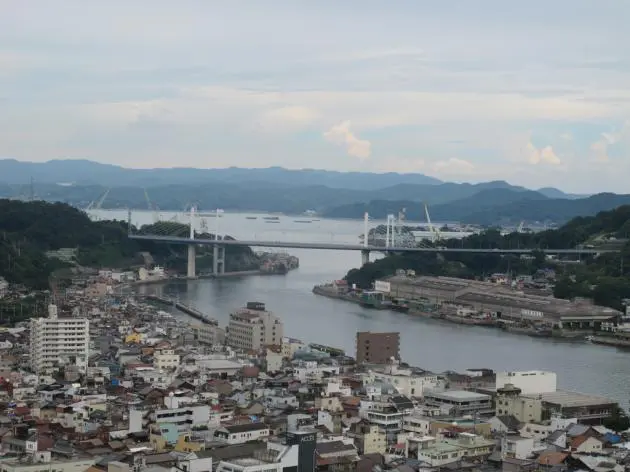
Cycling has long been a popular way of experiencing the Shimanami Kaido, a 70 kilometrelong purposebuilt route that connects Japan’s main island of Honshu to the island of Shikoku, passing over six small islands in the Seto Inland Sea on seven majestic bridges.
The journey takes you from Onomichi City on the coast of Honshu, about an hour and 20 minutes by local train from Hiroshima Station, to Imabari City in Ehime Prefecture on the island of Shikoku. An excellent example of green travel that other countries would do well to emulate, it’s designed with the cyclist in mind and with a series of trails and ramps mostly separating from bike lane from the road and offers sublime scenery of ocean views all along its path.
I had never cycled overseas before and so decided against taking my bike on the plane. Renting one was easy and surprisingly cheap, with the Municipal Parking Garage behind the Green Hill Hotel offering the very reasonable rental fee of 500 yen (Bt140) per day for adults including a helmet (children pay 300 yen per day). Electrically assisted bicycles are also available at 800 yen and cyclists need only put down a 1,000 yen deposit and leave a photocopy of their passport.
And you don’t even have to return to base to return the bike, as you can leave it at any one of the 14 cycle rental terminals along the way, though you don’t get your deposit back. I chose to forego the 1,000 yen and leave my rental at Imabari figuring it was too late in the day to ride back.
I’d wanted to stay at Green Hill Hotel but it was already full. The adjacent Hotel Cycle is much more expensive so I settled for a room in Fukuyama and spent an hour travelling by train to Onomichi Station. It was a mistake as it meant rising before 5 to be able to pick up the bike at 7.
Comfortably seated in the saddle, I pedalled along the waterfront pathway and boarded the ferry for the fourminute ride to Mukaishima. There I met a group of Japanese cyclists who were also consulting the signboard to ensure they had the directions right.
Setting off parallel with the coast and travelling through rural towns and fields of crops, it wasn’t long before I reached Innoshima Bridge, a suspension bridge 1,339metres long. Here the bike path is one level below the road and while safe, the vibrations from the traffic can be a little unnerving.
The traffic thickened as I entered Innoshima Island, which is home to several shipyards and warehouses. Although there are temples to see here, I continued on to Ikuchijima Bridge, a 790metre cablestayed bridge. Personally, I found Ikuchijima the prettiest island of the six and was happy to take a break in Setoda town and visit the Ikuo Hirayama Museum of Art, which is dedicated to its namesake, one of Japan’s most famous painters. I also stopped at Kosanji Temple, which was built by a rich businessman for his mother.
I was impressed not just by Ikuchijima’s protected bicycle lanes but also by Japan’s impeccable infrastructure. Cycling lanes are either separate from the roads or partitioned off by a blue line. Signs and maps are everywhere and the ramps leading up to the bridges have been built with small inclines with cyclists in mind. Separate cycling roads wind their way uphill to the bridge entrances and the toll fees have been kept low, ranging from 50 yen to 200 yen. Vending machines for drinks and restrooms are also plentiful.
Bidding farewell to Ikuchijima, I rode across Tatara Bridge, one of the world’s longest cablestayed bridges with elegant 220 metre-high steel towers that represent the folded wings of a crane, towards Omishima Island. Here I stopped at the Oyamazumijinja Shrine, which is dedicated to the gods who protect sailors and soldiers and houses the largest museum of swords, armour, and other military equipment from the age of the samurai. The island is also home to an attractive street painting of the cablestayed bridge and dolphins.
Crossing the 328metre Ohmishima Arch Bridge and across HakataOhshima Bridge, a 1,196metre suspended bridge, I pedalled on to Ohshima’s famed Kirosan Observatory Park which affords a grand view of the KurushimaKaikyo Strait Bridge, at 4.015metres the world's longest suspension bridge structure. I cycled down from the park to cross the fastmoving KurushimaKaikyo Strait and was gratified to see that it too offered a gentle incline that stays at or below a 3percent grade with loops gradually circling up.
Rubbing my thighs, which were badly cramped due to the hot afternoon sun, I allowed myself to be persuaded by an elderly Japanese woman to take a break and relax at her home.
Before long the cramps disappeared and I was off again, crossing the bridge and ending my journey at Imabari city on the island of Shikoku.
