
Milking the earth


Play
Why soy milk is being promoted as a healthy addition to our diets
Leading Swedish packaging company Tetra Pak is setting out to help the public stay healthy and look younger with a campaign that aims to encourage us to drink a carton of calcium- and vitamin-rich UHT soy milk every day.
The “Soy So Young” campaign is now in its third year and a recent market survey has revealed that Thailand now is the second biggest market for UHT soy milk after China and that consumption is growing in Vietnam, America and Japan.
For more than 5,000 years, the soya bean has been a main ingredient in Chinese cuisine, and the US Federal Drug Administration claims a daily intake of 25 grams of soy protein can help reduce the risk of heart disease.
Besides, soy protein is easily digested, cholesterol-free and low in fat, so it’s ideal for people on a diet. Good for both the skin and bones, it also contains the antioxidant isoflavone, which helps reduce ageing and promotes absorption of calcium, vitamins, and phytoestrogens to maintain bone mineral density and reduce the risk of osteoporosis.
To further drive the point that soy milk is good for us, Tetra Pak recently flew a group of Thai reporters to Singapore to tour its Soya Knowledge Centre and learn how advanced packaging technologies can help maintain soy-milk’s nutritive qualities.
“Our campaign aims to build a good perception of soy milk in UHT cartons, especially the advantage of Tetra Pak’s packaging that tightly seals the beverage in a six-layered carton. Thanks to aseptic packaging and processing technology, we guarantee food safety and that all the nutritional benefits of soy milk are completely protected,” communications director Gloyta Nathalang explains.
Dr Ruben Rausing established Tetra Pak in the early 1950s and created the first model of a plastic-coated paper carton to preserve dairy milk. Today the company supplies carton designs to many leading brands in more than 170 countries and provides integrated processing packaging for global food production.
The company has built Process Development Centres in the US, Brazil, Sweden, China, Japan and India, which are charged with researching food, beverage and UHT technology in different fields including prepared goods, bubble tea and sago.
The Jurong site was established in 1985 and expanded to a coconut learning centre in 2011 with a focus on functional product trials to extract soy milk, coconut and tea and ensure all nutrients remain during and after UHT process.
The company uses only wood fibre from sustainably managed forest plantations certified by the World Wildlife Fund for Nature and Forest Stewardship Council.
Tetra Pak’s six-layer carton features 75-per-cent recycled paperboard, 20-per-cent polyethylene and 5- per-cent aluminium foil, three materials that provide stability and strength and protect against oxygen, light and bacteria.
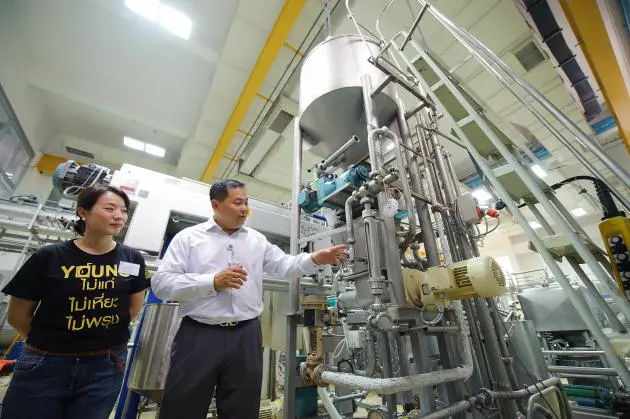
The centre also boasts the very latest in high-tech sterilisation systems and packaging machines.
We’re taken to see the soya extraction zone where the beans are ground and sorted as well as the mixing room where new flavours are created and tested.
Then it’s on to the UHT unit, where the soy beans are sterilised at 135 degrees Celsius for four seconds before being packaged in a process that preserves nutrients and shelf-life without refrigeration.
“Soy beans have different levels of protein and different colours depending on the customer’s preferred formula. We use hot water to control the enzymes in soy beans for the low beany flavour of soy milk that sells very well in Thailand, North America, Russia, Japan, Korea, Europe and Australia. China, Taiwan and Hong Kong prefer a stronger beany taste. Soya can be blended with tea, coffee, brown sugar, almond, sesame, chocolate, coconut, hazelnuts and pudding and all these products are available in Korea and Japan.” says Kitmun Lai, director of the Process Development Centre and Soya Knowledge Centre in Singapore.
We also have the chance to sample some of the 30 flavours that Lai tells us are the best-sellers around the world. They include Hershey’s mocha flavoured soya milk from Malaysia, Alpo soya mixed berry from Spain, pudding soya from Japan, silk vanilla and banana creme soya milk from the US and while they are all very different, they taste great – so great that it’s hard to pick the nicest.
