
A performance like no other


Play
More than three decades after its premiere, Jan Fabre's seminal work remains groundbreaking because of its interdisciplinary nature
Having watched some stage works by Belgian artist Jan Fabre, both live and on DVD, I wasn’t really surprised to find that his recreation of “C’est du theatre comme c’etait a esperer et a prevoir” (“This is theatre like it was to be expected and foreseen”), which premiered in 1982, would last eight hours without any intervals.
Knowing how challenging such a long work would be, I suggested to my two colleagues at the 16th Lyon Biennale de la danse, an Israeli and a Japanese critic, that we should take part in a kind of Olympic marathon. When the performance concluded just under eight hours later to a standing ovation and I could only congratulate my Israeli pal on winning the gold medal in our private Olympics for sitting through the whole thing with just one toilet break. The silver went to the Japanese critic, who, like myself, had two toilet breaks but unlike me, returned to the auditorium immediately after rather than take time out for a snack. After getting my bronze medal, they told me I had missed a few highlights.
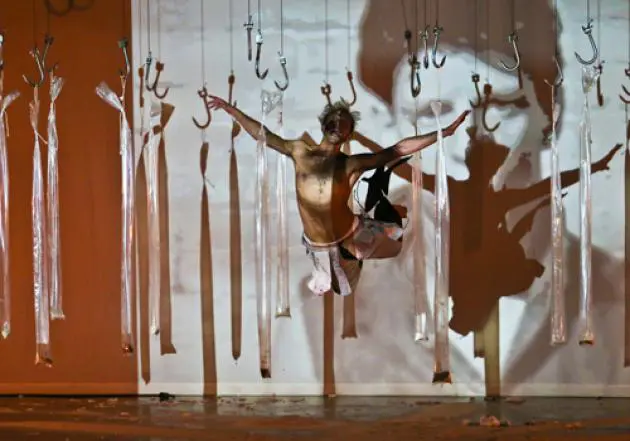
On a stage filled with set props like lamp stands and meat hooks hung from the ceiling, nine performers from Troubleyn company tirelessly repeated one another’s lines and actions. These included a hilarious competition between two of them to see who could undress and dress the faster. Although the degree of repetition was so high that members of the audience might have felt that they could foresee what would happen next, the opposite was true.
Thanks to the performers’ sheer energy and keenly choreographed actions, my eyes were glued to the stage actions, and before I knew it, almost three hours had passed when I glanced at my watch and took my first unofficial break. After each break, I was able to get back into the flow of the work quickly and easily.
In the end, notwithstanding the work’s wildly outlandish nature, which made licking yoghurt off the floor and full frontal nudity seem quite ordinary, the experience was like watching life in its truest form. The audience was reminded again and again that what we watch in other stage and screen works is merely life that has been dramatically edited, doctored or manipulated. Intriguingly, while it seemed that Fabre had put a lot into this work, there was also more than enough space for each individual audience member to take away from it.
Fabre is one of a handful of artists whose visual arts and stage works are equally, and highly, acclaimed, and that’s one strong direction of contemporary arts – unfortunately, not yet promoted in our country – that reflects both the relationship between various arts and also how they can work together. When artists cross boundaries, so do their audiences.
The writer’s trip was supported by the French Embassy, ONDA and the Biennale’s press office. Appreciation goes to Benoit Etienne, Rachel Spengler and Laura Lamboglia.
MARATHON RUNNING
Jan Fabre’s next monumental work is the 24-hour performance “Mount Olympus”, premiering this summer. For details, see www.JanFabre.be.
