
A resemblance among royals
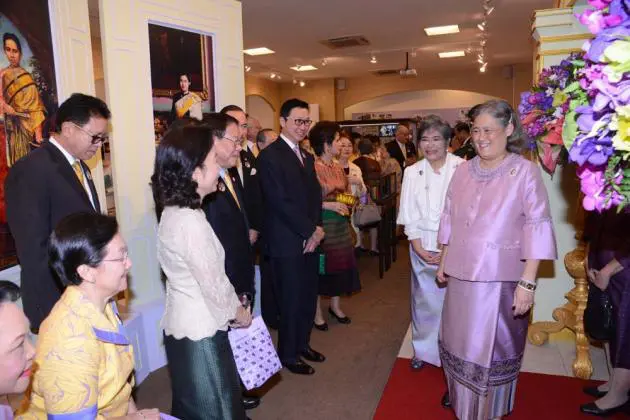


HRH Princess Maha Chakri Sirindhorn has much in common with Queen Savang Vadhana, her great grandmother
THE QUEEN SAVANg Vadhana Foundation is honouring Her Royal Highness Princess Maha Chakri Sirindhorn ahead of her birthday on April 2 with an exhibition that compares her work on behalf of the country to that of her great-grandmother, Queen Savang Vadhana, consort to King Chulalongkorn (Rama V).
Continuing through April, “Srisavarintira’s Royal Duties, Sirindhorn’s Pinij Royal Duties” is the latest in a series of annual exhibitions held at the Queen Savang Vadhana Museum at Srapathum Palace since its opening in 2008.
There is also a permanent exhibition in the Phra Tamnak Yai building at the palace, which is a central historical site for the Chakri Dynasty as the official residence of the Mahidol family. Princess Sirindhorn continues to live at Srapathum Palace as well.
The temporary exhibition is divided into two parts. The first is a charming biographical profile of Princess Sirindhorn, with many photos, including images of Their Majesties the King and Queen holding their second-eldest daughter and third child.
You can trace her education through photo essays and view some of her personal belongings, right down to the writing pens she’d insist on using until the ink ran dry. On view are tape cassettes and a player she used to catch up on school lessons missed while she was travelling upcountry with the King and Queen. Even her battered old schoolbag is there, a khun hiew, and her aomsin, a coin bank. The displays also cover her interest in music, photography and crafts.
Kanpirom Kangsanan of the foundation says the more she studies Queen Savang and Princess Sirindhorn, the more overwhelmed she is with appreciation. Kanpirom hopes visitors will similarly admire the character virtues that both women share. “Children should be grateful sons and daughters and good students for their teacher. When they grow up and get jobs, they should behave and take care of themselves, their families, their community and their nation.
“Queen Savang and Princess Sirindhorn are the two greatest personalities when it comes to loving kindness toward humanity. Their royal projects are primarily for the wellbeing of the people. They persevere and are patient as they strive for a successful outcome, whether in education or health issues. They never expect anything in return, only that the students they help will do good for the nation. And yet sometime their generosity goes beyond the border, into neighbouring countries,” Kanpirom says.
“Both strongly believe that people’s wellbeing has to be based on a good education and good health, and that, when there is suffering, everybody is a friend in need.”
The second part of the exhibition focuses on the royal projects in education, public health and culture. You learn about Princess Sirindhorn’s initiative to open learning centres in the northern mountains, as well as the Border Police schools and dhammongkol schools.
Queen Savang founded the Thai Red Cross Society and Princess Sirindhorn has been its chairperson for nearly 40 years. There is Queen Savang Vadhana Memorial Hospital, currently under renovation and seeking funds to purchase medical equipment.
Thailand’s cultural heritage, and its craftsmanship in particular, have been of enduring interest to both women. On display is an album in a delicately embroidered cover of photos of old Siam, which Queen Savang Vadhana presented at the Columbia Exposition in New York decades ago.
Phra Tamnak Yai was Queen Savang’s residence from 1916 until her death in 1955. The permanent exhibition there is arranged around its three rooms corresponding to the palace’s development over the years.
During “The First Period”, His Royal Highness Prince Mahidol of Songkkla, the Prince Father, returned to Siam after completing his studies abroad, and here, on September 10, 1920, he married Sangwan Talaphat, who would become Her Royal Highness Princess Sri Nagarindra, the Princess Mother. His Majesty King Vajiravudh (Rama VI) presided at the wedding and ritually poured blessed water from a conch on the royal couple hands.
In “The Second Period”, Prince Mahidol and Princess Sri Nagarindra raised a daughter, Her Royal Highness Princess Galyani Vadhana, and, in “The Third Period” the family became complete with the addition of the two sons, the future kings Ananda Mahidol and Bhumibol Adulyadej.
On the wide balcony adjoining her bedchamber Queen Savang spent her time reading and taking her meals. And here, on the open-air terrace, too frail to attend the wedding of King Bhumibol Adulyadej and Queen Sirikit, she bestowed her formal blessings on the royal couple.
Another moving display is a carrying pole with its balanced pair of baskets, as used by Chinese street hawkers. They regularly passed by the palace, calling out what wares they had to sell, and Queen Savang Vadhana often invited them onto the grounds to see what she might buy for her grandchildren.
CALL IN ADVANCE
-The Queen Savang Vadhana Museum is open weekdays from 10am to 3pm. The entrance is near the Siam Kempinski Hotel.
- Admission is Bt150 (Bt50 for students).
- Advance reservations are required. Call (02) 252 1965-7. Attire must be appropriate (skirts for women, no black or white clothing, no sleeveless outfits and no shorts).
