
Kids behind the masks


Play
A small school sets out to conserve traditional wisdom
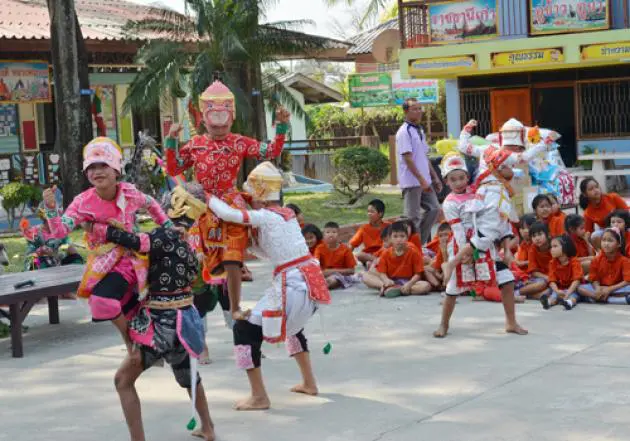
A small school in Ayutthaya’s Phachi district is putting a major effort into conserving traditional wisdom, especially the making of khon masks and conducting khon performances – art forms that are rapidly disappearing from modern society.
Wat Nongkruaboon School has 52 students from kindergarten to Pathom 6, and only three teachers.
Chuachan Soareok, who is acting director, says the school has included local wisdom in its curriculum.
Khon masks have been part of Ayutthaya society for a long time, and the school wants to conserve this local wisdom, she says.
The mask embraces spiritual and artistic values that derive from the belief of Thai society in Hindu gods and goddesses, as well as from the influence of the great “Ramayana” epic among Thais.
Since the early days of khon, this form of dramatic art was reserved only for the king and members of the royal family.
It was only in the 19th century that khon started to be more popular among commoners, especially when King Rama VI granted his full support to the development of arts in what was then the Kingdom of Siam.
The khonn mask was developed and evolved in |parallel with the performance itself.
The linkages between the performance and the mask are highlighted by the fact that the mask represents characters existing in the Thai “Ramayana”, including god, goddess, demon, divine ape and other animals.
According to the traditional tales, the creation of the classical dance earns the blessing of the god Shiva, who orders a hermit to be the master of the dance and to pass on this knowledge to all of humanity.
“We started the project around 2003 by bringing our students to learn the local wisdom with Uncle Sangvien Homklinkaew, 70, whose occupation was khon masks and performance,” says Chuachan, 60, who is due to retire in September.
Uncle Sangvien died about five years ago.
“We have taught seven or eight batches of students so far. Each batch contains about 10-15 youngsters,” adds the school director.
Students participating in the course are in Pathom 4 to 6, and they are able to produce about 30 masks per month, which sell from Bt350 for a Hanuman mask and up to Bt1,300 for a Tossakan mask.
“The making of small models of khon mask products allows our students to create their own earnings while studying, so that they can ease the financial burdens of their families.
Students can spend their free time, particularly during weekends, in more useful ways [by doing this]. They can promote personal skills, which can serve as a foundation for their occupations in the future,” Chuachan says.
Patra Khanthupat, 12, a Pathom 6 student at Wat Nongkruaboon School, started to make khon masks about three years ago.
“I’ve always been interested in art so I decided to join this school project. The making of khon masks is more than just an occupation for me as it allows me to earn some money. Although it’s not a lot, it does cover my spending on snacks,” she says.
Wipada Khiewwilai, 12, also a Pathom 6 student, started mask making when she was in Pathom 4.
“It was quite difficult at the beginning and I often felt discouraged,” she says. “But now with so much practise in this traditional art, I can make the masks and make enough money to buy snacks and |also save.”
