
The faith that brings fortune
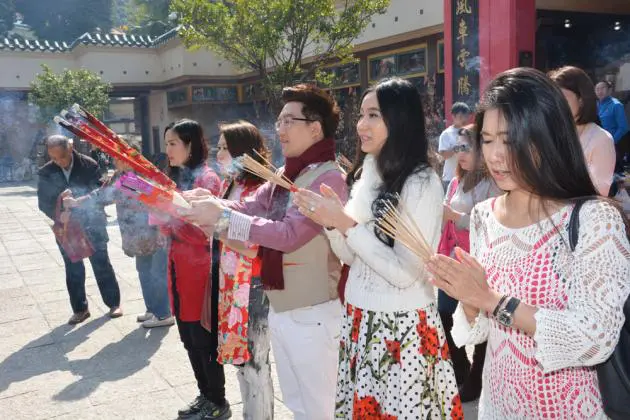


For the lunar New Year, the Mall Group taps into ancient Chinese beliefs
WITH THE LUNAR New Year rolling up a week from today and celebrations already starting to cackle like firecrackers, the thoughts of Chinese-Thais turn to the ancestral homeland, where tradition mingles Buddhist, Taoist and Confucian beliefs with localised practices.
Thailand’s Mall Group, gearing up for “The Mall Glorious Chinese New Year 2015”, flew a posse of reporters to Hong Kong last week to get the low-down on high expectations for the Year of the Goat, and specifically – since the four elements are important too – the Year of the Wood Goat.
We spent many hopefully auspicious hours among Tai Sua deities at the Huang Da Xian Temple and with a lucky windmill at the Che Kung Miu Temple. And we bagged for the return flight replicas of the god of love and marriage, Yue Lao, also known as “the Old Man from the Moon”.
It was clear from the start that the denizens of Hong Kong, apart from shopping ’til dropping and dining out unbelievably late, take their traditional beliefs very seriously indeed. A jeweller we visited pointed out that every decoration in every shop, every building in the city and every item in the home can be (ought to be) there to encourage good fortune. “You have to believe it in your heart,” Dickson Hau told us. “Otherwise it will be meaningless.”
But yes, he confirmed with a smile, “Chinese are very superstitious!”
Such is the depth of belief that developers reportedly pay out “feng shui compensation” if the buildings they put up adversely affect anyone living or doing business nearby. The authorities have spent millions of dollars realigning bridges and sorting out telephone lines after they were judged to be screwing up the neighbourhood feng shui.
A construction project on the edge of Victoria Harbour evidently destroyed the harmonious feng shui of several millionaires’ posh homes, sparking furious controversy. And you don’t mess with Victoria Harbour, where the natural visual harmonics of water and sky, stability and prosperity, are the stuff of geomancers’ dreams. Hong Kong itself boasts natural feng shui grace, its geographical position relative to the mainland creating a place where hopes come to fruition.
“Chinese take special care about everything they do,” explains famed fortune-teller Katha Chinabanchorn, “because they believe in the influence of the 12 animals of the zodiac signs. The influence varies depending on the year they were born – rat, ox, tiger, rabbit, dragon, snake, horse, goat, monkey, rooster, dog or pig. Each animal controls a year in a 12-year cycle. And each is associated with one of the five elements – gold, water, wood, fire or earth. Together these dictate our character and destiny.
“Most Chinese know these basics and can also make simple arrangements in the house to bring good luck, good health and prosperity. They pay respects to their Tai Sui deities and make sure they do nothing to offend them, and in this way they’re granted good luck and ward off bad luck.”
The intrigue is in the intricacy. There are 60 different iterations of Tai Sui, the heavenly generals, otherwise called the cycle gods. This year belongs to the 32nd Tai Sua – Ia Siang Tai Jiang Kung.
“If your zodiac sign is in conflict with it, fear and confusion result,” says Katha. “To avoid offending Tai Sui, people conduct a ritual on the first and 15th day of the lunar calendar to improve their health, luck, prosperity and family safety. If you were born in the year of the goat, ox, rat or dog, you’re in conflict with Tai Sui this year. If you’re pig, rabbit or horse, your luck is secure.”
Hong Kong’s 200-year-old Huang Da Xian Temple has a “secret room” where a sanctified statue of Tai Sui resides. The Mall Group has secured a replica from the temple, offering devotees in Bangkok a chance to appeal for the Old Man from the Moon’s blessings in love and marriage. In one hand he holds the book of love and in the other strings of red yarn. If you’re looking for love or security in a relationship, give him more yarn to hold. Valentine’s Day on Saturday would be a prime opportunity.
The famous Che Kung Miu Temple was built in honour of General Che Kung, a great military leader of olden times. The story goes that an epidemic broke out in Sha Tin and he directed that a windmill be erected to blow away the misfortune. It’s now at the temple. At Lunar New Year, says Katha, “even the Hong Kong governor and the richest people come here to spin the windmill to earn good luck”.
The windmill in more recent times has been endlessly replicated in a form that looks more like a table fan. Its four vanes represent spring, summer, autumn and winter, offering good fortune year round. Windmill jewellery charms are popular, the spinner held inside a locket. On any day where luck seems lacking, you just rap on the charm. The faster it spins, the more life will improve.
Beliefs begin as stories shared, and repeated sharing turns them into accepted legends, Katha remarks. “When more and more people are paying their respects, it becomes powerful energy and then widespread belief. And every belief makes people feel comfortable. A smooth life, good health and prosperity are all we wish for.”
Muang Thai Life Assurance, Bangkok Bank, Isuzu and Delta VIP picked up costs for the writer’s trip.
LIONS AND
DRAGONS
- You can pay homage to the Tai Sui deities in the MCC Hall on the fourth floor of The Mall Ngamwongwan from tomorrow through February 22.
- Final rounds in a Chinese lion-dance competition take place tomorrow through Sunday at The Mall Bangkae. You can watch lion dances in front of every branch from Monday through February 21.
- The Mall has also recreated Beijing’s Xian Men Market, complete with Shwen Gwe Te Peking duck, sugared fruit from Tang Hu Lu and Bao buns from Ko Pu Lee.
- Southeast Asia’s only performances of the Lotus Petal Dragon dance from China take place today at The Mall Bang Kapi and on Saturday at The Mall Bang Khae, at 2pm in both cases. The dragon and its seven attendant fairies are festooned with symbols of prosperity, power and justice, right down to the dragon’s 18 teeth – the numerals 1 and 8 adding up to the luckiest number of them all.
