
Chilling by the Chao Phraya


Play
A proposed development project aims to turn the Yannawa riverfront project into a public recreational space
THE WORLD’S urban population has increased more than fivefold in the last 60 years, going from 746 million in 1950 to 3.9 billion in 2014 according to official statistics. While the urbanisation rate in Asia over the same period has fluctuated widely, the continent is now home to 53 per cent of that urban population yet suffers from a lower level of urbanisation than anywhere else on the globe.
Like other major Asian cities, Bangkok is facing the challenge of urban sprawl. People move from rural areas to find work in the city but choose to live in the suburbs while residents of the inner city are also moving out in search of a better life. This migration pattern has led to more abandoned space in the inner-city area, extensive suburban infrastructure development, less agricultural space around the city, higher air pollution and, of course, more traffic jams.
But perhaps the degeneration can be halted if a proposed project sees the light of day.
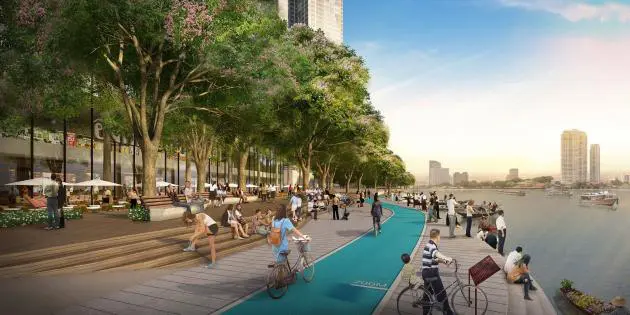
The Urban Design and Development Centre (UDDC), an agency under Chulalongkorn University’s architecture faculty, has spent the last three years researching, planning and designing the Yannawa Riverfront Project. This urban renewal prototype combines the development of recreational land with a flood prevention scheme along the Chao Phraya River so as to bring recreational activities to the inner-city area. With a good-quality bike lane and walkway, the project hopes to reduce the permanently clogged traffic on Charoen Krung Road, which runs a mere 200 metres from the waterfront.
Originally named the Saphan Pla Project – or the Bangkok Fishery Pier Project in English – the scheme was later renamed the Yannawa Riverfront to eliminate the ambiguity concerning the size of the project, of which the Bangkok Fishery Pier is only part.
The project stretches 1.2 kilometres from Taksin Bridge to Wat Yannawa, Wat Suthiwararam, the Bangkok Fishery Pier Organisation and the Bangkok Dock and takes in more than 100 privately owned-properties.
Working directly with stakeholders and city officials to brainstorm on the possibilities and limits, UDDC has held charrettes with different groups, among them businesses and professionals, residents, members of the private sector, government officers, and high school students.
“Of the whole of the river’s 72-kilometre path throughout Bangkok, this area is the most beautiful because the river bend here is magnificent. It is also an important landmark as it serves as the gateway to hospitals, business areas, parks and public transportation systems like Skytrain, buses and boats. This project will benefit the community and the economy,” says Vanchai Thanomsak, director of the Bangkok Metropolitan Administration’s City Planning Department.
“The government has long had a plan to build a cycle path along the river but they haven’t started anything. This project, on the other hand, has gone through every aspect of the development process, including public hearings. If this project could be built, then the government would understand that listening to the residents of the area and working together are key to success.”
Phra Phrom Vajirayarn, the abbot of Wat Yannawa, is also enthusiastic. “I am really happy to see this project and really hope it can be implemented in the near future. It would serve as the prototype for other urban development and it is good for the environment too.
“Many of us have travelled to other countries like Hong Kong, Singapore, South Korea and America. They have good waterfront public areas but our country doesn’t have any. The Yannawa Riverfront would be a historical project for Bangkok,” he adds.
Dr Niramon Kulsrisombat, director of the UDDC, points out that the riverfront areas in major cities were prime locations in the days when the waterways were the main routes of transportation. Their accessibility made them focal points for industrial activities but the areas were abandoned when railways and roads were introduced.
“Today many cities are turning these former industrial lands into spaces for recreation and learning,” she says.
“It is now or never for the Yannawa Riverfront Project if we are to regenerate the area. Everything is falling into place and the time is ripe to actually make this historical project come to life. If we let it go, we will never have a chance to revive it.
“Those living in the city have increasingly less space so public space is needed. Every major city tries to reunite the riverfront with the urban sprawl. It’s a timeless area that can bring together economic activities with leisure, recreation and transportation. Minato Mirai in Yokohama is very similar to Yannawa. For years it was the main industrial area but now it’s a cultural and art space where people gather and enjoy life.”
The UDDC’s field research reveals that while the waterfront from Krungthon Bridge to Krungthep Bridge is around 24 kilometres, the public can access a mere 3.5 kilometres of it and many residents have never given any thought to accessibility.
“The basic norm here is that each owner does whatever he/she wants. The owners of the land share no common vision as to how the area should or could be. The UDDC is a platform for them to start talking and sharing their visions concerning their community. The participation of local residents and other stakeholders since the very beginning has moved this project from words to paper and hopefully to the actual development of the recreational park. Our discussions show that the community has already set basic safety and maintenance plans for the area,” Niramon continues.
“The Yannawa Riverfront has the most potential for regeneration as more than 85 per cent of the area is owned by temples and government offices and they are more likely to focus on the public benefit. We have constantly exchanged information and concerns with all stakeholders so we understand their hopes and fears. This project is trying to set a model of cooperation between government, the private sector and private owners so the land can be developed for the benefit of the community and the public and do away with the need for expropriation,” Niramon explains.
Even the concerns raised initially by local residents appear to have been resolved.
“The community is concerned about their privacy and safety. Their backyards are next to the public area, and they won’t feel safe,” says Thawat Bamrungthammathorn, who lives a short distance from the waterfront project and often shows up when the design team calls for public hearings and discussion.
“But we have discussed these safety and privacy issues with the design team and they have resolved to plant gardens and put up tree fences to keep the households completely separate from the public area. It looks good and I think it will work.”
Economically, the community should also benefit as residents can set up small restaurants or refreshment stands to earn a little extra money.
Some, though, are doubtful that the project will ever get off the ground.
“It’s very challenging, too challenging perhaps. The waterfront project will need a lot of money, and the government doesn’t have much money,” says a 50-something woman who asks not to be named.
“Technically, it would be hard to re-landscape and beautify the community because it involves so many different parties. It really will make history if it happens though.”
Phra Phrom Vajirayarn refuses to be put off. “Reviving and regenerating the area is another way to pay respect to our country and our ancestors,” he says.
“We should be united in developing this area. Let’s all give it a good try.”
