
Rebuilding for the future


Play
Exhibitions in Kanazawa explore the highs and lows of Japanese architecture
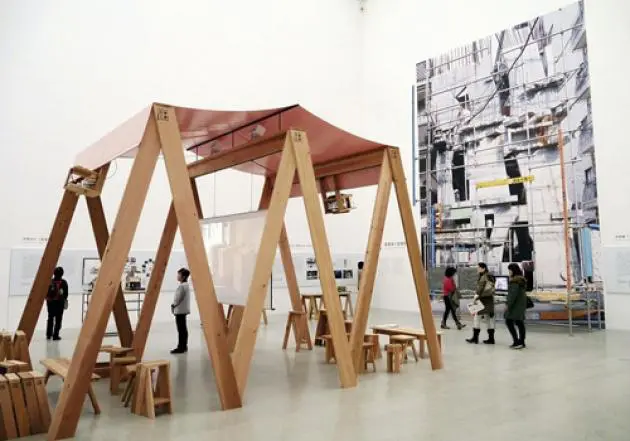
THE EXHIBITION “Japan Architects 1945-2010” at the 21st Century Museum of Contemporary Art in Kanazawa, offers a valuable opportunity to look back on the post-war history of Japanese architecture. And as it’s being concurrently with “Architecture since 3.11”, museum visitors will also be able to get an idea of where architecture is heading through the presentation of new trends since the 2011 Great East Japan Earthquake.
Co-organised with the Centre Pompidou in Paris, “Japan Architects 1945-2010” is a project of Frederic Migayrou, deputy director of the Musee National d’Art Moderne at the Centre Pompidou, which has been many years in the making. Migayrou also served as the exhibition’s designer.
The show starts with a darkened gallery displaying 48 pieces of rubble from now-defunct architectural structures, including Shirokiya department store that once stood in Tokyo’s Nihonbashi area. The store was destroyed in the Great Kanto Earthquake of 1923. It was then reconstructed, but part of the building was damaged again when a major fire broke out in 1932.
The gallery highlights an unusual tendency among Japanese cities and architectural structures: They have repeatedly experienced destruction and regeneration due to natural disaster, war or urban redevelopment.
The section is followed by more than 250 architectural drawings and miniature models by some 80 architects. The works trace the 65-year period from the start of the post-war era to 2010. Among the architects featured are Junzo Sakakura and Kenzo Tange, whose designs for public facilities aimed to express the ideals of democracy and reconstruction from the ruins of war.
In the 1960s, such architects as Masato Otaka, Kiyonori Kikutake, Kisho Kurokawa and Fumihiko Maki communicated their ideas for experimental cities and architecture to the world through the movement known as “Metabolism,” which grew out of a reaction to urban expansion and industrialisation. The movement reached its apogee at the 1970 Japan World Exposition in Osaka Prefecture.
After Tadao Ando, Toyoo Ito and others appeared on the scene in 1970s, Japanese architects won international acclaim thanks to their preference for geometric, minimalist residential architecture as well as transparent and light designs made with glass or metal.
The exhibition concludes with the introduction of works by SANAA (Kazuyo Sejima and Ryue Nishizawa), Kengo Kuma, Shigeru Ban and other more recent entrants in the field.
Some may object to Migayrou’s division of the 65-year period into six sections and coding of the each section’s concept in black, light grey and other colours. His assessment of architects may also invite differing opinions. Yet the vast amount of exhibition materials says a great deal about the diversity and originality of their works.
The fact that the Centre Pompidou has an unexpectedly huge collection of works related to Japanese architecture also comes as a surprise though it is in part explained by the fact that Japan’s National Archives of Modern Architecture opened only in 2013.
“Architecture since 3.11” is a show conceived by independent organisers from Japan. Under the supervision of architecture historian Taro Igarashi and community designer Ryo Yamazaki, it focuses on the works of 25 architects, architectural groups and offices. Architectural designs of public buildings and other works realised as part of reconstruction assistance or through dialogue with the public show a new role being played by architects.
GET GOING
“Japan Architects 1945-2010” runs until March 15 at the 21st Century Museum of Contemporary Art in Kanazawa, while “Architecture since 3.11” continues until May 10.
Find out more at www.Kanazawa21.jp.
