
Part way down a long road


Play
Four years after the devastation, many Japanese still live in temporary homes, but the spirit of survival is everywhere
ALMOST FOUR YEARS after being devastated by dual natural disasters, Japan is well down the road to recovery thanks to a combination of hard work, preparedness, dedication and human spirit. In the process, it has reaped invaluable experience that’s now being shared with the world.
The Tokyo-based Foreign Press Centre / Japan recently led members of the media visiting from overseas on a nine-day tour to witness first-hand the reconstruction efforts completed or continuing in several locations hard hit by the 2011 earthquake and tsunami and the radioactivity crisis they triggered.
Once the shock of the March 2011 catastrophe subsided, both local and international news media turned their attention to the details of the rebuilding. Post-survival themes have since dominated the coverage, with success stories and inspiring accounts continuing to appear to this day.
Preparedness paved the way. The Japanese, vulnerable to earthquakes for centuries, do not rely on luck when it comes to preparation for and mitigation of natural disasters.
They have learned to always be alert and ready for the sudden disruption of supplies and services.
A clear demonstration of this was seen at Kamaishi Higashi Junior High School in Kamaishi, Iwate Prefecture.
The students’ success in surviving the 2011 disaster made headlines around the globe. They knew in advance where to assemble in the event of an earthquake and drilled regularly with teachers, so hundreds of youngsters remained safe. A handful perished, but only those who left the designated safety areas afterwards in a bid to reach their homes.
On the economic side, Japan’s mainstay fishery and tourism industries have rebounded sufficiently to continue serving as long-term assets. At the Shizugawa branch of the Miyagi Prefecture Fisheries Cooperative Association, Fujio Abe and his fellow old hands in the trade told reporters of their love of the sea and explained how they’d developed new techniques in farming coho salmon to make the practice more profitable and sustainable.
Yasuragi House in Minamisanriku, Miyagi Prefecture, a cosy, traditional residence for fishermen, has a restaurant that serves fish and other produce fresh from the sea. Chieko Miura, who runs the place, said tourists coming to see the area wrecked by the tsunami have been a boon to local business since there are no actual tourist attractions in the vicinity.
Banya is now also used as the office of Oyamotoyoshi branch of Miyagi prefecture fishery cooperative as well as the community centre of the locals. A large number Banya were swept away by the waves all along the coast. The Nippon Foundation financed the reconstruction of many of them, and other organisations paid for new boats and fishing nets. Rebuilding the banya ended up as a low priority, however, because they’re not directly related to fishing, so those that survived or were rebuilt now often double as community centres.
Technological advances do much to aid Japan’s ability to forecast quakes and tsunamis and issue alerts, thus reducing the scale of injury and damage.
The Japan Meteorological Agency has steadily developed its equipment and warning systems covering the entire country, with many improvements made since the 2011 cataclysm.
The High Tide Management Centre watches for incoming tsunamis and can shut down watergates and pump out water to prevent Tokyo Bay from overflowing. The capital hasn’t sustained any tidal damage in decades.
Restoration has inevitably been an uphill task in many stricken areas along the coast. While the Japanese economy is robust enough to extend long-term financing to rebuilding projects, the scale of the undertaking is colossal and will take a long time to complete. This is evident in the town of Otsuchi in Iwate Prefecture, where project manager Mio Kamitani briefed reporters on the daunting effort.
Infrastructure alone will take years to restore, she said, and the filling-in of lost land surface at a colossal scale in a total vast swatch in all tsunami-hit areas will be just as long. Most of the money must come from the central government, but it the meantime it’s also budgeting for the 2020 Summer Olympics. Kamitani nevertheless remains hopeful that all goals will eventually be achieved.
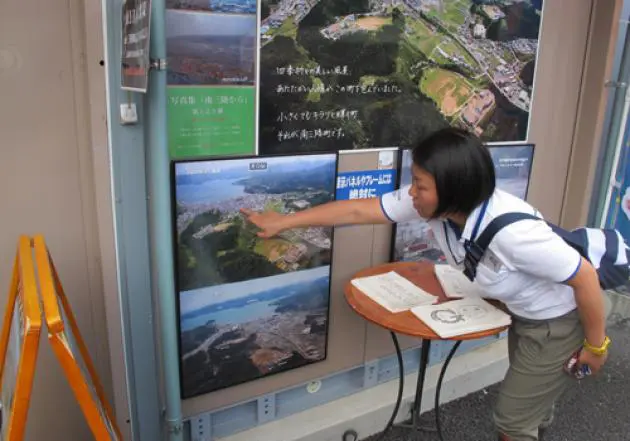
While the in-filling of the ravaged land continues, thousands of people in the areas hardest hit by the tsunami, like Minamisanriku, remain in temporary housing. For now there is simply no place to rebuild their homes, Sachie Saijo of the non-governmental Peace Winds Japan explained. She showed us a makeshift market and also Shizugawa Tokura Junior High school, which was moderately damaged in 2011.
Minamisanriku Mayor Jin Sato concurred with predictions of long-term restoration work and noted with gratitude that much of it is supported by donations from overseas.
In Sato, Saijo, Kamitani and Abe, the visiting media witnessed the same strong will to achieve their objectives – a firm determination to see through their duty, no matter how long it takes.
The Foreign Press Centre / Japan organised the travel and interviews for the media as part of its fellowship programme “Recovery from the Great East Japan Earthquake Sharing Tohoku Revitalisation Using Marine Resources with Asia”. Find out more about the centre at http://FPCJ.jp/en.
