
A puppet comes to life


Play
Beloved in old Ayutthaya, its mechanics now a mystery, the Hun Luang marionette returns to the stage
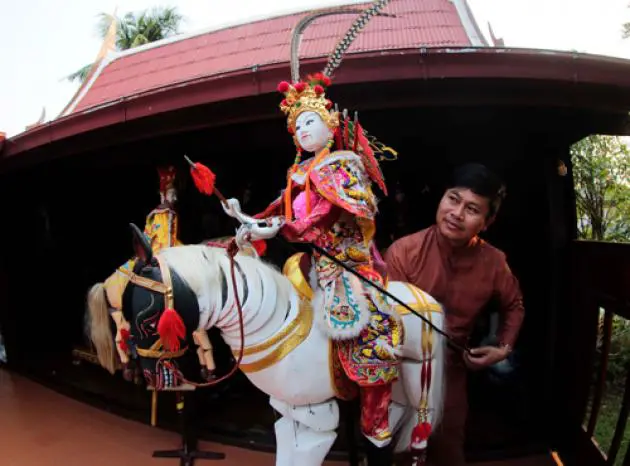
A “ROYAL” STRING puppet that has been out of circulation for more than 100 years has found a new lease on life thanks to Khru Surat Jongda, a leading figure in the field and a master of Thai dramatic arts.
Khru Kai, as he’s commonly known, briefly displayed the Hun Luang puppet to the public at the 2000 Wat Arun festival. The marionette performed the episode in the Ramakien in which the two sons of the King Rama learn to exercise their supra-natural powers with Hanuman, the monkey king. The lively retelling delighted the audience, Khru Kai recalls.
The Hun Luang returned to the public eye in November during the Bangkok World Puppet Carnival, this time appearing in a stage version of “Rajatiraj”, which narrates the victory of Mon General Saming Phra Ram over Chinese troops led by General Kamanee.
Thirty new Hun Luangs were made for the occasion, representing the two warriors, the soldiers and the horses.
“I chose this puppet because I knew it would make for lively scenes,” Khru Kai explains, adding that the audience also enjoyed the rhythmic poem and songs that were part of the production.
A lover of all things related to puppets, Khru Kai first took an interest while a student at the Dramatic Arts College of Bangkok, where he was inspired by the work of marionette master Chakrabhan Posayakrit.
He first had the idea of bringing the Hun Luang “back to life” after seeing examples of them at the National Museum. “You need to invest time and have the passion to revitalise a puppet,” he says.
Restoring the aged puppet was expensive, too, and Khru Kai is grateful to those who donated generously to this project. “There’s a need for continuity in developing this performing art, because it has to evolve with the rapidly changing world if it is to survive.”
Hun Luang is a large puppet whose popularity reached its zenith during the Ayutthaya Period. Interest waned during the reign of King Rama VI, and the marionette was “laid to rest” at the National Museum.
In 1992, through an initiative of the government’s Fine Arts Department, the long-lost Hun Luang slowly began to regain attention. Under the supervision of pioneering puppeteer Chakrabhan, a National Artist, the restoration continued, and was finally completed in 1997.
Production of new Hun Luang models began, thanks to students at the Poh Chang Academy of Arts, but because the mechanism is so complex and no instructions on their use could be found in the archives, they never made it back to the stage.
In fact, the only way the performance could be revived was if the entire mechanism were reinvented. “We were able to rely on the advice of experts – including Chakrabhan and Walapisara Sodprasert – and Chakrabhan’s books on the renovation of the Viceregal Puppets,” says Khru Kai, who’s 42.
The new string mechanism they concocted enabled the puppet to mimic movements in Thai classical dance, but for the most part they had to be simple and unsophisticated. The Hun Luang can only move its hands up and down, for example, and its head can only rotate 180 degrees, left or right.
Some of the new models can open their mouths, making them perfect for “speaking” roles, says Khru Kai. Each puppet has six strings that control all the movements.
Khru Kai is serving as an expert at the Bangkok Dramatic Arts College and recently earned his doctoral degree in fine- and applied-arts research at Mahakham University.
Having undertaken research for his doctorate on the evolution of the classical-drama costume, he has applied this knowledge to the design of the puppets’ clothing, as well as to khon, the masked dance.
He is a member of the team directing the masked-dance performances staged each November at the Thailand Cultural Centre, under the patronage of Her Majesty the Queen.
Khru Kai suggests that similar performances should be organised with the Hun Luang puppets, which would increase their value and help the art survive by fostering public interest.
“It doesn’t have to be performed every day,” he says, stressing that any measures taken to preserve the art form must be sustainable.
“To be a good Hun Luang puppeteer you need to be able to incorporate choreography into the manipulation of puppet,” Khru Kai points out. He hopes a new generation of artists can be taught the skills.
He’s found one such pupil in Yuthana Amrawong, 30, who says he’s determined to preserve the Hung Luang tradition. A former student at the Bangkok College of Dramatic Arts, Yuthana has accompanied Khru Kai on trips around Thailand and overseas.
“When we get back I try to incorporate elements I’ve observed to improve the mechanism of the puppet and enable it to be more sophisticated in terms of movement or to improve the stage setting,” Yuthana says. “The experience I gained from the College of Dramatic Arts and the work I’m doing now will enable me to bridge the gap between the modern and classical arts. The performing arts should evolve at the same pace as the world, while always ensuring respect for the core concept and traditional values.”
