
All that glitters


Play
Asian Lacquerware in all its forms goes on show at Museum Siam
THE RESINOUS sap tapped from the bark of a wild varnish lacquer tree is much more than a glue used to join different materials to ensure a hard and durable finish. It’s also the metaphor for a new exhibition at Museum Siam, which sets out to bind the cultures, traditions and close connections of the Asian people.
In “Lacquer: Gloss, Glitter, and Glamour”, on view until June 28, woven bamboo household utensils such as a rice basket, betel box and rice whisky flask coated with this black resinous substance sit alongside exquisite lacquered artworks inlaid with gold, mirror and pearl representing status and power.
The Chinese like their lacquer with mother-of-pearl inlay while the Siamese and Lao prefer an inlay of gold and coloured glass. Burmese lacquerware boasts a blown glass inlaid decoration and the Vietnamese use cracked eggshell in their lacquer paintings.
“The exhibition tracks the origin of the lacquer tree, which is part of the same family as the mango and cashew, and shows how it’s used in functional houseware and developed aesthetically both for religious artefacts and to define social status. Today designers think outside the box and apply lacquer to custom-made products like eyeglasses or mobile phone cases,” says the museum’s curator Pachat Tiptus.
Lacquer trees thrive in the dry and high-attitude forests of Chiang Mai and Mae Hong Son but they don’t produce enough sap to meet demand. Today, most of the lacquer is imported from neighbouring Shan State and costs about Bt15,000 for five gallons.
A video screen in the first room follows Karen Sakang Boonjee of Chiang Mai’s Om Koi district as he hunts in the forest for the precious resin. The lacquer-tapping season is short – just three months a year – and each tree produces no more than a small bottle of resin.
“If there are 50 lacquer trees on the hill, each month you will get one to five gallons of resin. That means only 15 gallons a season at the most,” he says.
Sakang’s simple bamboo-weave betel box, the Karen people’s rice basket, tote bag and trunk are showcased alongside exquisite lacquerware created by the ethic Tai people living in the North of Thailand, Myanmar’s Shan State and in Yunnan, South China. Borrowed from a Thammasat Museum collection, they include a Tai Yai flower bowl adorned with tiny balustrades at its centre, a carved and inlaid Tai Yuan betel box and a coiled bamboo bowl with layered lids coated with lacquer and inlaid with red cinnabar.
“The North is best known for lacquerware production, but the Isaan people also produce resin. Besides the resinous tap from the lacquer tree, they also have a sticky, muddy brown resin called yang na from the yang tree and the more brittle yang chan (gammar gum) from hard wood trees. These three resinous substances are used to coat household utensils like betel bowls, tobacco boxes, fish baskets and even oxcarts,” Pachat explains.
Lacquer has long played a leading role in the country’s royal courts and temples. During the Ayutthaya and early Rattanakosin eras, imported lacquer was in great demand by the royal bureau craftsmen who used it to decorate palaces and the temples, especially during the reign of King Rama III. And from the beginning of the Bangkok era, Chiang Mai sent large quantities of lacquer as tribute to the royal court.
“Gilded lacquer with coloured mirror inlay could only be used to decorate palaces and temples. It was a metaphor for status. During the Ayutthaya era, the royal bureau was unable to impose complete control over Lanna whose forests were an important source of lacquer for the Burmese royal courts. The lacquer used by the Siamese at that time possibly came from Cambodia, with whom they had a closer relationship,” the curator says.
From a book penned by celebrated art historian Nor Na Paknam, Pachat learned that Wat Pho owned a 17th-century scripture cabinet with a gilded lacquered pattern influenced by both East and West. Sadly, only two panels have survived the ravages of time and these have been loaned to Museum Siam for the exhibition.
“The pattern is badly faded but it’s still possible to see the artistic skills of the Ayutthaya craftsmen in the details that combine an elaborate free-hand Thai style with Western rococo,” he says.
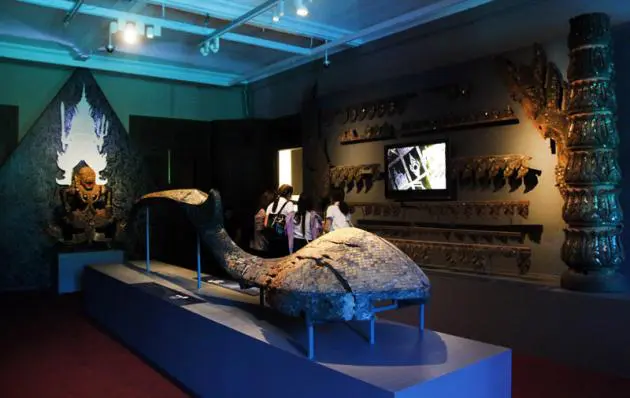
In pride of place in another exhibition room is an old wooden chor fah (serpent-shaped roof finial) from Wat Pho that was created from one gigantic log then lacquered and decorated with lead-coated glass. It is believed to date back to the reign of King Rama III, who ordered the major restoration of the temple. Several of the temple’s old wooden gable ornaments are laid out alongside, among them the hang hong, bai raka and nak sadung, each lacquered and decorated with thin glass chips, as well as an unfinished wooden figure of the monkey deity Hanuman whose skin has been lacquered in black though not yet decorated with white glass. A video projecting the grandeur of Wat Pho’s huge gilded Reclining Buddha and its mother-of-pearl inlaid feet screens quietly in the background.
“We can only wonder at the amount lacquer used in the construction of temples and Buddha images in the early Rattanakosin period,” Pachat says.
“We know that lacquer was sent from dependencies to Siam as a token of loyalty and the grandeur of the constructions clearly shows the power of the Bangkok court over its dependencies and neighbouring kingdoms.”
Several antiques on loan from the collection of Wat Phra Kaeo Don Tao Museum in Lampang reflect the influences of Burmese gilded lacquering and mirror art. They include a ceiling fixture that was lacquered and decorated with coloured blown-glass balls, hsun oke (a gilded lacquer container decorated with mirrors and lace metal), and a gilded scripture inscribed with black sticky lacquer.
Crafted by the late Khmer mask master An Sok, the Ramasura (giant) mask is a perfect representation of Cambodian lacquer art. Based on a papier-mache structure, the decorative elements were formed by combining lacquer, gum, wood oil and charcoal in moulds then applying the mixture to the mask. Layers of lacquer were later applied and the mask was gilded with gold leaf and then painted.
On loan from Bangkok’s BaBaBa Gallery is a collection of Vietnamese lacquer paintings on wood that incorporate crushed eggshell and gilt. The works show the talent of Vietnamese artists for blending traditional techniques with Western influences.
The Japanese stay true to ancient traditions while answering the needs of the modern lifestyle by producing black-and-red plastic bento trays and soup bowls based on traditional lacquerware. The exhibition places nine such objects in a row – some lacquered, others plastic – and invites visitors to make the distinction using their eyes only.
And Japanese creativity goes beyond the traditional. A group of Japanese artisans produce custom-made, wooden lacquer eyewear under the brand Moku. Every step is done by hand, from the cutting, veneering, polishing and shaping to the finishing and all the joints are made of wood. A pair of wooden eyeglasses with a bamboo case has been made exclusively for Museum Siam.
Chana Chairak, a master craftsman at the Royal Craftsmen School, is another artist to apply ancient techniques to a thoroughly modern item – a gilded lacquer mobile phone case. A video presentation shows the long and delicate process of applying the five to seven layers of lacquer and explains that each layer must dry completely before it can be polished. When the last layer is smooth, the yellow pigment from orpiment (arsenic sulfide) is mixed with gum arabic and imbedded in the case, which is then painted and gilded.
ASIAN TRADITIONS
>>“Lacquer: Gloss, Glitter, and Glamour” continues until June 28. Museum Siam on Sanam Chai Road (near Tha Tien) is open daily, except Monday, from 10am to 6pm. Call (02) 225 2777 or visit www.MuseumSiam.com.
