
The glory of Siam enthroned


Play
Within the magnificent Ananta Samakhom Throne Hall - a century old this year - Thai craftsmanship continues to flourish
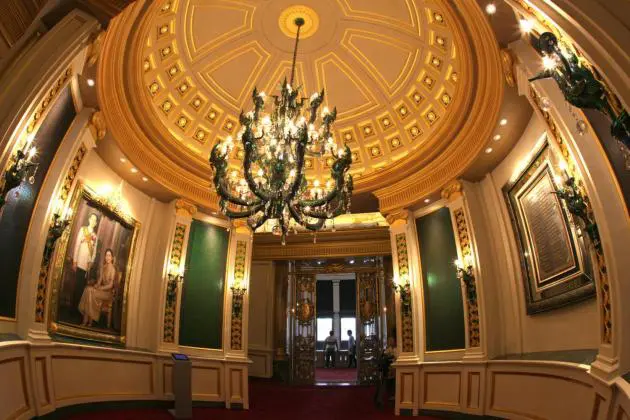
A MARVEL of architecture open to visitors almost every day of the year, the century-old Ananta Samakhom Throne Hall shared all its glories with subscribers to Advanced Info Service’s Serenade mobile-phone programme on a recent guided tour.
Work began on the domed neo-classical building in 1907, during the reign of King Chulalongkorn (Rama V), and was completed 100 years ago, in 1915, by which time his son had ascended the throne as King Vajiravudh (Rama VI). The cost was Bt15 million – the equivalent to Bt15 billion today. King Vajiravudh fulfilled his father’s wishes in every way.
It is a stunning amalgam of European architecture and Siamese decor. Outside is all Renaissance embellishment erected by Italian artisans, inside meticulous Thai artistry created in recent years by the craftspeople of the Queen Sirikit Institute.
“In 1915 it was the most expensive building ever erected in Siam,” celebrated historian Paothong Thongchua told the visiting AIS customers. “King Rama V used his own money to buy the land, which was occupied by rice fields. The exterior and floors are of white marble from Carrara, Italy, and the style was influenced by the palaces of St Petersburg in Russia.”
King Chulalongkorn became enamoured with Italian art on his tour of Europe in 1897, during which he eagerly took in the galleries, museums, churches and artists’ studios. He realised that modernising his own country could protect it from European colonial ambitions. So, as well as introducing a raft of Western conveniences for the citizenry, he ordered the construction of buildings that were as visually impressive as they were functional.
The Kingdom benefited from an influx of Italian artists, sculptors, architects and engineers who erected dozens of showcase palaces, temples and private residences.
“It took Rama V almost 10 years preparing for construction of the throne hall,” Paothong said. “Because the building would put such tremendous weight on muddy rice fields, the engineers first dug a water reservoir before driving the pilings into the ground. The structure sat on these pilings in the reservoir so that the water would help support the weight.”
Architects Mario Tamagno, Annibale Rigotti and Ercole Manfredi were commissioned for the throne hall of two storeys with a large central dome surrounded by six smaller ones. The domes and walls are covered with gilded paintings by Galileo Chini and Carlo Riguli depicting the history of the Chakri Dynasty from the first to the sixth reign. You can see, for example, Rama I and the founding of the dynasty, and Rama V’s abolishment of slavery.
“At the edge of each dome you see a palm leaf in a triangular frame,” Paothong pointed out. “That’s Mario Tamagno’s ‘signature’, inspired by the palm branches that greeted Jesus on his triumphant entry into Jerusalem.”
To this day, the artistry doesn’t rest. In the east of the throne hall, craftsmen are fashioning a nine-spire pavilion of stainless steel with a bronze ornate gable for celebrations next year of His Majesty King Bhumibol’s 70th anniversary as monarch and Her Majesty Queen Sirikit’s 84th birthday. The structure replicates the Siwalai Maha Prasat Throne Hall in the Royal Palace.
“His Majesty asked that the pavilion be built on the same site where his grandfather, Rama V, sat in a pavilion while overseeing progress on the throne hall each day.”
In 2008 His Majesty granted permission for the Queen Sirikit Institute to use the throne hall as a gallery for “The Arts of the Kingdom”, a permanent display of delicate embroidered screens, carvings and other exquisite examples of Thai craftsmanship. The flow of visitors has been constant – 10,000 people a day admiring both the beautiful architecture of the surroundings and the refined arts still being produced, which easily measure up to the work of the royal artisans of the Rattanakosin Period.
This is the astonishing output of the Queen Sirikit Institute, which began in 1978 as the Support Training Centre affiliated with Her Majesty’s Support Foundation, a boon to families of low income. Its 700 talented employees produce beautiful works of nielloware, damascene inlays, gold and silverware, yan lipao basketry, carved wood, embroidery, weaving and much dramatic decoration done with beetle wings.
“Everyone has innate artistic aptitude, Her Majesty the Queen said, and can create wonderful works if given the chance. Her Support Foundation affords people that chance,” Thanpuying Supornpen Luangthepnimith, deputy private secretary to the Queen, observed during the tour.
The masterpieces currently on view in the throne hall were mainly created for the sixth edition of the “Arts of the Kingdom” exhibition in 2012, which marked Her Majesty’s 80th birthday. New works are being produced for the seventh edition a year from now.
One of the pieces is a large, elaborately carved wooden screen depicting scenes from classic Thai stories on both sides. It took 79 craftsmen three years to complete. On the front is a snippet from “Sangthong”, on the back the Himavan Forest with all its mythical creatures amid flowering vines. The four main characters – Chao Ngor, Rojana, Kinnorn and Kinnaree – are sculpted life-size in teak and decorated with beetle-wing “jewels”.
Another 143 craftsmen spent almost four years on a second, much larger screen, this one with a hand-embroidered representation of Rama II’s poem “Inao”. Sixty-one metres long and more than four metres tall, it’s a lofty example of the venerable embroidery technique called “pak soy”, using the finest strands of “mai noi” silk in overlapping stitches that play up the colours and light and make the scene quite realistic.
“The silk thread is thinner than human hair,” Thanpuying Supornpen noted. “It’s used for smooth, delicate and shiny work that mimics the original art much better – in this one, 250 shades of silk in all.”
An octagonal room is stunningly decorated with carved wood panels enhanced with woven lipao vines and beetle-wing collages. The wings can only come from beetles that have died naturally – otherwise they lose their luminous graduated green shading.
“The rural people whom Their Majesties used to visit didn’t have fresh flowers to make garlands for them, so they collected beetle wings and painstakingly strung them into garlands,” Paothong explained. “Her Majesty oversaw the development of this craft into a fine art – the wings are cut into thin slices that can be used in embroidery, basketry and woodcarving.”
TREASURES NOT TO BE MISSED
The Ananta Samakhom Throne Hall on U Thong Nai Road is open Tuesday through Sunday from 10am to 5pm. It’s closed Mondays, on Songkran Day and Constitution Day and during the New Year holidays.
Admission is Bt150 (Bt75 for students in uniform or with an ID card, free for children under five years and 120cm in height). Thai nationals are admitted for free on Father’s Day, Mother’s Day and Children’s Day.
Find out more at (02) 283 9411, (02) 283 9185 and www.ArtsOfTheKingdom.com.
