
Weaving traditions


Play
A new exhibition in Ayutthaya showcases the textile finery of the Asean member nations
With the launch of the Asean Economic Community drawing ever closer, various public and private agencies are working hard to fill the yawning gaps in our knowledge of the traditions of our fellow members. Among them is the Support Arts and Crafts International Centre of Thailand (Sacict), which is currently turning the spotlight on the textiles of the region with a new exhibition at its premises in Bang Sai, Ayutthaya province. More than 500 unique textiles are on display in this show, which also marks the 60th birthday of Her Royal Highness Princess Maha Chakri Sirindhorn.
The exhibition is in two parts, with the first dedicated to photographs featuring photos of Their Majesties and Princess Sirindhorn on their visits to Asean member countries, thus underlining the close links between the 10 countries.
The second part focuses on original fabrics and costumes and is divided into two geographically connected groups. Thailand, Laos, Cambodia, Myanmar and Vietnam make up the first group while Singapore, Malaysia, Indonesia, Brunei and Philippines form the second. The fabrics and costumes, which reflect the individual character and identity of each nation, have been loaned to the Centre by Paothong Thongchua and his friends. All are more than 40 years old.
“The exhibition aims to draw attention to cultural connections among the Asean countries, while at the same time illustrating their aesthetic differences through the way of dressing, which in a way represents their cultural heritage, artistic expression, beliefs, and local wisdom. It’s a way of life that is both similar and unique. The French might have mapped the borders but they could not divide the cultural interweave among people in this area,” Paothong says,
The oldest textiles in the exhibition come from Thailand, Pha lai yang, a ceremonial fabric reserved for the King and his direct descendants, can be traced back to Ayutthaya period and the particular pieces on show are some 200 years old.
The pattern of the pha lai yang was designed by the Siamese royal court and the cloth was then sent to India, when an artist would painstakingly draw it on finest quality white cotton fabric made in Manchester, England. Common motifs included garudas, praying angels and dancing angels. The fabric is also known as pha kien thong or pha phra pusa lai kien thong in a nod to the manufacturing process, which involves drawing on the fabric using gold powder mixed with fig rubber.
The adjacent display of Myanmar textiles explains that the longyi is the Burmese version of the panung, a wide sheet of cloth sewn together in a cylindrical shape, the most important part of the Burmese costume worn by both men and women. The longyis on show are made from the luntaya acheik cloth, a unique woven textile of Burmese people. Literally translated as “one-hundred-shuttle weave”, it is made by using wooden shuttles to construct the double-interlocking tapestry weave structure. In tapestry weaving, weft yarns are typically discontinuous. Artisans interlace each coloured weft back and forth it its own small pattern area. A difficult weaving technique, it is also one that strengthens the fabric. The motifs are inspired by the currents in the Irrawaddy River.
The cultural heritage of Laos is showcased in its pha sin blouse and the cross-over front panel known as the chok shoulder cloth. Typically woven in the traditional northern Laotian or Tai Daeng styles, it is normally made from woven silk with decorations using the chok or discontinuous supplementary weft technique. The motifs and patterns depend on the weavers but the most common are nagas, elephants, lions, people and castles. Laotian women wear the cloth over one shoulder during special rituals and religious ceremonies.
The elegant and valuable cultural heritage of woven fabric is still very much part of Vietnam today and reflects the history, relations and way of life of the communities. Vietnamese woven fabrics come in a variety of patterns; each containing different meanings and require a specific woven technique. The most popular pattern is the eight-point star placed proudly in the middle of the fabric.
Pha sin tai is a woven fabric that integrates the cultural beliefs from various ethnic groups in Vietnam and is typically woven from cotton. The body is usually dyed black while the end border or hem is sewn to the body using the chok technique and incorporates various flower motifs including the dokkab, dokkham and doktum. Butterfly buttons add to the uniqueness of the blouse. According to Tai Dam folklore, the butterfly motif has its roots in the story of a man near death who promised his wife he would come back to her and was reborn as a butterfly
In Cambodia, the sarong is known as the sampot and was once the preferred clothing for women of the upper and middle classes. A rectangular piece of cloth measuring three metres by one metre, it’s worn by wrapping it around the waist, stretching it away from the body, and twisting the knot. The pattern is made using the ikat (mat mii) technique. There are more than 200 motif and design patterns of the sampot with each reflecting the social status of the wearers. The patterns are influenced by India’s patola and come in five colours – yellow, red, brown, blue, and white.
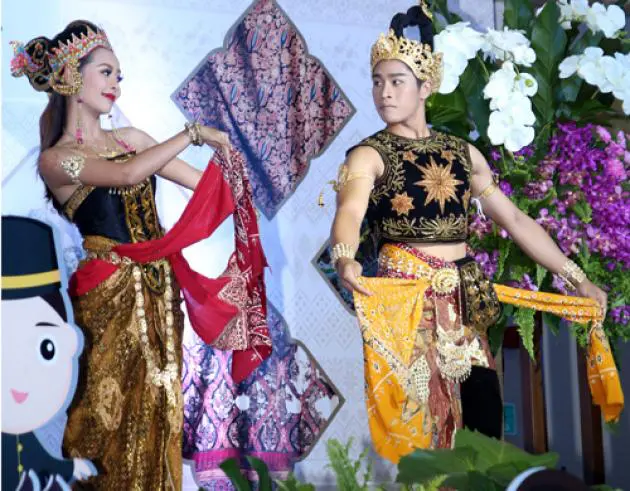
Batik is the most popular fabric in Indonesia and upper-class women insist on hand-painted batik or batik tulis. Most of the batik is made in Java though motifs and pattern differ depending on the place. Among the best known are Yogyakarta batik, Solo batik and Cirebon batik.
The tapis lampung is made of pineapple thread and embroidered with shiny materials and the salendan is used as scarf by Malayu women and has its origins in the 19th century.
Malaysia boasts a distinctive and distinguished fabric made by weaving gold and silver thread with the silk. The women wear flower motif batik sarongs with u-neck blouses and long sleeves that run to the wrist. Songket is a hand-woven fabric intricately patterned with metal thread and traditionally only worn for auspicious occasions. Lima is a traditional ikat-style textile influenced by the Indian patola and worn as a shoulder cloth, head shawl or breast cloth. Men typically wear it as an outer wrapping cloth, on top of trousers. The edge of the fabric is usually dyed red or black.
Ethnically diverse Singapore boasts the most colourful and exotic costumes. Singaporean batik reflects the 400-year travelling and trading history of Chinese immigrants to the Peninsular Malaysia and Singapore and is known as Peranakan. The mix of cultures has affected the colour and patterns of the local batik.
Silver or gold brocade is a unique characteristic of textiles in the Islamic culture of Brunei, The main fabric is cotton, which better carries the weight of the metal threads inserted to make the desired pattern. Also known as songket, the fabric is made into a matching set of shirt and trousers to be worn at special religious events. Women in Brunei strictly follow Islamic customs that require them to entirely cover the body. This type of costume is known as baju kurung.
Clothing designs in the Republic of the Philippines have been greatly influenced by the Christian Spaniards. The barong, sometimes known as baro, is the national costume and worn at state functions. Made of hand-loomed pineapple leaf fibres, it is a collared, long-sleeved shirt with exquisite embroidery on the wrists. The fabric is lightweight and translucent so the barong is often worn on top of an undershirt.
Box
FINEST FABRICS
n The Asean textile exhibition runs until September 20 at the Support Arts and Crafts International Centre of Thailand in Bang Sai, Ayutthaya. Admission is free.
n Find out more by calling 1289, (035) 367 054 or visit www.Sacict.or.th.
