
The wind whispers Murakami


Play
New adaptation does justice to the Japanese author's first novel
In a year when the country’s stages are filled with either a musical or a special event show, any meatier offering that tells a lesser-known story is worth both our attention and attendance.
Comprising lecturers, students and alumni of Burapha University’s Faculty of Music and Performing Arts, the 206 Performing Troupe debuted at Bangkok Theatre Festival last November.
Their stage adaptation of Haruki Murakami’s first novel “Hear the Wind Sing” – “Sadap Lom Khapkhan” in Thai – proves that they’ve not only continued to perform at their Bang Saen campus but are also willing to collaborate with professional artists who’re not affiliated with it.
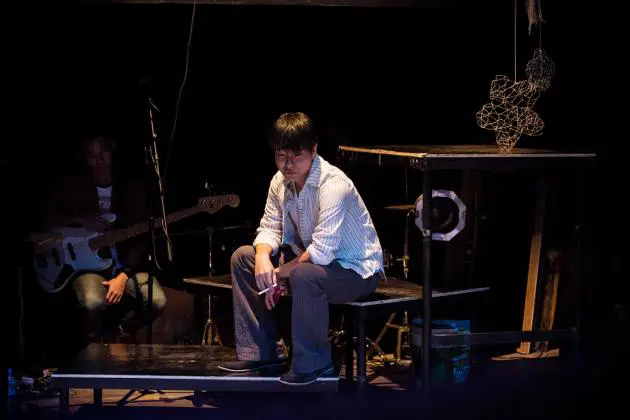
Veteran playwright and director Apirak Chaipanha, known for his previous works for Theatre 8X8, has adapted Noppadon Wejsawat’s Thai translation of the Japanese novel and his storytelling technique is simple, clear and effective. His choice of using a live band not only fits the main setting of a jazz bar, but also enhances the style of the production and helps vary the pace and tone of the play. The only problem is that sitting on right side of the audience stand gives you a full view of the band and the demeanour of some of its members underlines that they’re not really performing in the bar.
As the unnamed lead character/narrator Manop Kedpradit is subtle and realistic – he doesn’t try to do too much and as a result achieves a lot. As his high school friend Musik, who invited him to return from Tokyo to his rural hometown for 19 summer days in 1970, Japanese expat Tanikawa Shogo is a delight, other than when his scene partners need to repeat his Thai lines, making sure that the audience understands them without having to read the English surtitles.
Near the middle of the 90-minute play, in what can only be described as a Murakami-esque moment, Musik decides he should speak Japanese, and now Thai surtitles are added to the back wall. It’s a decision that should really have been made earlier.
The rest of the cast fills in other parts and in all form a strong ensemble. A guest actor takes turns appearing in one scene and while Kusuma Tepparak’s presence is memorable and her rendition of famous Thai song “Duen Phen” pleasant, it’s quite difficult to see how the song fits into this Japanese novel. That Japanese and Thai juxtaposition is another major problem, as while most of the original context has been kept intact, almost all Japanese characters keep opening cans of Thai beer, one of the sponsors of the show.
Thematically, Murakami’s works, even with their specific Japanese contexts, are universal enough for the audience to relate them to their lives. If the director builds a bridge, but only halfway like this, we may fall off the edge.
This production of “Hear the Wind Sing” may not be as astounding and poignant as the Japan-UK collaboration of “The Elephant Vanishes” that travelled to many cities more than a decade ago, or as elaborate and entertaining as the US production of “The Wind Up Bird Chronicle”, but I’m still sure many audience members will pick up this novel after watching this charmingly sincere play adaptation.
LITERARY CONS
“Hear the Wind Sing” runs until August 1 at Thong Lor Art Space. Shows are at 7.30 on Thursdays and Fridays and 3pm on Saturdays and Sundays. It’s in Thai with English surtitles. Tickets are Bt500 (Bt350 for students). Call (095) 694 9891.
Also at Thong Lor Art Space, there’s “According to Marguerite Duras Project”, featuring her films every Tuesday and Wednesday until August 1. Admission is free. In addition to films based on Duras’ work, there’s the play “Epilogue to ‘The Malady of Death’” by Banthun Ratmanee and Wasurat Unaprom. Shows are at 7.30pm tonight and tomorrow and 3pm on Saturday and Sunday. Tickets are Bt500 (Bt390 for students), at (095) 924 4555.
For more details, check Facebook.com/ThongLorArtSpace.
