
All dressed up for summer


Play
Japan's department stores come up with a range of yukata suitable for any occasion
About 1,000 yukata kimonos are available this summer at Seibu department store in Tokyo. Classic botanical motifs are especially popular this year, as are yukata in vivid colours and those in traditional navy-and-white colour combinations.
Yukata are summer garments traditionally worn at festivals and for fireworks displays, but they’ve also been gaining popularity as street clothes and among foreign tourists, too.
Yukata are believed to have originally worn at home and donned after a hot bath. In the Edo period (1603-1867), ordinary citizens began going to public baths regularly, which led to the creation of various motifs for yukata and to the development of this form of dressy summer clothing.
Yukata are worn more casually than ordinary kimono, usually without a collar, an obijime sash cord and an obidome ornamental clasp for the sash cord. However, undergarments for yukata including lace tabi socks for kimono, obidome clasps in various colours and many other accessories have gone on sale, making yukata suitable for a variety of occasions.
“I want people to use these accessories to better enjoy yukata,” says Keiko Nakayama, who is in charge of the department store’s kimono section.
She recommends yukata with large, white hamanasu Japanese roses on a red background, worn with a han-eri collar and accessorised with an off-white sash. Using an obijime sash cord and an obidome clasp makes the wearer look more chic and mature, she says. The yukata sells for 35,000 yen (about Bt9,700) and the sash for 9,800 yen.
Nakayama also pairs yukata with eye-catching stripes in purple and light blue on a white background, with a reversible sash that bears a motif that looks like a sash cord. The yukata’s glamorous design is accentuated by the sash’s sophisticated touch. The yukata sells for 40,000 yen and the sash for 23,000 yen.
These outfits make their wearers feel like they could easily blend in at an art gallery or the restaurant of a luxury hotel — places where people often hesitate to go to in yukata. “You should join the collar tight together so it doesn’t get loose,” Nakayama says. “Adjust the bottom length so your ankles are only just covered. If your hair is long, tie it up to make your face and neck area tidy. And stand up straight.”
Yukata are becoming popular among foreign tourists as a symbol of Japanese culture and a souvenir of the country. As a result, department stores are offering better selections and services to foreign customers.
This year, Kintetsu Abeno Harukas department store in Osaka launched a set of yukata, sash and geta wooden clogs for foreign customers. The set sells for 16,200 yen, including tax. Extra-large sizes are available.
Most foreign tourists who buy the store’s yukata are from China and other parts of Asia. Some change into yukata at the store immediately after buying them and then go sightseeing, according to the store.
Department stores regard yukata’s popularity as a precious opportunity to increase the number of young kimono fans. For the younger generations, Takashimaya Osaka sells yukata designed by Rumi Rock, featuring unconventional motifs such as cars and wolves. These yukata with a sash sell for 55,080 yen.
This year, major casual wear manufacturer and retailer Uniqlo began selling yukata for the first time in five years. The yukata are sold in Japan and 13 other countries.
There are eight motifs, designed by company staff based on drawings by Yumeji Takehisa, who is known for his drawings of beautiful women in the Taisho era (1912-1926), and the works of Junichi Nakahara, who was active in the early Showa era (1926-1989).
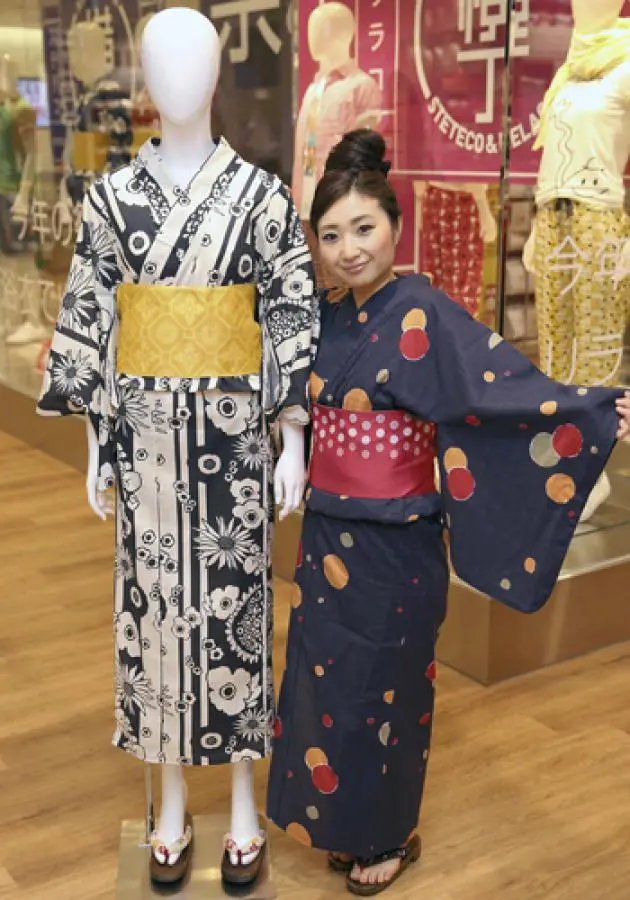
The designs have traditional touches, including one with vermilion and mustard-yellow dots scattered on a navy background, and another with large and small flowers on a striped background in white and navy. The products, each with a sash, sell for 5,990 yen. The sash is not sold pre-tied, unlike some sashes for yukata and kimono, which are generally regarded as more convenient for customers.
“We’re aware many people want to tie the sash by themselves as a kind of cultural experience, so we sell them untied,” says Wataru Kitada, a publicist for Uniqlo, adding that the company’s website provides videos showing how to put on yukata and tie the obi sash.
