
The whirlwind that is Ai Weiwei


Play
This year, dead trees brought back to life, Andy and Ai's cats, and a whole lot of conceptual pop
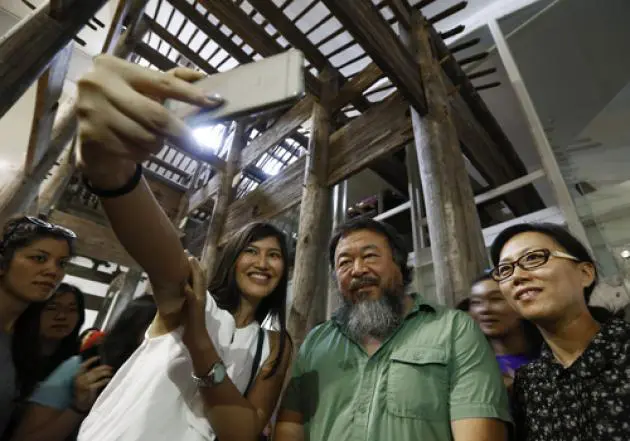
Dissident artist Ai Weiwei, 57, ranking among China’s boldest and best-known contemporary artists, is barred from leaving the country. Yet, this summer alone, the productive Ai has four solo exhibitions in his homeland. “Ai Weiwei”, currently on view at Tang Contemporary Art and Galleria Continua in Beijing’s 789 art district, makes no explicit comment on communist rule, but is officially off-limits. It includes a replica of an ancestral Ming Dynasty shrine.
Ai is not allowed to travel abroad, though his creations certainly do.
London’s Royal Academy launched a crowd-funding appeal last Wednesday to finance an installation by Ai that would see its courtyard filled with giant “reconstructed” trees.
The gallery hopes to raise 100,000 pounds (Bt5.3 million) to display eight trees that Ai has assembled from parts of dead trees collected in the mountains of southern China.
It is thought to be the first time a major British arts institution has used crowd-funding, although an exhibition by Ai on San Francisco’s Alcatraz Island last year also turned to the online source Kickstarter. “It’s a calculated risk, but it’s one worth taking,” says artistic programmes director Tim Marlow, adding that he’s “quietly confident” they can raise the money.
The installation will be free to view and will complement a major, ticketed exhibition of Ai’s work at the gallery running from September to December.
The exhibition is funded by sponsorship – the RA receives no public money for its shows – but Marlow says there has been no time to raise additional funds for the installation. He says crowd-funding is unlikely to replace “very necessary and generous corporate sponsorship” for most exhibitions. “But it seems to me that a contemporary project that’s available to all in the courtyard, from an artist who has widespread international public support – that works.”
Ai is China’s best-known contemporary artist as much for his work as his clashes with the authorities over his criticism of official corruption and political repression, the reason he is barred from travelling overseas.
The Royal Academy installation would be the biggest display to date of his “Trees” series, which he began in 2009. It would see the seven-metre-tall trees clustered around a marble sofa on which visitors can sit. The replicated trees are “the idea of a tree”, Marlow says, “and they’re actually made of once-living, now-dead trees that the artist brings back to life. They’re extraordinary things.”
Fourteen hours after the appeal went live, 100 backers had pledged about 7,500 pounds in return for a variety of benefits, from Ai prints to gallery membership.
In line with all crowd-funding projects, the gallery will only pay out if the 100,000-pound target is reached by the deadline of August 21, although Marlow says failure is not an option. “If we don’t raise the money, we’ll have to find another way.”
In December the National Gallery of Victoria in Australia will present an exhibition comparing and contrasting the work of Ai and American pop artist Andy Warhol, with several child-friendly highlights.
Covering the scope of both artists’ careers, the show will feature more than 300 works, among them a newly commissioned installation from Ai’s “Forever Bicycles” series and a wide range of media, including, in Ai’s case, the social media.
For organisers, Warhol represents 20th-century modernity and the “American century”, while Ai stands for contemporary life in the 21st century and the possible “Chinese century” to come.
“Andy Warhol/Ai Weiwei” opens on December 11 at the gallery in Melbourne and next June moves to the Warhol Museum in Pittsburgh in the US. It was developed by the two institutions with the participation of Ai, who calls the side-by-side show “a great privilege for me as an artist”.
Ai says the first book he purchased while living in New York in the 1980s was “The Philosophy of Andy Warhol (From A to B and Back Again)”, and he has drawn inspiration from Warhol’s conceptual approach.
Among the parallels the exhibition will draw is the two artists’ affinity for cats, the focus of a large-scale installation for kids and families. Warhol lived with a “herd” of Siamese cats in the 1950s (all but one of which were named Sam) and he depicted them frequently in his work. Ai’s studio houses more than 30 cats he regularly mentions on social media and in blog posts.
Ai is developing a children’s project for the show that will reflect that interest, along with an interactive feature allowing young visitors to take a Warhol-inspired image and share it via the social media.
