
The sound of stamps


Play
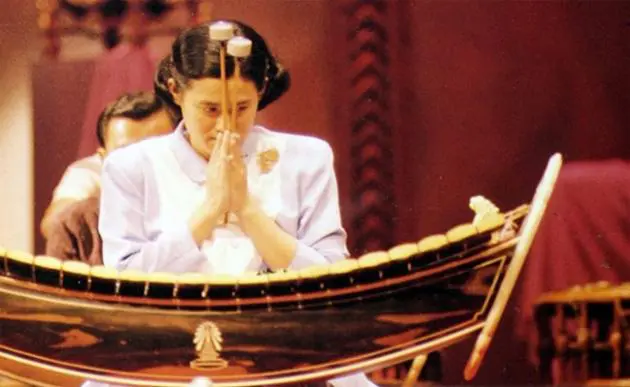
HRH Princess Maha Chakri Sirindhorn's love of playing Thai classical music is paid tribute by the Thailand Post
HRH PRINCESS Maha Chakri Sirindhorn’s talent for playing Thai classical music is being celebrated through four new stamps, which are being issued next week as part of the Thailand Philatelic Exhibition 2015.
The stamps, which are also the Thailand Post’s way of marking the Princess’ 60th birthday, feature each of the four instruments with which she is associated: the sor duang (treble fiddle), the sor sam sai (three-stringed fiddle), the ja khae (three-stringed zither) and the ranad ek (alto xylophone). Lithography and hot-foil stamping have been used to create the Princess’ royal emblem in purple.
What’s more, thanks to augmented reality, not only can the public admire the visual beauty of the instruments, they can also listen and watch them being played in a short video featuring a new arrangement of the traditional Thai song “Lao Damnoen Sai” by downloading the StampAlive application to their smartphones.
The brief rendition of the song featuring the four traditional Thai musical instruments was recorded by ranad ek virtuoso Taweesak “Berng” Akarawong, who portrayed Khun-In in “Hom Rong the Musical” and Thai classical and contemporary fiddler Lerkiat Mahavinijchaimontri on the sor duang and sor sam sai.
“Thais are used to seeing images of the Princess playing the sor duang, sor sam sai and ranad ek but rarely the ja khae. The ranad ek is her favourite instrument and indeed she often plays it in recitals,” says Sirichaicharn Fachamroon, PhD, president of the Bunditpatanasilpa Institute.
“The song is ‘Thai Damnoen Doi’, which was given its name by the Princess and was penned by her as a kind of verse to the original melody of ‘Lao Damnoen Sai’ after following His Majesty the King to his development projects in the countryside.”
Recognised as a National Artist in traditional Thai music in 2014, Dr Sirichaicharn says the Princess studied the sor duang as a child under the instruction of National Artist Benjarong “Term” Thanakoset, who is now 97. While attending Chitralada School and Chulalongkorn University, the Princess became interested in the sor sam sai and studied it under Phawat Bunnag, under-secretary to the King. She learned the ja khae with National Artist Khunying Paitoon Kittiwan, who was also a skilled sor duang player, and the ranad ek with National Artist Charoenjai Sundharavadhin. Kamchai Thonglor was the Princess’ first singing teacher.
“The Princess used to complain that playing the ja khae hurt her fingers and that she preferred the ranad ek,” says the 72-year-old Sirichaicharn.
The Princess’ interest in the ranad ek was sparked during the 1985 Songkran festival, which she spent at Wang Khlong Toei, the home of the great Thai architect Krom Phraya Narisara Nuvadtivongs. While HWWthere, she attended a Thai classical music performance and resolved then and there to come back and study. She was true to her word, returning just three months later.
“At first, I was worried about teaching the Princess how to play the ranad ek, especially as I was given just 15 minutes notice of her first lesson! I hadn’t prepared a lesson plan and I didn’t know where to start. On that first day, the Princess held her book, a pair of xylophone mallets, and a tape recorder, and told me to start the lesson. And so I did. I taught her in the same way as students of the College of Dramatic Arts, instructing her to sit in the correct position, how to hold the mallets, how to play an octave scale and giving her the traditional Thai song ‘Mulong’ for practice.
“I would sit opposite the Princess and play the ranad ek in the reverse direction so that she could easily follow. After each lesson, the Princess would ask me to record my instructions so that she could listen to them wherever she went. She has an excellent memory, which is why she can speak so many languages,” Dr Sirichaicharn says.
“The Princess is also a philosopher and always poses questions. She liked to learn and practise the ranad ek and meditate at Wang Khlong Toei, which was shady, peaceful and private.
“The Princess is gifted with tremendous perseverance and even though she would ache during practise, she never complained. She also has a great sense of humour and told me that she would use analgesic balm cream on her hands and arms after presenting graduates with their degrees. She never used it after playing the ranad ek though.”
The Princess will preside over the Thailand Philatelic Exhibition 2015 (ThaiPex) on Tuesday as the stamps of bearing her four Thai classical musical instruments are introduced.
The highlight of this year’s ThaiPex is an exhibition that celebrates the Princess’ 60th birthday and honours her as “Wisit Silapin”, a “Great Artist” or the “Princess of Art”. The zone will be decorated with muang thepparat – Persian violets – and will showcase Her Highness’ works in biology as well as her drawings, paintings, poems and books. The display will also feature the four instruments complete with a sound dome where the public can listen to the royal songs, as well as a collection of stamps and postcards.
A second highlight is “Stamp Beyond Frontiers” – a mix of stamps, music and friendship – that invites the public to cross borders through postage stamps and video clips of Thailand’s Asean partners and have fun with the StampAlive app.
FEELS LIKE PHILATELY
- The Thailand Philatelic Exhibition runs from 10am to 8pm from Monday until August 9 at the Grand Postal Building in Bang Rak.
- The miniature sheet of all four special-edition Princess stamps are available at post offices as well as at www.PosteMart.com. Just 900,000 copies have been printed.
- For more information, call 1545 or visit www.ThailandPost.co.th.
