
The lukchin who built Siam


Play
The immense scale of Thailand's debt to Chinese immigrants at last becomes clear in a fascinating story of talent, effort and influence
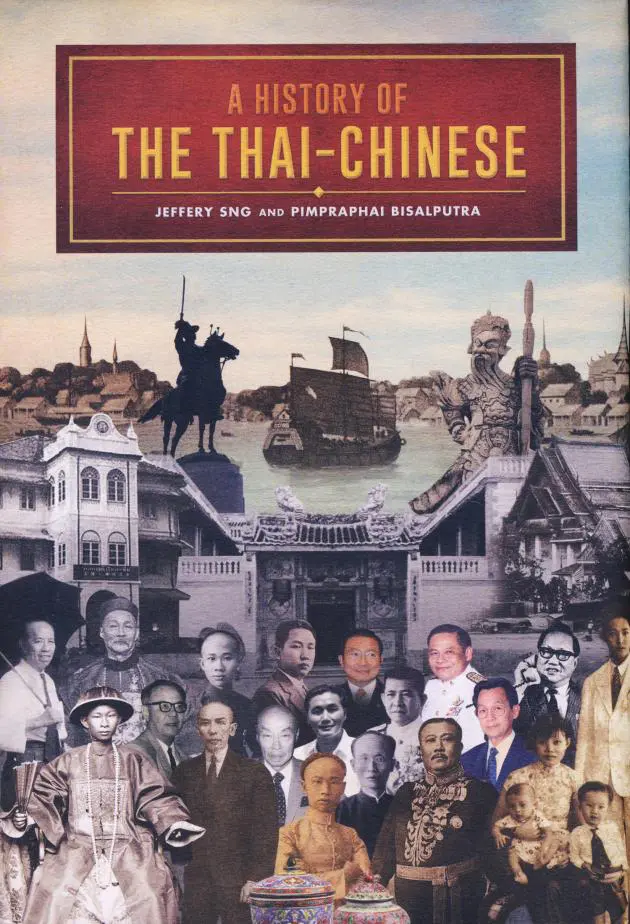
MAINTAINING a growing reputation for well-researched and beautifully designed and illustrated books that fill in the gaps in mainstream Thai history, publisher Didier Millet has added “A History of the Thai-Chinese” to a list that already includes “Chronicle of Thailand: Headline News Since 1946” and last year’s “Americans in Thailand”.
Whereas “Chronicle” was gleaned from the pages of the Bangkok Post and “Americans” flowed from the studies and insights of an array of established but non-scholarly writers, “The Thai-Chinese” has a distinctly professorial cast. There’s good and bad to this – the scope and research are breathtaking, but the prose is much less colourful than that of its immediate predecessor and can be withering when imbibed at length.
Regardless, after scouring countless books, archives and family histories, Jeffrey Sng and Pimpraphai Bisalputra have assembled a remarkably cohesive story, one that’s full of surprises and, importantly, renders much of modern Thai politics in a more understandable context.
The service to Thai history they perform is to paint in the background that’s glaringly missing from what has always been a skeletal view of the role the Chinese have played in it. We have been pretty much limited to the vague notion of Tai people migrating from China and settling what became Siam, and then the rulers of Siam paying tribute to China’s emperors. Much later there is awareness of the immense Chinese labour force in Bangkok, the opium dens and, finally, the astute businessmen of Chinese descent who now head some of Asia’s most profitable enterprises.
Clearly much was missing from this sketchy picture. Sng and Pimpraphai colour it in, beginning with the crucial parts the Chinese played in Siam’s administration right from its earliest days.
No other Southeast Asian country has matched Thailand in terms of absorbing its Chinese immigrants into the weave of daily life. And among the masses, the authors point out the individuals who played key roles. While much space is devoted to, for example, King Taksin (whose father was a Teochew immigrant – the children of Chinese who married Thai women are called lukchin), scores more extraordinary personalities emerge, some of them the ancestors of Thais who are well known in business and politics today.
The authors have amassed such a vast amount of information that “A History of the Thai-Chinese” could easily have doubled its 450 pages. Their efforts at compression become evident in later passages where the years fly by at breakneck speed.
Chinese influence waned considerably between the 1932 coup and the era of Thaksin Shinawatra – its deliberate suppression in the name of Thai nationalism is adequately covered here – but it is startling to see prime ministers come and go in quick succession with scant acknowledgement. And surely Kukrit Pramoj’s historic meeting with Mao Zedong in 1975 warrants more than a single sentence.
On the other hand, the broad sweep of Sino-Thai relations extended to the Cold War and Bangkok’s alignment with Washington in the Indochina conflict and the suppression of communism here and in Cambodia, and the book covers all of these subjects well.
Thaksin, who is proudly of Hakka Chinese descent, commands a page and a half. Admittedly he deserves at least that much space, given his ancestry and a name that remains utterly enmeshed in the Thai political situation today.
The rise of Thai-Chinese wealth and power really deserves a book of its own because, as the authors explain in engaging detail, what began with merchants accruing formidable fortunes and titles in the 1700s and 1800s as trade and tax representatives of the royal family evolved into a Chinese nobility of sorts. Their fortunes were later depleted in the surge of Western colonialism, yet they then began exercising enormous influence in the civil service.
Thais of Chinese descent were soon prominent in various professions far beyond their modest mercantile roots, and we witness the advent of family dynasties comprised of what are now household names. Charoen Sirivadhanabhakdi of Thai Beverage, Kraisorn Chansiri of Thai Union Frozen Product, who began his career as a tea boy named Tan Hangsu, and Dhanin Chearavanont of the Charoen Pokphand Group, which started out as a humble seed store, are among the most obvious examples.
Through much of the last century Chinese immigrants still arrived here poor and struggled to find their niche, but find it they did, and not always in legal pursuits. It wasn’t until globalisation began fattening the Thai banks that many of their numbers began making fortunes of their own.
There are two chief shortcomings to this book, one related to the cursory attention given certain events and eras, as mentioned. This underlines an overt imbalance, since a great deal of China’s history must be waded through to get at the specifically Thai ramifications.
The other fault is one shared with “Americans in Thailand”. While the text is chronological and the index is usually helpful, there is no other guide to the chapters’ contents, so relocating a given character or event on subsequent readings becomes largely a matter of luck and memory. This is a book you can dip into anywhere and be immediately caught up in the flow of the narrative, but if it strikes you another time to revisit a particular passage, you can only resume the dipping.
A History of the Thai-Chinese
By Jeffrey Sng and
Pimpraphai Bisalputra
Published by Didier Millet, 2015
Available at leading bookstores, Bt1,295
