
Embrace the DARKNESS


Thai queer cinema finds its time in "The Blue Hour"
IN HIS SONG “This Land is Your Land”, American folksinger Woody Guthrie had a verse that only he usually ever performed, about a “no trespassing” sign: “But on the other side it didn’t say nothin’. That side was made for you and me.”
The verse came to mind while watching “The Blue Hour” (“Onthakan”), in which a young man sneaks through a fence to the other side of a sign that says “do not enter”. Inside the cordoned-off property is a filthy swimming pool. Everything about the place must have audiences thinking “don’t go in there!” but the kid goes in anyway. And there’s no turning back.
“Blue Hour”, the feature debut for respected short-film maker and indie-industry figure Anucha Boonyawatana, takes its title from that magic time twice a day, in the morning and evening, when it’s neither dark nor completely light. But the tone of the film is pitch-black.
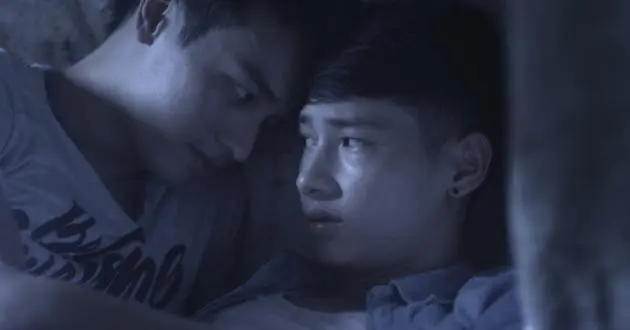
Atthaphan Poonsawas stars as the meek schoolboy Tam, a slim bundle of vulnerabilities. Bullied at school and unloved and isolated at home because he’s gay, Tam is coming into his own. He’s arranged to meet another boy at the abandoned pool, a masculine youngster named Phum (Oabnithi Wiwattanawarang). It’s an ugly place for romance, and their first coupling is rough, more resembling the vice lock of a mixed-martial-arts match than intimacy.
The boys also strip down to their briefs for a dip in the dirty pool, and they talk of people who have been taken by spirits and only reappear after they’re dead. The atmosphere is eerie, with mildew stains on the walls of the pool resembling human shadows.
Things get more surreal when the lads visit a garbage dump that Phum says his family used to own but was taken away from them in a land grab. I swear I could smell the putrid stink of the place as the mounds of trash wriggled to life.
A handgun enters the picture, and it’s the trigger for confusion, as writer-director Anucha and co-writer Waasuthep Ketpetch (and film editors Chonlasit Upanigkit and Anuphap Autta) aim to keep the audience as mixed up as possible while the suspense builds and the chronology of the story is shattered.
The overall foreboding mood is also thanks to the blue-tinged cinematography of Chaiyapreuk Chalermpornpanit and Kamolpan Ngiwtong, the ghostly mildew shadows dreamed up by production designer Phairot Siriwat.
“The Blue Hour” has a similar vibe to the movies of Apichatpong Weerasethakul, whose influence looms large over all Thai indie films. Additionally, “Blue Hour” is part of a trio of strong gay-themed Thai indie films being released this year. It debuted at the Berlin International Film Festival, alongside another Thai queer entry, director Josh Kim’s “How to Win at Checkers (Every Time)”, also known as “P’Chai My Hero”. The pair of films, which both had local premieres at the inaugural Bangkok Gay and Lesbian Film Festival, have been joined by a third gay romance, Tanwarin Sukkhapisit’s widely released “Red Wine in the Dark Night”, which explores similar themes of gays as outsiders thrown on the trash heap of society, but with a slightly lighter tone.
Tam’s transformation is complete, and he’s crossed over to the other side. But what’s on that other side, and who is it for?
“The Blue Hour” might not be a movie for everyone, but fans of gay cinema and Thai art-house films will find something there.
GLOOMY GAYS
“The Blue Hour” (“Onthakan”) is screening at SF World, SFX Central Rama 9, SFC The Mall Bang Kapi, SFC The Mall Ngamwongwan and SFX Maya Chiang Mai.
For more details, see www.Facebook.com/thebluehour.onthakan.
