
Saying it with flowers
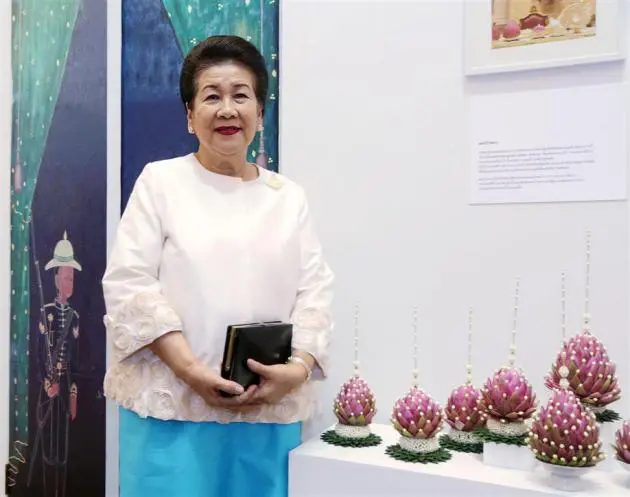


Emporium exhibition showcases royal floral decorations
HER MAJESTY THE Queen’s 83rd birthday is tomorrow, and one of the biggest celebrations in Bangkok will be at the Emporium, which is holding a massive floral exhibition called “Busabanchalee”.
Organised in honour of Her Majesty’s tireless efforts in promoting Thailand’s floral culture, “Busabanchalee” is being held in collaboration with the Museum of Floral Culture and showcases displays designed by floral artist Sakul Intakul.
The exhibition features 12 rare fresh and artificial floral displays used for important royal events, along with sketches, photographs and props on loan from the museum. Sakul has been serving Her Majesty with flower arrangements since 2003, under the direction of MR Yongswadi Kridakorn.
The highlight includes five delicate Thai contemporary floral works especially designed to grace the royal ceremony and banquet for the 60th Anniversary Celebration of His Majesty the King’s Accession to the throne in 2006 at Borommaratchasathit Maholarn Hall.
Among the highlights is “Phumdokmai”, an intricate contemporary Thai pointed-dome arrangement in various sizes, with the domes fashioned from the petals of white, green and pink orchids. The patterns differ from piece to piece, creating a delightful visual effect. The pointed-dome arrangements support pedestal trays that are also completely covered with orchid petals. In between the pointed dome arrangements and the pedestal trays are classical flower arrangements in white, green and orange.
Together with floral garlands made from orchids are banana-leaf works completed with garlands made of small white gardenias serving as the bases for each of the pointed dome arrangements.
“Many people think orchids are indigenous to Thailand but in fact they were introduced here only about 50 years ago,” says Sakul.
Garlands made from orchid petals were first created by the flower ladies working in the inner court at the Grand Palace under the approval of Her Majesty. Because of their incredible beauty, orchid garlands quickly gained popularity and have become an integral part of Thai floral culture.
“I have had the honour of serving HM the Queen. Those are opportunities in my life that are so auspicious and precious to me. Working so closely to Her Majesty, I witnessed her talents in floral culture, which the public may not be aware she possesses. Floral garlands with orchid petals were Her Majesty’s creation. Since the petals are quite stiff, they break easily so as to have beautiful garlands, one needs skill and perseverance,” Sakul says. “Another interesting flower petal that has famously been used is the lotus, but though the petals are very different from the orchid, they too are fragile and can easily tear.”
Also on show are large Thai contemporary floral works used to decorate walls, one of which has been considerably scaled down for the exhibition. It features a golden frame of intricate Thai ironwork in European design, which is filled with navy-blue velvet. The ironwork is richly embellished with traditional Thai floral accessories, such as floral nets, garlands, tassels and stitched work.
A floral work on another panel, which was used to decorate the front panel of the royal dining table, has at its centre an image of Indra, the king of heaven in Hindu mythology. On both sides is the auspicious emblem of the star of nine jewels. These were inspired by the state decoration of Thailand called “The Ancient and Auspicious Order of the Nine Gems”. Following an age-old Thai floral tradition, all these intricate floral works were painstakingly fabricated from the tiny petals of globe amaranth blossoms.
Another never-before-seen piece is from a dinner party hosted for Chinese government officials when HM the Queen represented HM the King on a visit to China in 2000. The flower stand was specially designed, taking into consideration the traditional auspicious symbolism of both China and Thailand. On the Chinese side, those symbols included orchid blossoms and weeping willow branches signifying long-lasting friendship as well as pine tree twigs, which represent longevity. In Thailand, globe amaranth blossoms symbolise respect among friends, and traditional Thai garlands were woven into the work, signalling the long-lasting friendship between the two countries.
The “Floral Chandelier” was designed to decorate the outdoor space known as Lan Kamhom at Phu Phan Ratchaniwet Palace during the annual silk festival in Sakon Nakhon in 2001. It was here that Her Majesty presented the awards to the winners of the silk competition and the space also served as the venue for a silk fashion show. Inspired by European chandeliers, Sakul created a theatre-like ambience in the open space surrounded by large trees. Instead of pieces of crystal, the floral chandeliers were decorated by garlands of fresh orchids. Catching the light of the electric candles, the pink orchid petals glowed in the night sky.
The Silk Cocoon Floral Installation was also designed to decorate the Lan Kamhom in 2000. Inspired by the lifestyles in the northeast part of the country, Sakul used two woven bamboo rooster cages to create the inner structure of this floral installation. Lotus leaves were pasted on the outer surface, and pieces of bamboo, serving as flower containers, were suspended beneath the cocoon-like installation.
“Her Majesty loves beautiful things,” says Thanpuying Charungjit. “When we were visiting the countryside, Her Majesty liked to stop the car and ask us to take picture of flowers. While staying at Phu Phan Ratchaniwet Palace, she named a small purple dark blue flower “Dusita”. There is one photograph in the exhibition of the Queen sitting on the ground surrounded by bluish flowers. These are the Dusita flower.”
However, Her Majesty’s favourite flower is actually the rose.
“Her Majesty requested the gardener to grow many different kinds of roses. There is one type of rose, the ‘Queen Sirikit’ with golden yellow petals, which is named after Her Majesty.
“The title of the exhibition means paying respect to Her Majesty,” says Sakul. “Flowers are very much part of our culture, and their creative evolution relies on the royal court. When I create a flower arrangement, I always bear in mind that it has to be something new. So that’s why we will continuously see new development.”
Sakul’s comments were reflected at the Queen Sirikit Textile Museum workshop last Saturday. Facilitated by the Royal Craftsmen School, “To Mother from My Heart: Silk Flower Garland” saw participants making a further step to developing Thailand’s floral culture by making silk garlands from plastic flowers.
The workshop was designed to encourage the use of Thai textile in daily life and also to strengthen the relationships between mothers and their children on Mother’s Day.
“We use silk to wrap around plastic flowers then string them into different designs to form a garland. It is definitely value added also economically sustainable. You don’t even have to buy plastic flowers. If you already have plastic garland at home, you can wash it and wrap it with new fabric,” says Narongchai Hutachai, master of craftsmanship from the Royal Craftsmen School. “Artificial flowers can also have a new life.”
