
Memories caught between the walls


Play
A new coffee table book examines the heritage of some of Yangon's older residents
YANGON IS A city steeped in history, but it’s also a city of contrasts, one that’s very much caught between the old and the new. Ramshackle public buses and taxis navigate streets that are today shared by brand-new supercars like Ferraris and Porsches. Flyovers are slowly springing up, as are condominiums and posh hotels.
Yet it’s the old that piqued the interest of Virginia Henderson and Tim Webster.
The couple visited Yangon in 2013, and spent the next two years documenting and photographing the city’s tangible and intangible heritage – classic and privately owned old homes and memories. The fruit of their research is contained in “Yangon Echoes: Inside Heritage Homes”, which was launched and discussed at a talk hosted by the British Council in Bangkok earlier this month.
The book’s Facebook page describes “Yangon Echoes” as an anthology of life stories that explores notions and values of heritage and home. It is a popular history of buildings, charting social space and urban folklore, and linking past to present via living memories. These informal stories record everyday life through domestic connections to old places. In short, it’s a collection of oral histories from Yangon’s older inhabitants.
The talk was illustrated by photos and stories featuring some of the people interviewed for the book.
Henderson and Webster were in Yangon as volunteers with the Yangon Heritage Trust and spent most of their time exploring privately owned heritage homes around the city. Once these homes had been located, they would, with the help of interpreters, contact the owners and set up interviews.
Unlike colonial buildings protected by the government, these heritage homes are privately owned and thus subject to urban development.
“It gradually grew upon us what interesting stories these buildings contained. And so we started to take a much more human perspective to the whole thing,” Henderson explains.
Webster started by introducing the dream home of a father who travelled all the way from the Delta area in a boat to purchase his property in Yangon. He arrived at the house in a horse-drawn carriage with black-and-red leather upholstery. His daughter told the couple that some American GIs lived next door and gave her chocolates as a child. She was particularly proud of her father because he was once awarded by the British for his participation in the Second World War. Ironically, his younger brother had fought on behalf of the Japanese and trained with Gen Aung San in the highlands.
“One major issue faced by many people like this woman is ownership entitlement. Documents disappeared during the war and the cyclone and there’s lots of conflicting competition for the house. Many want to sell their properties to divide up the assets,” Henderson says.
“In Myanmar people don’t make a will,” Webster adds. “As land prices skyrocket, there’s money to be made. A few places are being demolished.”
Webster also talked about the home of Daw Thida and Professor Saw Tin, explaining that Thida learned her family’s story from an uncle and aunt.
The book’s Facebook page offers a glimpse into Thida’s home and family life: “This old home was given to me by my parents and aunt, who bought it from an Englishman. I remember my mother calling an old Anglo-Burman lady ‘Aunty Xavier’,” Thida told the couple.
“The Xaviers purchased this house from a Chinese merchant related to Lim Chin Tsong, who in turn had bought it from a Burmese prince.”
Thida’s parents renovated it in 1950. A family friend who ran a factory persuaded her mother to put plywood in the house to save money on paint, but the original pyingado (hardwood) beams are still there.
“The parquet floor has been dislodged by earthquakes and Cyclone Nargis. These days the loose pieces sound like a xylophone…,” Thida tells her interviewers.
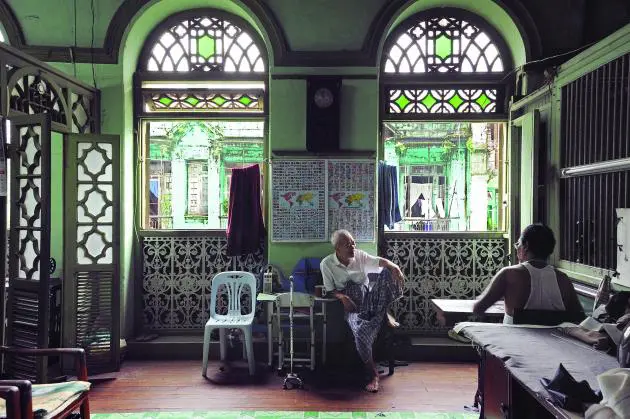
Webster also showed a few photos of a building constructed by an Armenian, purchased by Indians and confiscated by the government in the 1970s. A veteran of the Myanmar navy and other tenants live there today.
“I didn’t know until I got to Yangon that Armenians were important in the city. The staircase was die-cast from Scotland. One of the inhabitants is a navy veteran from the socialist era who worked for the people’s Pearl and Fisheries Corporation. Today he still works for the fisheries ministry and lives in a small room in a very decrepit but one of the most beautiful buildings in the city.”
The most glamorous oral history is related by Peggy – one of the subjects in the book – who owns a beautiful house in downtown Yangon.
“You never know what you are going to find inside someone’s home. It takes a lot of building up of |trust. You are, after all, in intimate spaces,” Webster says.
Peggy, who is now in her 80s, turned out to be the wife of a former Myanmar envoy to the UN. Adorning the walls of her home are photos of Peggy and her husband with US politicians like Jimmy Carter and Ronald and Nancy Reagan. There’s also a great deal of Buddhist art that Peggy refers to as Burmese art.
“She has a fabulous perspective on the way other countries would view her country. I can only imagine what it was like to be a socialist envoy standing next to Reagan. But she said he was a personable fellow,” Webster laughs.
Another set of photographs show a house belonging to U Aung Than, a man of humble circumstances. He told the couple how he and his mother had been walking on the streets of Yangon during the Second World War. They had nowhere to live, but finally were taken in by the daughter of a wealthy textile Persian merchant who made a small fortune in Yangon. The Persian owned seven buildings in downtown Yangon.
Aung Than grew up in one of the rooms in this building and became the merchant’s accountant. After he retired, he taught himself to repair electronics, but now earns the equivalent of Bt40 a day selling betel.
The Persian’s three daughters used to live in an adjacent building, which is part of the same complex. His son lived on the first floor, which belonged to the merchant’s first wife while the second floor housed his second wife.
“They all have moved out and developers have got hold of the property, which will be demolished. It was very sobering for me to stand in front an empty block. I’m sure the people of Bangkok have faced a similar experience in trying recreate the spirit of a place that was once so familiar but is now no more,” Webster says.
While vintage homes in Yangon are easy to find, Henderson points out that interviewing their owners and occupants is a long complicated process that requires several visits.
“They want to tell stories, share their history for posterity. It’s a process of listening, writing out the text, recording, correcting, and taking it back to the person to check the facts. The process also involves an agreement that they are happy for their stories to be shared. Signing an agreement in both languages is surprisingly wearing,” she concludes.
BEHIND THE FACADES
“Yangon Echoes: Inside Heritage Homes” is published by River Books and available at leading bookstores for Bt1,300.
For more information, visit Yangon Echoes on Facebook and www.RiverBooksBK.com.
