
Chords of sheer excellence


Play
Japanese piano maker Kawai opens a music school in Bangkok
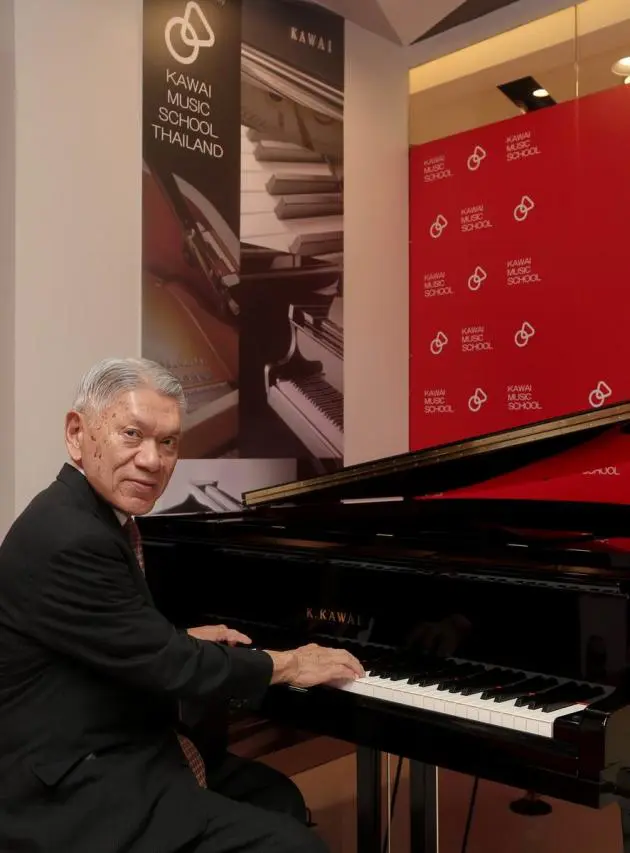
As a child growing up during World War II, Hirotaka Kawai missed out on learning the piano. Yet that small blip in his musical education has not stopped the president of Kawai, the Japanese piano maker, from being every bit as committed to the instrument as were his father and grandfather.
In Bangkok last week to preside over the grand opening of the first Kawai Music School in Thailand, he spoke proudly of the brand’s heritage and its dedication to making instruments for the generation to come.
“I am proud to carry the Kawai name. In the world of piano makers there are no other brands that are still family run. And I also very proud to see students of my music school grow up with music in their heart. I do not expect my students to become great musicians. Whether they turn out to be doctors, engineers, or even piano teacher, as long as they love music they are happy,” he says.
“Music is an individualistic skill, something that one must acquire by him or herself, and with a passion for music. He will always come back to it. That’s how Kawai Music School nurtures its student from the first year of life. We teach them to learn to love music, to use music to help them grow and develop and to become a person with complete strength physically and mentally. Our approach to music teaching here is not to remember the note or to put the finger correctly on the keyboard but to learn by heart with the input of sound and rhythm in an enjoyable ambience,” he says. “Kawai pianos are crafted with meticulous skill and care and children are too.”
Founded in 1956, Kawai Music School believes in personality and harmony. Its child-centred lessons prioritise talents and abilities from the age of one through music. Using the “Rhythmic” method that drives the imagination, the child is never forced to learn but instead allowed to have fun.
Kawai Pianos was started in 1927 by the current president’s grandfather, Koichi, who represented the company’s imaginative spirit and laid an ambitious foundation for all who would follow.
When Koichi died in 1955, he was succeeded at the helm by his son Shigeru, who led the move to modern manufacturing. He foresaw that the company could not continue to rely solely upon traditional “hand work”. The future, he believed, would combine hand-craftsmanship with the finest technology. In term of marketing too, believing that music education was the key to any instrument purchase, he built a network of Kawai Music Schools.

With domestic business now firmly established, he turned his attention toward making Kawai “the sound heard around the world” launching Kawai America in 1963 and following up with Kawai Europe, Kawai Canada, Kawai Australia and Kawai Asia.
When Hirotaka took over in 1989, he invested tens of millions of dollars to incorporate advanced robotics in the production process. Then he took production outside Japan for the first time, founding Kawai Asia Manufacturing in Malaysia in 1991 and Kawai Finishing in the US America in 1995. A plant in Indonesia followed, and today, Kawai Musical instruments enjoy recognition in every major market in the world.
Kawai has pioneered many of the piano industry’s most compelling and beneficial innovations; aluminium action rails, slow-close fallboards, hard finish music desk, the revolutionary use of ABS composites and carbon fibre in piano action as well as the industry’s first digital pianos with real wooden keys.
The schools have expanded too and now number more than 4,000 worldwide.
“In the 1980 Chopin Competition, I saw a grand piano on stage and decided that one day it would be Kawai grand piano,” Hirotaka recalls. “My father and our artisans put great effort in producing the grand piano. Despite much trial and error, we were determined to keep going, sending our staff to collect data and conduct research and development in Europe. As a result, five years later [the competition takes place every five years], the Kawai Grand Piano EX was chosen as an official piano.
“The pianos we create have more than 10,000 pieces. It is extremely fine in detail and each piano is unique. Each key of a piano has its own unique tonal characteristics. Some have only one string, others two and still others three, for instance. There are also differences in hammer felt shape and density. These and other factors create subtle differences in tone from one note to the next. Our students quickly come to understand that the sound quality is certainly very different even with the same song. That’s why we do not force our students. We engage them to love music and be happy first; technical skills can be acquired later,” he says.
“In the world of Western classical music, I am very proud to carry the name Kawai. We continue our quest for perfection and innovation as we head towards our centenary.”
88 KEYS
n Kawai Music School is on the 15th floor of the Zen building at CentralWorld in Bangkok.
n For more details, see or kawaimusicschool.com or www.facebook.com/kawaimusicschoolTH.
