
Mindful of the rules


Play
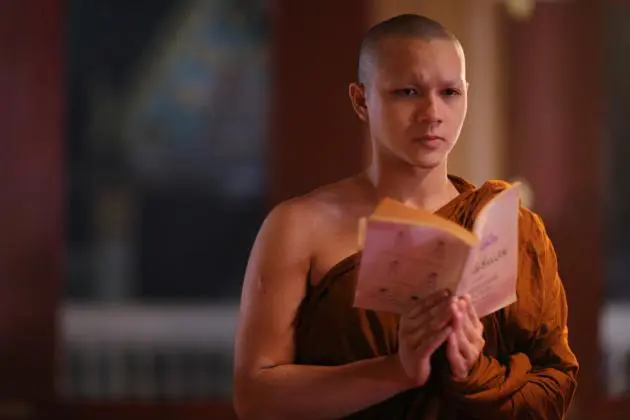
With its amorous novice monk, the upcoming horror film "Arbat" has caused controversy among Buddhists
Rookie director Kanittha Kwunyoo has known right from the start that her horror movie “Arbat” was likely to cause controversy. Yet even she didn’t expect the level of outrage that followed the release of the trailer showing a monk touching a girl’s cheek and escorting a woman into his cell, nor the appeal that’s been made to the Culture Ministry to ban the film.
Opponents to the film say such images of monks behaving badly will make people lose faith in Buddhism.
Yet the actions depicted in the movie’s trailer seem tame in comparison to the reports carried almost daily in the newspapers and on social networks about monks having sex with women at motels or in their cells, and of monks falling down drunk or showing signs of drug addiction. However, the film’s detractors are not convinced, arguing that bringing such images to the big screen will damage the religion and therefore the film should be banned.
With the film, which is scheduled for release next week, so much in the spotlight, Kanittha is now busy working on a back-up plan. She will be submitting the film to censors for its official rating and while she is confident that the entire movie will pass muster, her producer Prachya Pinkaew has told her to be ready to cut any potentially problematic scenes
Prachya, she says, is as confident as she that “Arbat” is not controversial, especially when compared to an earlier film “Nak Prok”, which was also released by Sahamongkol Films.”
Indeed “Nak Prok” (“In the Shadow of the Naga”) became a case study for what is – and what isn’t – acceptable in Thai film.
It tells the story of three thieves who hide their loot in a temple and are forced to pose as monks so they can retrieve their treasure. The film was completed under the old Thai film law, which gave the authorities more power to ban a film and fears that it would indeed by banned caused Sahamongkol to shelve it for three years until the new law was introduced. It was finally released in 2008 with a 18+ rating.
“Arbat” or “apatti” is the word used for an offence in which a monk breaks the precepts or rules. Such offences are committed by action or word, although intention is almost always a decisive factor. In the case of the film, the title refers to monks who have broken rules and try to sweep their offences under the rug only to have karma catch up with them.
It tells the story of Son (Charlie Potjes), a youngster who is forced by his father to enter the monkhood. Upset and bored with his situation at a rural temple, the novice isolates himself and lives alone in an abandoned monk’s cell. He eventually makes friends with village girl, Fhai (Ploy Sornarin), and their relationship develops into something more than platonic. As his misconduct becomes more serious, Son is confronted by horrible incidents both in the area where he lives and at the temple, and that leads to the secret that has long been hidden.
“Son is just the person who leads audience to a deeper story where bad deeds are hidden. The further he goes in his relationship with Fhai, the stranger the situations he has to face and so he has to decide whether to keep doing bad things or get back on track and follow the right path,” says the director.
A film graduate from Bangkok University, Kanittha’s short film “Wela Rak” about a relationship between two elderly people was snapped up by GTH, which bought the rights to turn it into the dramatic feature “Khwamjum San Tae Rak Chan Yao” by Yongyooth Thongkongtoon.
While waiting for an opportunity to direct her own feature, Kanittha worked as a guest lecturer in story-telling at Bangkok University as well as on occasional short films.
Even though she loves drama and is scared of ghosts, she eventually chose a horror film for her debut.
“I got the idea when a young friend told me he had seen a ghost while he was a monk. He called it ‘Phee Phed’ – the Isaan dialect for Phee Pred – the hungry ghost who has grown so tall he cannot reach food – retribution for bad deeds commited while he was alive.
Kanittha combined her friend’s idea with the festival of Boon Khao Pradub Din, in which offerings of food are made at night for both ancestors and wandering spirits like Phee Phed.
The Lop Buri native is a committed Buddhist and often attends the temple near her home, where her father also offers his services. In recent years, though, she has observed that many people go the temple just for merit making, seemingly disinterested in learning the Buddha’s teachings.
“Viewers will understand the cause and the consequence of everything in the film. Nothing is there just to stir up controversy. My father told me that if my intention was clear and I could make the film reach the goal I intended, then I should go for it,” she says.
The young director has also lined up a powerful cast including Soraphong Chatree, who plays a mentally ill vagabond who knows all the secrets, Attaporn Theemakorn as the abbot, TV actor Danai Jarujinda and Phimphan Chalainakhup.
“I haven’t touched on anything I don’t fully understand and I have made the film as a committed Buddhist who still has faith in my religion,” she says.
“And I also believe that as a woman, I have made the movie softer.”
SAY YOUR PRAYERS
- “Arbat” is set for release in cinemas next Thursday.
- For clips an d other details, see www.Facebook.com/sahamongkolfilmint.
