
Your worries have gone away


Play
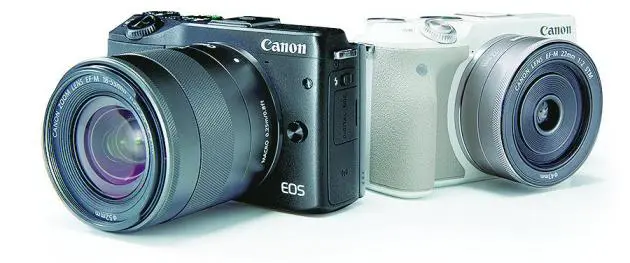
With the brilliant new M3, Canon has done a lot more than just fix the shutter lag and autofocus problems
THE EOS M3 is the third generation in Canon’s line of mirrorless, interchangeable-lens cameras, and you quickly discover how much the performance and image quality have improved.
Canon, which had earlier focused on digital SLR and compact cameras, hopped on the trend bandwagon to produce this kind of camera in mid-2013, but the original EOS M clearly had room for improvement. The M3 has advanced by leaps and bounds, boosting the resolution of the APS-C image sensor to 24.2 megapixels, for example, compared to just 18 on the EOS M.
There’s a much faster autofocus system, with the display showing exactly what’s in focus on a tilting screen. You can connect to Wi-Fi easily with the built-in NFC function. And now there’s no noticeable shutter lag, higher ISO, and an internal flash to boot.
Canon obviously heard enough complaints about the sluggish auto-focus and shutter that it had to act, developing a separate third-generation technology, Hybrid CMOS AF III. It’s made auto focus 6.1 times faster than the EOS M could manage and locks quickly and accurately onto the subject. You see 49 AF points spread out across 80 per cent of the frame vertically and 70 per cent horizontally.
Under certain lighting conditions, focus is attained solely from “rapid focal-plane phase difference”, which is very precise and ensures a better user experience, especially when shooting moving objects (such as your kids or pets racing across the lawn).
Also new is the 24.2-megapixel CMOS sensor, which teams with a Digic 6 image processor to enhance performance and image quality, as well as ISO speed, which ranges from 100 to 12,800 and is expandable to 25,600 where greater light sensitivity is required. The image processor cuts the “noise” at higher ISO settings, adding to the camera’s ability to capture sharp, clean pictures at night without a tripod in Handheld Night Scene mode.
There’s an optional EVF-DC1 electronic viewfinder to make composing shots under bright sunlight even simpler.
The touch-screen LCD can tilt up 80 degrees to make low-angle shots and selfies easier, and downward 45 degrees for high angles.
The touch panel now incorporates a user interface that makes it easy and intuitive to use the camera. It will pinpoint the main focus spot and, used with certain buttons, allows quick access to settings without the bother of sifting through layers of menus.
You can, for example, press the “Info” button at the back repeatedly and use the arrow buttons and control dial – and just touch the function you want to adjust when it appears on the screen. The Quick Settings Menu/Set button will display the current mode and the parameters you can change.
With built-in Wi-Fi capability, sharing your pictures online is a breeze. You can connect the camera to a printer or to your smartphone – one you’ve downloaded and installed Canon iMage Gateway. NFC makes all this as easy as can be.
In fact all the controls are quite intuitive. You have a mode dial and an exposure-compensation button. The first accesses the modes Scene Intelligent Auto, Scene Hybrid Auto, Manual, Aperture Priority, Shutter Priority, Programmed Auto, Creative Assist, Scene, Creative Filters and Custom.
Hybrid Auto records two- to four-second “clips” of scenes before each shot and then combines them into a mini-movie. The choices in Scene mode are Portrait, Landscape, Close-up, Sports, Handheld Night and Food.
Creative Assist has even more options. Among other things, you can adjust how blurred the background is, control the overall scene brightness and even change colour tones. These are done via sliders, so you can see the effect in action, a great way to improve your understanding and your photographic skills. And, when you get a variant that you really like, you can load the settings into Creative Assist as a personalised option for future use.
Creative Filters mode is a lot of fun with filters – HDR, Fish-eye, Art Bold, Water Painting, Miniature (for both stills and movies), Toy Camera, Soft Focus, and Grainy B/W.
I tested the EOS M3 with an 18-55mm STM kit lens with an aperture of f/3.5-5.6. The camera has a lens crop factor of 1.6 times, so this lens is equivalent to 28.8-88mm focal length in 35mm photography.
Mostly using Scene Intelligent Auto, I got good-quality shots in most lighting environments.
The portraits were lovely with their blurred background and the colours were well saturated (further adjusted with the Picture Style options Auto, Standard, Portrait, Landscape, Neutral, Faithful, Monochrome, and User Defined.
I was especially impressed with Handheld Night Scene mode. The camera fired consecutive shots and combined them into a single sharp image with great lighting.
The focus was fast and I sensed no shutter lag at all. The camera took less than two seconds to power up, focus and shoot, and in fact the time to focus and shoot in most lighting environments was about half a second.
Lacking a wide choice in EF-M lenses, you can use the optional EF-EOS M mount adapter to fit the camera with any EF/EF-S lens from Canon, of which there are more than 70 available.
The Canon EOS M3 with an EF-M 18-55mm, f/3.5-5.6 IS STM kit lens retail for Bt22,900. With an EF-M 18-55mm, f/3.5-5.6 IS STM kit lens and an EF-M 55-200mm, f/4.5-6.3 IS STM lens, it’s Bt30,900.
Image sensor: 24.2megapixel APS-C CMOS sensor
Imaging processor: Digic 6
Lens mount: EF-M (EF and EF-S lenses compatible via Mount adapter EF-EOS M)
Focal length: Equivalent to 1.6x the focal length of the lens
Shutter type: Hybrid Single Blade Shutter (electronic first curtain and mechanical second curtain shutter)
Shutter speed: 30-1/4000 seconds (1/3 stop increments), Bulb
Drive modes: Single, Continuous, Self timer (2s, 10s, remote)
ISO speed: 100 to 12,800 (expandable to 25,600)
Continuous shooting speed: 4.2 fps
Maximum video quality: 1920x1080 Full HD, 30fps
AF: Hybrid CMOS AF III
AF System/ Points: 49 AF points (maximum)
Wi-Fi: Yes, NFC-enabled
LCD: 180/45 degree tilt touch panel LCD, 1.04 million dots
Memory card: SD, SDHC, SDXC (UHS-I compatible)
Battery: Rechargeable Li-ion Battery LP-E17, 250 shots per charge
Dimensions: 110.9x68x44.4mm
Weight: 319g body only, 366g with battery and memory card
